Medea’s Fire
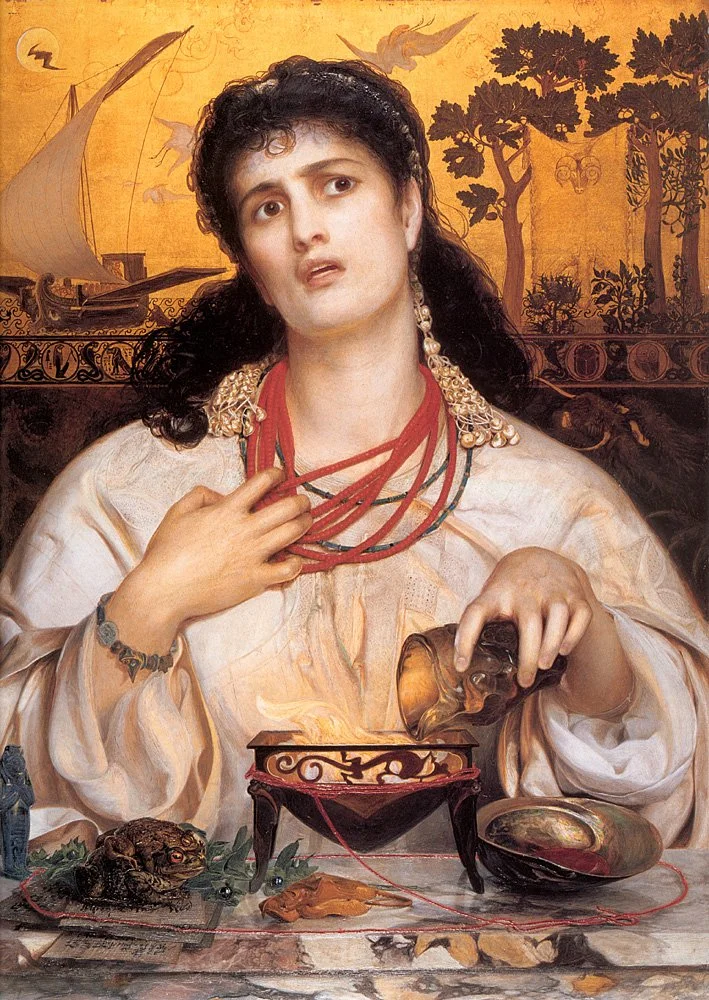
Desire, Knowledge, and the Price of the Golden Fleece
Jason does not win the Fleece by strength alone. He wins it through Medea’s intelligence, love, and dangerous power. The poem’s moral problem begins exactly where the adventure story usually ends.
Jason’s great heroic achievement has a complication.
Medea does most of the impossible part.
King Aeëtes of Colchis does not simply refuse Jason the Golden Fleece. He offers a bargain with the reliable generosity of a man who expects his guest to die before dinner.
Jason must yoke fire-breathing bulls with bronze hooves. He must plow a field. He must sow dragon’s teeth. From the earth will rise armed warriors whom he must defeat. Then, if he survives, he must overcome the sleepless dragon guarding the Fleece.
It is a formidable list.
Jason accomplishes it only because Medea gives him what he needs: drugs, ritual knowledge, practical instruction, magical protection, and the assistance of a love that does not begin as her free and uncomplicated choice.
The Golden Fleece is therefore never merely Jason’s trophy.
It carries a moral debt.
Medea’s divided soul
Apollonius gives Medea an extraordinary inner life.
She is not simply “the sorceress,” a stock figure who appears with magic at the convenient moment. In Book 3 of the Argonautica, she becomes one of ancient literature’s most vivid portraits of desire as psychological disturbance.
She is ashamed. She is afraid. She is physically agitated. She imagines consequences. She argues with herself. She feels loyalty to her family and attraction to Jason. She knows what assisting him will cost. She cannot easily stop wanting what she knows may destroy her.[2][7]
This is not romantic decoration.
Medea’s desire alters political order, family allegiance, royal succession, and the fate of the Argonauts. Love in Apollonius is not a private feeling safely stored in the heart. It is a force that rearranges the world.
The ancient Greeks did not need modern psychology to understand that desire can be intelligent, irrational, divided, bodily, imaginative, humiliating, and dangerous all at once.
Medea’s trouble is not simply that she loves unwisely.
Her trouble is that love has entered a life already structured by family, power, fear, duty, divine intervention, and unequal consequences.
Aphrodite, Eros, and responsibility
The gods matter.
Medea does not simply wake up one morning and decide that a foreign stranger with difficult tasks is the natural object of her deepest devotion. Hera and Athena seek Aphrodite’s aid; Aphrodite sends Eros; Medea’s desire is divinely provoked.
This complicates the story. It does not remove moral responsibility.
Ancient myth is full of divine influence, but it rarely allows characters to escape the consequences of what they do under that influence. Desire may arrive uninvited. What a person does with it remains part of the moral drama.
Medea chooses to help Jason. She also suffers the cost of that choice more fully than he does.
This asymmetry matters.
Jason risks death in the trials. Medea risks death, exile, betrayal of family, loss of homeland, and the destruction of every familiar bond. Her assistance is not a convenient service performed by a secondary character. It is the condition of Jason’s success.
Jason’s dependence
There is nothing shameful about needing help.
The solitary-hero fantasy is one of the less useful things mythology has given us. No serious undertaking is completed by one person alone. Jason’s dependence on Medea should not embarrass him merely because she is more capable than he is in the arena that matters most.
The moral problem begins elsewhere.
It begins when a person receives another’s intelligence, sacrifice, courage, love, labor, or loyalty—and later treats that person as a tool that can be set aside.
Jason does not overpower Colchis through personal strength. He persuades. He promises. He receives. He succeeds through gifts that are not his own.
This creates obligation.
The debt may not be written down. It is still real.
Modern life has many versions of this moral problem. A person advances because someone believed in him, taught him, introduced him, defended him, sacrificed for him, carried work he could not do, or stood beside him at a difficult moment. Later, when circumstances change, he begins speaking as though his success were entirely self-made.
This is not independence.
It is amnesia.
The Fleece and the dragon
The Fleece itself is protected by a dragon that does not sleep.
This is a fitting image.
The visible prize is never unguarded. It is protected by the consequences attached to the means of acquiring it. Jason receives the object. But the moral problem does not end with possession. It begins there.
Medea drugs the dragon. Jason takes the Fleece. The adventure-story machinery has done what it was built to do.
But the reader should notice what remains.
Medea has left her father.
Apsyrtus, her brother, will die in the escape in versions of the tradition central to the story.
Jason’s future has become inseparable from the woman whose life he has overturned.
The prize glows. The debt grows.
This is why the Argonautica is more mature than a simple quest tale. It understands that success has an afterlife.
Euripides and the later reckoning
Euripides’ Medea is not a straightforward sequel to Apollonius. It is earlier than Apollonius, and it belongs to a different genre, dramatic purpose, and emotional universe.
But it makes the Argonautic moral crisis impossible to ignore.
In Euripides’ tragedy, Jason abandons Medea in order to marry the daughter of Creon, king of Corinth. He treats the woman who saved him, bore his children, and sacrificed her homeland as an obstacle to a more advantageous arrangement.
The result is catastrophic.
Jason has mistaken the external achievement of his life for its moral vindication. He has the Fleece, the reputation, the royal connection, the public standing. He believes he can now manage the human debt behind them.
He cannot.
The tragedy does not offer a simple moral. Medea’s revenge is horrifying. Jason’s betrayal is real. The play refuses easy innocence.
But it makes one truth unmistakable: a person cannot use another human being as the means to his advancement and then expect the moral account to close because the outward goal has been achieved.
A man may obtain the Fleece.
He may still fail the test.
The obligation of success
This is the article’s Masonic and philosophical center.
Every achievement carries hidden contributors.
No degree, office, publication, job, promotion, honor, or reputation is entirely self-created. Other people have taught, encouraged, corrected, recommended, forgiven, waited, served, given time, offered friendship, or carried part of the burden.
To remember this is not false humility. It is moral accuracy.
The person worthy of success does not merely ask, “What have I earned?”
He also asks, “Whom do I owe?”
That question may be one of the surest signs that he has begun to deserve the thing he has gained.
Endnotes and further reading
Apollonius Rhodius, Argonautica Book 3, especially Medea’s psychological struggle, her meetings with Jason, and her decision to assist him; Book 4, for the escape and its consequences.[7]
Euripides, Medea, for the tragic aftermath of Jason’s betrayal and the moral catastrophe of treating Medea as disposable.
Ovid, Metamorphoses Book 7, for a Roman retelling of Medea’s aid to Jason.
Richard Hunter, Apollonius of Rhodes: Argonautica Book III (Cambridge Greek and Latin Classics).
James J. Clauss and Sarah Iles Johnston, eds., Medea: Essays on Medea in Myth, Literature, Philosophy, and Art.
Related reading: “The Golden Fleece Is Not the Prize You Think It Is.”