The Smell of Progress: How Jamaica Bay Became a Dumping Ground
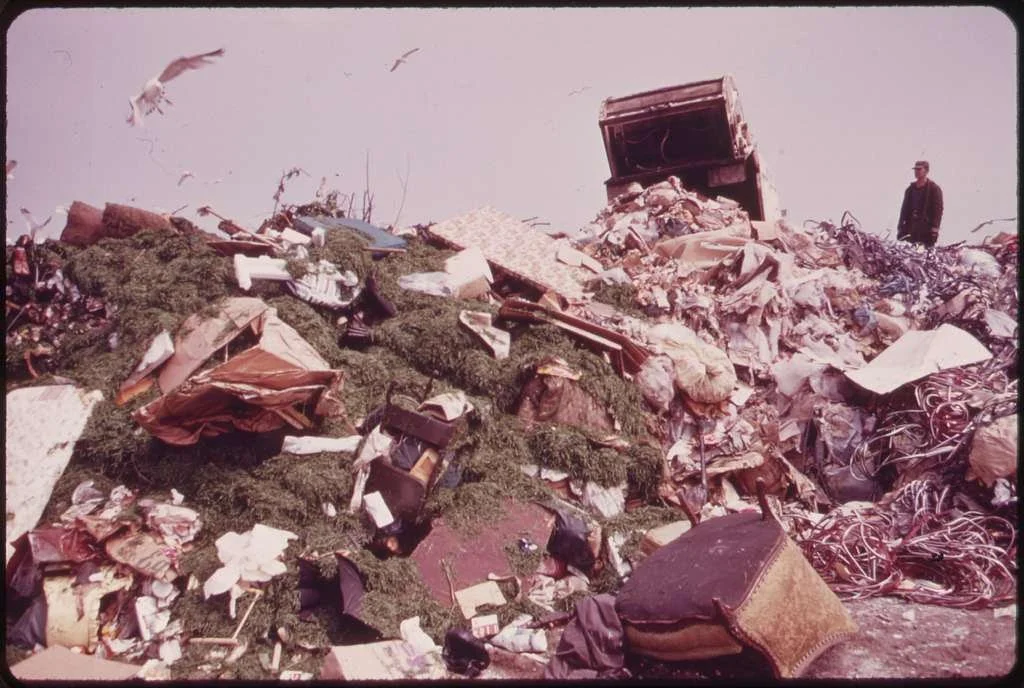
Landfill dumping in Jamaica Bay, c. 1972–1977.
As New York expanded, the bay’s edges absorbed the refuse, industrial uses, and environmental burdens that the growing city preferred to push out of sight.
Cities rarely throw things away.
They move them somewhere else.
In the nineteenth and early twentieth centuries, Jamaica Bay became one of the places where New York moved what it did not want to see, smell, or keep nearby. The bay had once been valued for food, fisheries, and recreation. It remained, for a time, all of those things. But it also became something else: a peripheral landscape onto which the city exported the material consequences of its own growth. Waste processing, refuse dumping, noxious industry, marsh filling, and speculative redevelopment all converged there, turning a productive estuary into a conflicted metropolitan backyard.
This was not accidental. It was policy, business opportunity, and urban habit working together.
Jamaica Bay did not become degraded simply because modernity arrived in some abstract sense. It became degraded because New York found it useful to place dirty, unpleasant, and politically inconvenient functions at the water’s edge, where fewer powerful people had to look at them.
That is one of the oldest stories in urban history.
Jamaica Bay tells it especially well.
The logic of the edge
Peripheral landscapes often appear empty to the cities that use them.
Wetlands, islands, marshes, and tidal margins can seem available in ways dense neighborhoods do not. They are harder to build on, easier to dismiss, and often inhabited by people with less political influence than those in wealthier, more central districts. To planners, speculators, and public officials, such places invite a dangerous conclusion: that land on the edge is land with fewer consequences.
Jamaica Bay fit that logic perfectly.
Close enough to serve New York and Brooklyn, but far enough to remain socially and politically expendable, the bay became a space where multiple urban desires could be pursued at once. It could support fishing and boating. It could absorb industrial functions. It could receive waste. It could be reclaimed for development. It could even, in certain moments, be sold back to the public as recreation or improvement. What made the bay vulnerable was not that it lacked value, but that it had too many competing values and too little power to defend any one of them consistently.
The Science and Resilience Institute’s environmental history of Jamaica Bay describes this shift bluntly: a place that had become one of America’s early exurban recreational areas later served as a depository for the wastes of a burgeoning city.[1] That phrase captures the moral structure of the transformation. The bay did not cease to be useful. It became useful in uglier ways.
Waste after cholera
The transformation of Jamaica Bay into a waste-processing landscape has deep roots in nineteenth-century sanitary reform.
According to Kristin Olsen’s work on the bay’s history, Jamaica Bay became part of New York City’s waste disposal and recycling network in the 1840s.[2] In response to cholera and fears about putrescible matter within the city, officials sought to move foul-smelling processing operations away from dense urban populations. This was typical of the era’s sanitary logic. Rather than eliminating the waste stream, the city displaced its treatment and byproducts outward.
That distinction is important.
Public health reform in the nineteenth century often improved conditions in urban cores by pushing hazards into marginal zones. Cleaner central neighborhoods could depend on dirtier peripheries. The city became healthier for some by becoming more toxic for others.
Olsen notes that City Inspector Alfred White established a franchise system in 1849 to manage waste disposal and, through a dummy partner, secured monopoly control over that trade. He and William B. Reynolds selected Barren Island, at the eastern end of Jamaica Bay, as the operational center.[3] There is something almost archetypal in this arrangement: public-health emergency, privatized opportunity, peripheral siting, and monopoly profit. A sanitary problem became not only an administrative challenge but a business model.
Barren Island would become one of the most notorious places in that system.
Barren Island and the industry of rot
The name alone sounds like an omen, though Barren Island was not barren at all. It became intensely active, but in ways that most of the city preferred not to think about too closely.
By the late nineteenth century, Barren Island had developed into a processing center for all kinds of waste products.[4] In the late 1860s and early 1870s, fish-oil and fish-meal plants were built there; other rendering and reduction industries followed.[5] Grease and tankage — fats, oils, and the leftover solid material processed into fertilizer — were among the useful products extracted from urban and animal waste.[6] These industries were economically rational. They turned refuse into inputs for soap, candles, leather treatment, lubrication, and agriculture. They belonged to a broader nineteenth-century world in which industrial capitalism wasted less material than modern consumers often imagine, but concentrated its filth violently in specific places.
That is one of the central paradoxes of the recycling economy before modern environmentalism: it could be efficient and disgusting at the same time.
Jamaica Bay’s waste economy was not simply about disposal. It was about conversion. Dead animals, offal, fish scraps, city refuse, and other putrescible matter were processed into commodities. The bay’s margin became a zone where decomposition itself was industrialized.
Residents and visitors complained about the smell for decades. Attempts were made to close or regulate the worst operations, but Barren Island remained a center of noxious industry into the early 1930s.[7] The endurance of these businesses reveals how difficult it is to remove profitable filth once a city has geographically assigned it to an area deemed suitable for nuisance.
Places chosen for dirty work tend to remain dirty longer than anyone initially promises.
A bay of contradiction
What makes Jamaica Bay’s history particularly striking is that these noxious uses coexisted with recreation, fishing, shellfishing, and settlement.
This was not a remote industrial wasteland isolated from all other urban life. It was a mixed landscape where thousands of anglers traveled by train on weekends to rent skiffs, where hunters used the marshes, where small numbers of commercial fishermen still worked, and where bay communities persisted even as pollution worsened.[8] In other words, New Yorkers were trying to enjoy, inhabit, and exploit the same estuary at the same time.
That overlap is not incidental. It is the essence of the bay’s history.
Modern readers sometimes imagine environmental decline as a clean sequence: first nature, then industry, then damage. Jamaica Bay was messier. Recreation did not end before waste processing began. Pollution advanced even as leisure culture remained active. Marshes could host birdlife and foul odors simultaneously. Oyster contamination and weekend boating could belong to the same historical moment.
Cities are often perfectly capable of loving places they are in the middle of ruining.
By the 1890s, water quality had deteriorated enough that rank pollution was already being recorded in parts of the bay, and disease outbreaks were linked to environmental contamination, including typhoid associated with Jamaica Bay oysters.[9] But even such warnings did not produce immediate reversal. The bay had become too economically convenient in too many incompatible ways.
When wetlands become real estate
Once the oyster economy weakened and environmental quality declined, another possibility rose in importance: landmaking.
The environmental history of Jamaica Bay notes that as the value of submerged lands for oystermen’s leases diminished with the collapse of the industry, the drive to reclaim wetlands accelerated.[10] This was a crucial shift. If underwater space no longer seemed most valuable as productive estuarine bottom, it could be reimagined as future dry land.
That transformation from marsh to parcel is one of the great acts of metropolitan simplification.
Wetlands are complicated. They flood, shift, absorb, filter, breed, and resist easy boundaries. Real estate markets prefer something more stable: lots, bulkheads, streets, tax maps, and saleable frontage. Once developers and officials begin to see marshes as incomplete city rather than functioning estuary, filling them can look less like destruction than improvement.
In Jamaica Bay, that mindset reshaped the perimeter. Olsen notes that property developers filled much of the marshland around the bay in the first decades of the twentieth century, often using refuse as fill.[11] This was not merely an environmental intervention but an ideological one. Garbage could become land. Waste could become development. The city could solve one problem by burying it inside another.
There is something brutally elegant about that formula. It converts disposal into growth.
It also leaves behind landscapes whose instability remains long after the rhetoric of improvement fades.
The politics of whose land matters
One of the most revealing details in Olsen’s research is that refuse filling was curtailed in the 1920s not principally because officials had suddenly become ecologically conscientious, but because landfill operations were encroaching on areas where prominent city figures had real estate investments.[12]
This detail should not be treated as an anecdotal curiosity. It gets to the heart of how environmental decisions are often made.
Urban nuisance is rarely distributed according to abstract principle. It is distributed according to power. Dirty land uses remain acceptable so long as they burden politically weak areas. They become unacceptable when they threaten valuable property, influential investors, or districts whose residents can make themselves heard. What happened around Jamaica Bay was not just environmental degradation. It was environmental inequality, long before that term became common.
The bay’s marshes and shorelines were not merely physically marginal. They were politically marginal too.
That is why they could be asked to absorb so much.
A sacrifice zone in plain sight
By the early twentieth century, Jamaica Bay had become what we would now call a sacrifice zone: a place expected to bear the environmental costs of urban expansion for the benefit of the larger metropolis.
The phrase is contemporary, but the pattern is old. Productive landscapes on the edge of cities are often treated as expendable precisely because they appear less socially central than downtown districts or affluent residential neighborhoods. Their damage is normalized as the price of growth. Their prior uses are forgotten. Their communities become easier to overlook. And when later generations encounter them in degraded form, they assume they were always somehow meant for that fate.
Jamaica Bay resists that amnesia.
It had been a living estuary, a shellfishing zone, a recreational frontier, and a set of local communities before it was heavily reworked by waste industries and fill. To describe it only as a dumping ground is to accept the city’s final insult as the whole identity of the place. But to ignore that dumping-ground history would be equally misleading. The bay became central to New York’s metabolism precisely because it was treated as peripheral to New York’s self-image.
That contradiction defined its modern history.
What the smell meant
Odor may seem like a minor detail beside disease, habitat destruction, or land loss, but smell is one of the most important facts in this story.
People noticed the stench from Barren Island and related industries not because smell was the greatest environmental harm in purely scientific terms, but because odor made denial difficult.[13] Filth became atmospheric. It traveled. It offended visitors, residents, and passersby. Smell is democratic in a way contamination often is not: it forces itself on anyone within range.
For that reason, bad smells often become early public evidence of broader ecological violence. They translate hidden processes into undeniable sensation. They announce that waste has not vanished at all, only changed location and form.
The smell of progress, in Jamaica Bay, was the smell of a city externalizing its costs.
To breathe it was to encounter the underside of metropolitan growth.
After the dumping ground
The later history of Jamaica Bay did not end with Barren Island or early marsh filling. Landfills continued around the bay well into the twentieth century; as Olsen notes in her work on Progressive Era sanitary reform, the Edgemere Landfill alone received more than 9 million cubic yards of waste between 1938 and 1991.[14] Even after Jamaica Bay became a National Wildlife Refuge, waste disposal and recreation remained in uneasy conflict.[15]
That persistence is telling. Once a landscape is incorporated into a city’s disposal system, it is difficult to reclassify fully. Restoration may begin, public values may shift, and ecological science may improve, but older land-use logics linger in infrastructure, contaminated sediments, altered shorelines, and institutional habit.
This is one reason Jamaica Bay’s present cannot be understood without its waste history. Restoration is not happening on a blank slate. It is happening in a landscape physically and politically shaped by generations of dumping, processing, filling, and forgetting.
The bay’s future, like its past, depends on whether New York can stop treating its edge as consequence-free.
Conclusion
Jamaica Bay became a dumping ground not because it lacked worth, but because its worth could be overridden.
Its marshes were useful. Its remoteness was useful. Its water was useful. Its political weakness was useful. Sanitary reformers, industrial entrepreneurs, developers, and city officials all found reasons to value the bay in ways that steadily degraded it. They transformed a complex estuary into a place where the city deposited refuse, processed rot, manufactured land, and concealed the violence of its own expansion behind the language of improvement.
But the history of Jamaica Bay is not only a record of abuse. It is also a record of recognition.
Again and again, people objected to the smell, the contamination, the destruction of marshland, and the conflict between recreation and waste. Again and again, the bay forced New Yorkers to confront the fact that no city can truly throw anything away. It can only move the burden to a place it hopes to ignore.
For a long time, Jamaica Bay was that place.
Its history asks what New York owes the landscapes that made its growth possible by bearing what the city did not want to keep near home.
Endnotes
Image
Source: National Archives and Records Administration, “Dumping Garbage in Landfill Operation on Jamaica Bay…,” ca. 1972–1977, via PICRYL, https://picryl.com/media/dumping-garbage-in-landfill-operation-on-jamaica-bay-increased-water-pollution-eaaf0f. Public domain.
Literary
[1] Science and Resilience Institute at Jamaica Bay, “The Environmental History of Jamaica Bay,” accessed from user-provided search result. https://srijb.org/the-environmental-history-of-jamaica-bay
[2] Kristin M. Olsen, “Jamaica Bay As New York City’s Conflicted Backyard,” Montclair State University page, accessed from user-provided search result. https://msuweb.montclair.edu/~olsenk/Abstract%20presentation.html
[3] Ibid.
[4] Ibid.
[5] Ibid.
[6] Kristin M. Olsen, “What Do You Do With the Garbage? New York City’s Progressive Era Sanitary Reforms and Their Impact on the Waste Management Infrastructure in Jamaica Bay,” Long Island History Journal, accessed from user-provided search result. https://lihj.cc.stonybrook.edu/2015/articles/olsen
[7] Olsen, “Jamaica Bay As New York City’s Conflicted Backyard.”
[8] Science and Resilience Institute at Jamaica Bay, “The Environmental History of Jamaica Bay.”
[9] Ibid.
[10] Ibid.
[11] Olsen, “Jamaica Bay As New York City’s Conflicted Backyard.”
[12] Ibid.
[13] Ibid.; see also Science and Resilience Institute at Jamaica Bay, “The Environmental History of Jamaica Bay.”
[14] Olsen, “What Do You Do With the Garbage?”
[15] Ibid.