Hermes at the Crossroads
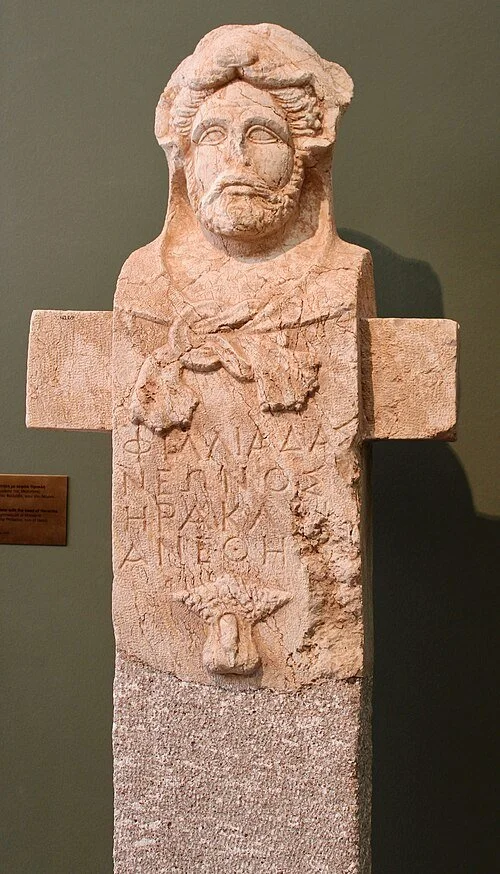
Symbol, Soul, Education, and the Shared Work of Becoming Human
Hermes begins as a divine thief, cattle-driver, musician, messenger, guide of souls, and master of exchange. In late antiquity he becomes Hermes Trismegistus, the imagined Egyptian-Greek sage of Hermetic wisdom. His long afterlife reveals not one secret doctrine hidden beneath every religion, but a recurring human question: how can symbols, stories, study, ritual, and disciplined self-knowledge help us become less ruled by ignorance, appetite, fear, and illusion?
Hermes is born in the morning.
By midday, he has invented the lyre.
By evening, he has stolen Apollo’s cattle.
This is not the usual beginning of a respectable career.
Yet it is the beginning of one of the most durable figures in the history of symbolic thought. Hermes is not merely a messenger with winged sandals. He is a god of roads, thresholds, exchange, language, cattle, trade, theft, music, interpretation, dreams, trickery, travel, and the dead. He moves between gods and mortals, city and wilderness, life and death, wealth and poverty, silence and speech, visible form and hidden meaning.
He is the god of crossings.
And crossing is difficult.
One must know where one is going. One must know what language is being spoken. One must recognize that a boundary is not merely an obstacle. It may be a place where responsibility changes.
Hermes becomes especially important in later antiquity, when Greek Hermes is joined imaginatively with Egyptian Thoth to form Hermes Trismegistus, Hermes the Thrice-Great. The resulting Hermetic writings—the Corpus Hermeticum, the Asclepius, and related texts—ask how the human mind may awaken to the divine order of the cosmos, recover knowledge of itself, and undergo a kind of spiritual rebirth.
The figure was powerful.
He was also not historical.
Hermes Trismegistus was not an actual primeval Egyptian sage who wrote every text attributed to him. He was a fruitful literary and religious creation of the Hellenistic and Roman world, born from the encounter of Greek and Egyptian intellectual traditions. His influence nevertheless became immense: late antique philosophers, early Christian writers, medieval scholars, Renaissance thinkers, alchemists, magicians, theologians, and modern esoteric readers all found something in him worth claiming.[1][1]
The story of Hermes opens a larger question.
Across Greece, Egypt, Israel, Persia, India, China, the Nordic world, and many other cultures, human beings have developed stories, laws, rituals, philosophical systems, sacred texts, symbols, journeys, ladders, trees, roads, temples, songs, and disciplines for confronting recurring problems:
How should desire be educated?
What is the relation between body, mind, soul, community, and cosmos?
How should a person carry suffering?
What does justice require?
How can the living remember the dead?
How should knowledge be used?
What does it mean to grow?
How can a person become worthy of responsibility?
How does an inherited tradition become living rather than merely old?
The answer is not that all traditions secretly teach the same doctrine.
They do not.
Their theologies, histories, moral demands, sacred languages, ritual forms, metaphysical claims, and understandings of God, self, salvation, liberation, law, rebirth, and community differ profoundly.
But they often confront recognizably human questions.
That is where comparison becomes useful.
Not to flatten difference.
To understand why symbolic thinking has appeared wherever human beings have tried to turn life into more than appetite, survival, and accident.
The series question
How do human beings use symbols, stories, education, ritual, discipline, and self-knowledge to travel between ignorance and understanding?
Hermes is the guide because he is not the owner of one fixed doctrine.
He translates.
He crosses.
He carries messages.
He turns rivalry into exchange.
He leads souls.
He teaches that intelligence without responsibility becomes trickery, that language can connect or deceive, and that every crossing requires humility before what lies on the other side.
The historical guardrail
This series will make careful distinctions.
| Topic | What it is | What it is not |
|---|---|---|
| Greek Hermes | A Greek god of messages, crossings, trade, theft, herds, music, and guidance | Hermes Trismegistus |
| Hermes Trismegistus | A Greco-Egyptian Hellenistic literary-religious sage combining Hermes and Thoth | A verified ancient historical teacher |
| Hermeticism | Diverse late antique philosophical-religious texts and later traditions attributed to Hermes | A single unchanging secret doctrine |
| Greek paideia | Education through literature, rhetoric, music, gymnastic, philosophy, and civic formation | Identical with Christian formation |
| Early Christianity | Diverse movements rooted in Jewish Scripture and shaped by Greek and Roman worlds | A simple rejection or simple adoption of Greek learning |
| Hebrew Bible and rabbinic Judaism | Covenant, law, prophecy, wisdom, memory, justice, and communal interpretation | Greek myth under different names |
| Kabbalah | Medieval and early modern Jewish mystical traditions, especially around the sefirot, divine emanation, prayer, and repair | A universal esoteric system interchangeable with Hermeticism |
| Comparative philosophy | Study of similarities, differences, transmission, and recurring human questions | Proof that all traditions are secretly one |
The central principle is simple:
Similarity is not proof of identity. Difference is not proof of irrelevance.
A tree, ladder, road, cave, temple, light, darkness, journey, song, or sacred name may perform analogous work in different traditions without carrying the same meaning. The comparison becomes worthwhile when it preserves both the resemblance and the distinction.
The series
The thief, the lyre, Apollo’s cattle, and the moment cleverness becomes an office with responsibility.
The history of a legendary teacher and the real late-antique writings that transformed his imagined authority into a long intellectual tradition.
How early Christian thinkers argued with, borrowed from, criticized, and redirected Greek education toward Scripture, Christ, and moral transformation.
Shared human questions across Greek, Jewish, Christian, Hermetic, Persian, Indian, Chinese, Nordic, and other traditions—without pretending their answers are identical.
Why cultures use visible symbolic maps to imagine invisible work: growth, ascent, descent, law, confusion, memory, and transformation.
Hermes as messenger, guide, interpreter, and boundary-crosser—and what symbolic traditions teach about bringing ideals into ordinary life.