The Work of Translation
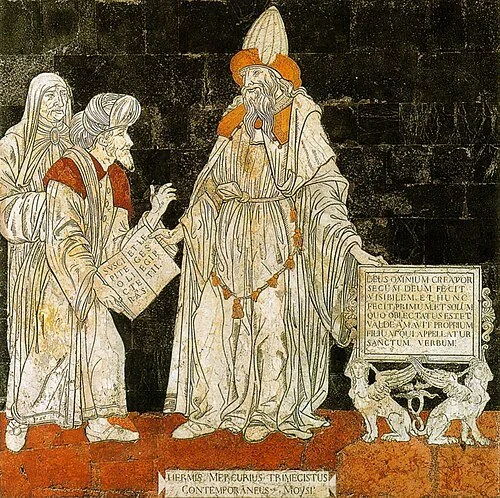
Hermes, interpretation, and the moral meaning of crossing boundaries
Hermes is messenger, interpreter, trader, guide, and conductor of souls. His deepest lesson may be that growth requires translation: between body and mind, past and future, self and neighbor, tradition and present life.
Hermes is a messenger.
But “messenger” is too small a word.
He carries communication across boundaries. He moves between gods and mortals, living and dead, city and wilderness, buyer and seller, traveler and host, language and meaning, hidden intention and public speech.
He is an interpreter.
The Greek word hermēneia, often connected in later thought with Hermes, concerns interpretation and explanation. Whether or not every linguistic connection is historically exact, the symbolic truth is clear: Hermes became the figure through whom people imagined the difficult work of making meaning travel.
This is translation.
And translation is moral work.
More than changing words
Translation is not merely replacing one word with another.
A translator must carry meaning across differences of language, history, worldview, tone, context, and expectation. Something may be preserved. Something may be altered. Something may resist transfer entirely.
The same is true of tradition.
A person inherits symbols, stories, rituals, buildings, songs, texts, offices, customs, and memories. He cannot simply repeat them exactly, because the world has changed. He cannot discard them casually, because they carry labor and meaning from the past.
He must translate.
What does this symbol require now?
How can an old moral teaching speak honestly in a new circumstance?
What must be preserved?
What must be clarified?
What must be left behind because it has become empty, unjust, or misleading?
What cannot be translated without loss?
These are Hermes’ questions.
Translating symbols into life
Every symbolic tradition faces the same danger.
The symbol remains inside the room.
The square becomes an object rather than justice.
The compasses become an emblem rather than restraint.
Light becomes a word rather than truthfulness.
Brotherhood becomes a greeting rather than service.
Education becomes a credential rather than judgment.
Charity becomes a donation rather than a habit of attention.
This is failed translation.
A symbol has crossed from past to present physically, but not morally.
The work of the Mason, philosopher, historian, teacher, citizen, parent, and friend is to translate ideals into conduct.
Not perfectly.
But honestly.
The symbol must become a choice.
The story must become a habit.
The inherited word must become a living responsibility.
Translation across cultures
Comparative work also requires translation.
One must not collapse Kabbalah into Hermeticism, Christianity into Platonism, Greek myth into biblical narrative, or Nordic fate into Stoic providence. Each tradition has its own language, historical wounds, sacred texts, practices, and claims.
But one can still listen.
One can ask how different traditions have confronted the relation of self and community, desire and discipline, death and memory, knowledge and humility, creation and responsibility.
The point is not to make every tradition agree.
The point is to understand what it has tried to say in its own language before deciding what relation, if any, it bears to our own.
This requires humility.
Hermes is not the god of instant agreement.
He is the god of difficult crossings.
The guide of souls
Hermes is also psychopompos: guide of souls.
He conducts the dead across a threshold they cannot cross alone.
This is one of his deepest symbolic functions.
Every serious transformation involves a kind of crossing. The old self cannot simply carry every old habit into the new life. A person must leave something behind. He needs guidance, language, memory, ritual, friendship, discipline, and often help from those who have traveled part of the road before him.
The guide does not walk the journey for the traveler.
He makes the crossing possible.
This is the work of a good teacher.
A good mentor.
A good brother.
A good tradition.
A good historian.
A good symbol.
The final Hermes lesson
Hermes does not teach that every road is the same.
He teaches that every serious crossing requires a guide, a language, and the humility to know that one has not arrived.
The great work of symbolic education is translation.
Take the past and make it truthful in the present.
Take an ideal and make it a habit.
Take a symbol and make it a moral question.
Take knowledge and make it service.
Take Light and carry it into the ordinary world, where it is most needed.
Endnotes and further reading
Homeric Hymn to Hermes, on Hermes as messenger, mediator, cattle-driver, musician, and boundary-crosser.[3]
Corpus Hermeticum, on divine mind, human knowledge, rebirth, and the soul’s relation to the cosmos.
On Hermes Trismegistus and the history of Hermeticism, see Florian Ebeling, The Secret History of Hermes Trismegistus.[1]
Related reading: “The Symbol Is Not the Thing” and “The Work Is Not Over When the Lodge Closes.”