The Tree, the Ladder, the Road, and the Labyrinth
Why cultures draw maps for the work that cannot be seen
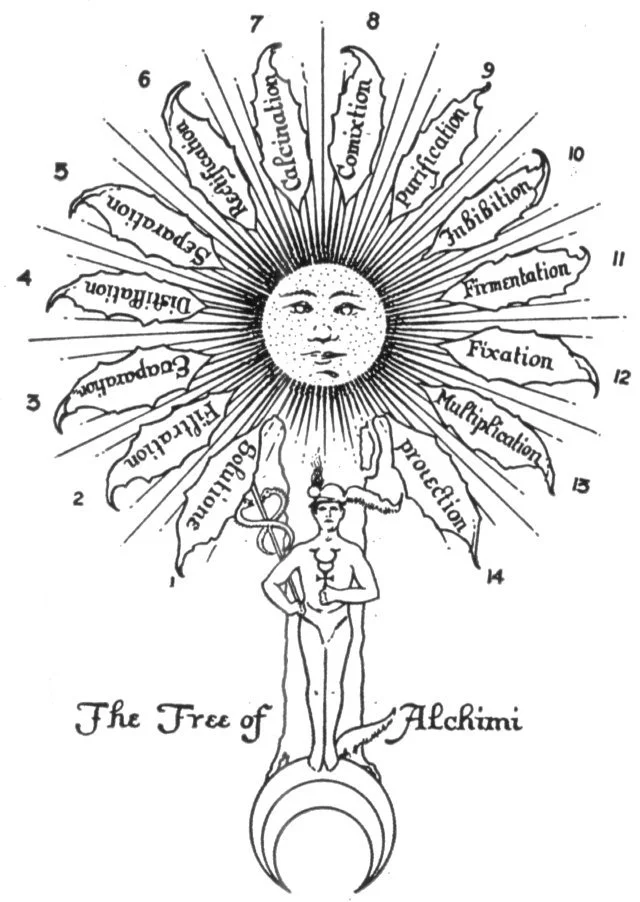
The Tree of Life, Jacob’s ladder, Plato’s ascent, the Hermetic cosmos, the Buddhist path, the Dao, the Norse world tree, and the Masonic staircase do not say the same thing. But each turns invisible moral and spiritual work into a visible map.
Human beings draw maps for what cannot be seen.
A road becomes a life.
A ladder becomes ascent.
A cave becomes ignorance or initiation.
A tree becomes relation among worlds.
A temple becomes an ordered cosmos.
A labyrinth becomes confusion.
A light becomes knowledge.
A darkness becomes concealment, unknowing, grief, danger, or the beginning of revelation.
These symbols appear across cultures because human beings need ways to imagine moral and spiritual movement.
We cannot see justice with the eye.
We cannot photograph wisdom.
We cannot place courage in a box.
But we can climb a stair, walk a road, enter a chamber, follow a thread, tend a tree, carry a lamp, or build a house.
The visible action gives form to the invisible work.
The ladder
A ladder or stair suggests ascent.
In Plato, education turns the soul upward from shadows toward the Good. In the Symposium, Diotima’s ladder leads from attraction to particular beauty toward Beauty itself. In biblical tradition, Jacob’s ladder joins earth and heaven. In later Christian spirituality, ladders become images of virtue, prayer, contemplation, and ascent.
The Masonic winding stair belongs to this family of symbols.
It does not repeat Plato or Jacob. Its ritual setting and meanings are its own. Yet it shares the human intuition that understanding comes by stages, that ascent requires effort, and that higher vision does not arrive without movement.
The tree
A tree suggests rootedness, branching, growth, continuity, and relation between worlds.
The Norse world tree, Yggdrasil, connects realms. Biblical trees mark knowledge, life, exile, and restoration. The Kabbalistic Tree of Life provides a symbolic arrangement of sefirot, or divine emanations, in later Jewish mystical traditions. It is not merely a diagram of the psyche. It belongs to a distinct theological world of divine life, creation, sacred language, prayer, ethical action, and repair.
The tree is powerful because it joins what appears separate.
Roots are hidden.
Branches are visible.
Growth takes time.
A tree does not become mature by wishing to be tall.
This is why it has become such a durable symbol of formation.
The road
A road suggests journey, direction, risk, exile, pilgrimage, return, and the fact that understanding is not achieved by standing still.
Ulysses travels the sea toward Ithaca. Aeneas travels from Troy toward Italy. Psyche moves through tasks. Lucius wanders through humiliation. The Buddhist path, Daoist way, biblical wilderness journey, Islamic pilgrimage, and countless other traditions use movement to imagine moral, religious, and existential transformation.
The road is never only geography.
It asks: What must change in the traveler if the destination is to mean anything?
The labyrinth
The labyrinth is the opposite kind of map.
It gives movement without direction.
It creates the sensation of progress while returning the traveler to confusion.
This is why it works so well as an image of self-deception, addiction, bureaucracy, unresolved grief, moral evasion, and the inner life ruled by habits one no longer understands.
Daedalus builds the Labyrinth as an architectural solution to a moral problem Minos refuses to confront.
The thread of Ariadne, by contrast, gives orientation.
A person does not escape every labyrinth by force.
Sometimes he needs a thread.
A tradition.
A friend.
A rule of life.
A practice.
A moral memory.
A symbol that points toward the exit.
The Masonic map
Masonic symbolism uses architectural and spatial forms because moral education requires embodiment.
The candidate moves.
He sees.
He listens.
He enters.
He ascends.
He encounters tools, lights, pillars, measures, and chambers.
These are not merely theatrical objects. They make ideas visible.
The square gives justice a shape.
The compasses give restraint a boundary.
The plumb gives uprightness a line.
The level gives equality a plane.
The staircase gives education a direction.
The temple gives the self and community an architecture.
A symbolic map does not tell us where the soul lives.
It gives the soul a way to imagine where it must travel.
Endnotes and further reading
Plato, Republic VII, Phaedrus, and Symposium, on ascent, education, beauty, and the soul.
On Kabbalah as a historically specific Jewish mystical tradition, readers should consult scholarly introductions rather than treating the Tree of Life as a universal psychological chart.
On symbolic interpretation in late Platonism, see scholarship on myth, allegory, and the Cave of the Nymphs.[7][9]
Related reading: “The Two Caves and the Work of Light” and “The Labyrinth and the Wings.”