Hermes Before Hermeticism
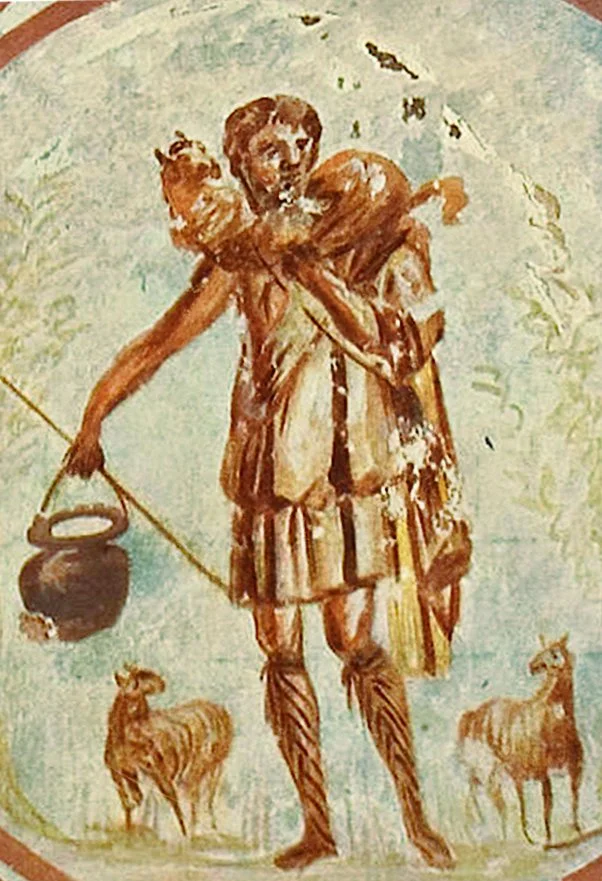
The thief, the lyre, and the office of the shepherd
Before Hermes became a sage of Hermetic philosophy, he was a newborn god who stole Apollo’s cattle, invented the lyre, and transformed conflict into exchange. His first myth is a story about raw intelligence becoming responsibility.
Hermes is born in the morning.
By noon, he has made a lyre from a tortoise shell.
By evening, he has stolen fifty cattle from Apollo.
It is a busy first day.
The Homeric Hymn to Hermes is one of the funniest, cleverest, and most revealing poems in Greek myth. Its Hermes is not yet the polished messenger of later art. He is an infant prodigy: inventive, charming, dishonest, fearless, restless, and already capable of turning every difficulty into an opportunity for cleverness.
He steals Apollo’s cattle and makes them walk backward, disguises their tracks, uses sandals made from branches to confuse pursuit, sacrifices animals in a manner that anticipates ritual, and then lies with almost supernatural calm when Apollo finds him.
This is not the beginning of a moral example.
It is the beginning of an education.
Cleverness before responsibility
Hermes possesses mētis: cunning intelligence.
The Greeks admired mētis. It is the intelligence of the sailor, hunter, inventor, craftsman, strategist, trader, storyteller, and survivor. Odysseus has it. Athena has it. Daedalus has it. It is flexible, quick, indirect, inventive, and often dangerous.
Hermes has it in its purest and least regulated form.
He sees possibilities where others see limits.
A tortoise becomes an instrument.
A herd becomes an opportunity.
A path becomes a puzzle.
A lie becomes performance.
Apollo is the god of music, prophecy, order, and shining clarity. Hermes is the god of movement, ambiguity, exchange, trickery, and the road where one thing becomes another.
Their conflict is not accidental.
Hermes steals Apollo’s cattle.
Apollo brings him before Zeus.
The world must decide what to do with a divine intelligence that is brilliant but unassigned.
This is the Hermes question.
What becomes of cleverness when cleverness has not yet found its proper office?
The lyre changes the argument
Hermes does not defeat Apollo through force.
He plays.
He gives Apollo the lyre.
Apollo hears its sound and is delighted. The conflict begins to change. The stolen cattle are returned or exchanged. Apollo receives the lyre, an instrument suited to his sphere of music and prophecy. Hermes receives authority connected with cattle, herds, exchange, and other functions. Zeus confirms Hermes’ place among the gods.
This is one of the great scenes of ancient negotiation.
A theft becomes an exchange.
A rivalry becomes a division of offices.
Cunning becomes socially useful.
Hermes is not punished into dullness. Apollo is not defeated into resentment. The gods find a relation between their powers.
This is more than a comic mythic episode.
It is a story about the formation of talent.
A person may possess energy, cleverness, charm, invention, and an instinct for breaking rules. None of these makes him mature. But none must be destroyed.
The question is whether the talent can become responsible.
Can cleverness serve music rather than merely theft?
Can skill serve community rather than merely self-advantage?
Can invention become craft?
Can wit become interpretation?
Can movement become guidance?
Hermes and the shepherd’s office
Apollo gives Hermes authority associated with cattle-driving and herds. Hermes receives the shining whip and is linked with tending, guiding, and managing flocks. Zeus confirms wider divine functions: messenger, intermediary, giver of luck, guide, and boundary-crosser.[3][4]
This is the story behind the “shepherd” element you raised.
Hermes is not the original shepherd in a Jewish or Christian theological sense. Nor is he a hidden precursor of the biblical shepherd imagery applied to Moses, David, or Christ.
But the comparative connection is meaningful.
The shepherd is a recurring ancient image of guidance, responsibility, care, movement, protection, and the moral difficulty of leading beings who cannot always explain what they need.
Greek Hermes guides herds and souls.
Biblical shepherd figures lead communities and carry responsibility before God.
Christian texts develop the image of the good shepherd in a distinct theological framework centered on Christ.
The similarities are motifs of guidance and care. The meanings are not identical.
A responsible comparison lets both truths stand.
The office makes the god answerable
Hermes is not made less intelligent by receiving an office.
He becomes answerable for what intelligence is now permitted to do.
This is the moral center of the hymn.
A person with natural gifts may initially use them for mischief, display, private advantage, or the thrill of proving that rules can be bent.
But talent matures when it receives a purpose.
The gifted speaker becomes responsible for speech.
The capable organizer becomes responsible for the group.
The historian becomes responsible for memory.
The ritualist becomes responsible for meaning.
The businessman becomes responsible for exchange.
The teacher becomes responsible for the mind of the student.
The Mason who receives an office becomes responsible not for the appearance of authority, but for the people, work, and tradition entrusted to him.
The office is not merely a reward.
It is a moral claim.
The Masonic Hermes
A lodge contains many Hermes-like talents.
The brother who can solve practical problems.
The member who knows everyone.
The person who can translate conflict into workable language.
The one who understands how to make things happen.
The one who sees an opening others have missed.
These gifts are valuable.
They become dangerous only when they are used without responsibility.
Hermes teaches that intelligence is not enough. It must become accountable to a larger order.
A clever man can find a way around a rule.
A wise man asks whether the rule protects something worth preserving.
Hermes does not become less clever when he receives an office.
He becomes answerable for what cleverness is now allowed to do.
Endnotes and further reading
Homeric Hymn to Hermes, especially lines 1–580, on Hermes’ birth, lyre, theft of Apollo’s cattle, confrontation, and reconciliation.[3]
Apollodorus, Library 3.10.2, for a mythographic summary of Hermes’ birth and theft of Apollo’s cattle.[5]
On Hermes as a divine figure of cunning intelligence, mediation, exchange, and boundaries, see studies of the Homeric Hymn to Hermes.[4]
Related reading: “Skill Is Not Wisdom” and “The Work of Translation.”