Greek Paideia and the Christian School of the Soul
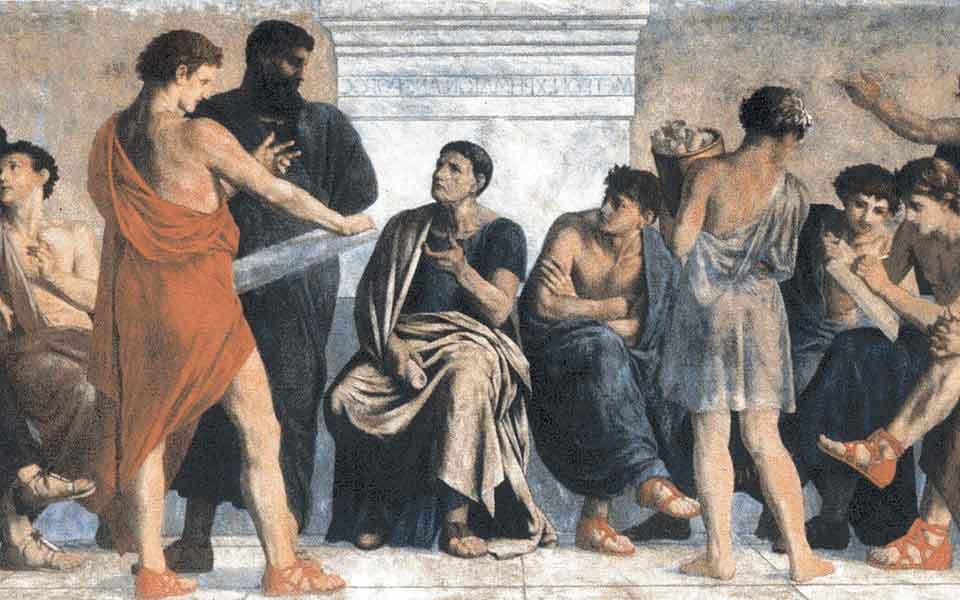
Education, Scripture, philosophy, and the long argument over what forms a human being
Early Christianity did not grow outside the Greek educational world. It inherited the language of paideia—formation through texts, rhetoric, philosophy, discipline, and moral practice—then argued with it, criticized it, borrowed from it, and redirected it toward Scripture and transformed life.
The ancient Greek word paideia means more than education.
It means formation.
It concerns the making of a human being through language, literature, music, rhetoric, exercise, philosophy, civic memory, moral discipline, imitation, and the long work of learning what deserves admiration.
A Greek boy of means might learn Homer, poetry, grammar, music, rhetoric, mathematics, philosophy, and public speech. The curriculum was not merely designed to produce employees with better handwriting. It was meant to form character, judgment, taste, civic identity, and the capacity to participate in public life.
Homer mattered because Homer provided stories of courage, failure, leadership, temptation, grief, honor, hospitality, rage, and fate.
Plato criticized parts of this education sharply. He worried that Homeric stories could form bad character if read without moral discrimination. Yet he did not treat education as optional. He wanted it reformed.
This is the world into which early Christianity emerged.
Christianity enters the Greek schoolroom
Early Christianity began within the Jewish world of Scripture, synagogue, covenant, law, prophecy, memory, and messianic hope.
But it spread rapidly through Greek-speaking cities of the Roman Empire.
Christian teachers wrote in Greek. They used Greek rhetorical forms. They encountered Greek philosophy. They lived in cities shaped by Greek education. Their converts had heard Homer, attended rhetorical schools, encountered Stoic, Platonic, Cynic, Epicurean, and other philosophical ideas, and inherited assumptions about what a cultivated person should know.
Christianity could not avoid paideia.
It had to decide what to do with it.
Some Christians rejected pagan literature and philosophy as dangerous. The myths of the gods could be immoral, violent, absurd, or spiritually corrupting. The prestige of rhetorical education could produce vanity. Philosophy could become prideful speculation.
Others took a more complex view.
Clement of Alexandria treated Greek philosophy as a kind of preparation for the Greeks, analogous in some respects to the role of the Law for the Jews. Basil of Caesarea advised young Christians to read Greek literature selectively, taking what was useful for virtue while rejecting what was morally harmful. Origen, Gregory of Nyssa, Augustine, and others engaged deeply with Greek philosophical concepts even as they transformed them within Christian theological frameworks.
Christianity did not simply inherit Greek education or reject it.
It argued with it, borrowed from it, baptized parts of it, and tried to turn its formative power toward another end.
Homer in early Christian learning
Greek stories did not vanish when Christianity rose.
Homer remained foundational to elite education. Students learned language, rhetoric, history, poetic form, and cultural memory through Homeric texts. Christian intellectuals often knew Homer extremely well, even when they criticized pagan religion.
This creates a useful distinction.
A Christian reader could reject Zeus as a religious object of worship while still recognizing the literary, educational, and moral power of the Iliad and Odyssey.
He could criticize the gods’ behavior while learning rhetoric from Homer’s speeches.
He could see Greek myths as morally dangerous in one sense and psychologically instructive in another.
This is not hypocrisy.
It is the complicated reality of cultural inheritance.
The early Christian world did not develop in a vacuum. It developed through argument with the intellectual materials it had received.
The Christian school of the soul
The Christian reworking of paideia shifted the center of education.
The goal was not merely eloquence, civic reputation, philosophical contemplation, or cultural refinement. It was transformation of life: humility, charity, repentance, prayer, Scripture, imitation of Christ, care for the poor, moral discipline, and hope in resurrection.
Yet many of the educational tools remained recognizable.
Reading.
Memorization.
Interpretation.
Rhetoric.
Music.
Moral exempla.
Community.
Discipline.
Teachers.
Texts.
Symbols.
A rule of life.
The difference lay in the ultimate horizon.
Greek paideia sought formation for virtue, citizenship, reason, and contemplation.
Christian formation sought life in Christ, conversion, holiness, charity, and participation in God.
The two traditions overlapped and disagreed.
That is why their encounter was productive.
The Middle Chamber and paideia
The Masonic reader can see why this matters.
The Middle Chamber’s liberal arts and sciences belong to the long tradition of paideia: the conviction that human beings become more capable through disciplined education.
Grammar teaches precision.
Rhetoric teaches the power and danger of speech.
Logic teaches discernment.
Arithmetic and geometry teach proportion.
Music teaches harmony.
Astronomy teaches scale.
The Masonic system does not simply reproduce Greek education or Christian formation. But it participates in the old conviction that a person can be shaped by study, symbol, discipline, fellowship, and moral aspiration.
The question remains the same.
What is education for?
To make a person cleverer?
More employable?
More impressive?
Or more capable of truth, justice, restraint, service, and responsibility?
The answer determines what kind of school the soul enters.
Endnotes and further reading
On Greek paideia as formation toward the good and as a central educational ideal, see scholarship on Greek educational traditions.[6]
Plato, Republic Books II–III and VII, on poetry, music, education, philosophy, and the formation of the soul.
Basil of Caesarea, Address to Young Men on How They Might Derive Benefit from Greek Literature.
Clement of Alexandria, Stromata, on Greek philosophy and Christian formation.
Related reading: “The Middle Chamber of the Mind” and “The Symbol Is Not the Thing.”