Hermes Trismegistus
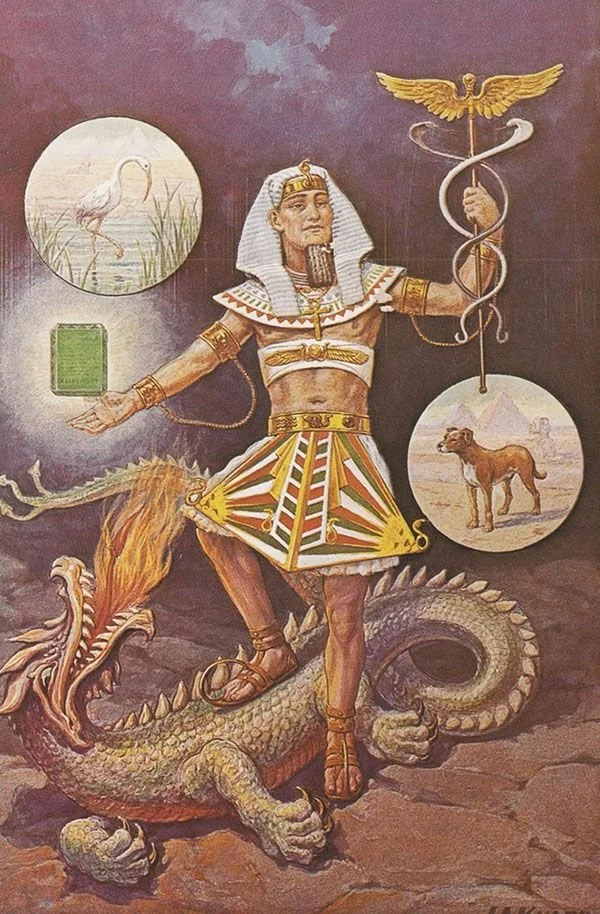
The Egyptian-Greek sage who never existed
Hermes Trismegistus was not an ancient historical master speaking from the dawn of civilization. He was a Greco-Egyptian literary creation—and one whose imagined wisdom changed late antiquity, early Christianity, Renaissance philosophy, and modern esotericism.
Hermes Trismegistus never existed.
This is a useful place to begin.
He was not one man who lived in ancient Egypt before Moses, taught Plato, invented all wisdom, wrote every Hermetic text, and left behind a secret doctrine for Renaissance magicians to discover in a locked chest.
He was more interesting than that.
Hermes Trismegistus was a literary and religious figure created through the meeting of Greek and Egyptian traditions in Hellenistic and Roman Egypt. Greek Hermes and Egyptian Thoth were associated with one another. Both were connected with writing, language, mediation, measurement, divine knowledge, and the crossing of boundaries. The result was Hermes Trismegistus—“Hermes the Thrice-Greatest”—an imagined ancient sage whose authority became a vessel for philosophical, religious, cosmological, and spiritual writings.[1][2]
The person may be fictional.
The tradition is real.
Hermes and Thoth
Greek Hermes is a god of movement.
Egyptian Thoth is associated with writing, calculation, language, sacred knowledge, measurement, judgment, and the recording of divine order.
The identification of gods across cultures was common in the ancient Mediterranean. Greeks and Egyptians did not necessarily assume that their gods were identical in every respect. They looked for functional correspondences. Hermes and Thoth both governed forms of mediation: messages, writing, calculation, knowledge, and the difficult movement between worlds.
Hermes Trismegistus emerges from this contact zone.
He is not merely Greek.
He is not merely Egyptian.
He is a Greco-Egyptian figure created in a world where languages, gods, rituals, philosophies, trade routes, imperial structures, libraries, and religious communities constantly met and reshaped one another.
This matters because Hermeticism is not a fossil from pristine antiquity. It is a product of cultural exchange.
Hermes is the perfect patron for such exchange.
The Hermetic writings
The writings attributed to Hermes are diverse.
The Corpus Hermeticum consists of Greek treatises, largely from the Roman imperial period, in dialogues between Hermes and various pupils, including Tat and Asclepius. The Latin Asclepius survives as another major Hermetic work.
Their concerns include:
The divine mind or nous.
The origin and order of the cosmos.
The human being as a creature with a special relation to the divine.
Spiritual rebirth.
The body and the soul.
The dangers of ignorance and passion.
The possibility of awakening to a higher understanding.
Prayer, reverence, and the transformation of life.
The famous Poimandres, the opening treatise of the Corpus Hermeticum, presents a revelation in which Hermes encounters a divine Mind and receives a vision of cosmic origins, humanity’s fall into material life, and the possibility of return through knowledge.[1]
This is not identical to Platonism.
It is not identical to Egyptian temple religion.
It is not identical to Christianity.
But it speaks in a late antique philosophical-religious language shaped by all of these worlds.
Rebirth without a secret password
A central Hermetic theme is rebirth.
The individual must become more than a creature governed by ignorance, appetite, material fixation, and false identity. He must awaken to mind, divine kinship, and a more truthful relation to the cosmos.
This is why Hermetic writings became attractive to later readers interested in self-transformation.
But Hermetic rebirth is not merely acquiring secret information.
It is moral and spiritual reorientation.
A person must become less ruled by passions and ignorance. He must recognize the divine order of the world. He must live more reverently. He must understand himself not as an isolated ego but as a participant in a larger reality.
This is close enough to Platonic and Stoic concerns to create conversation.
It is distinct enough to remain Hermetic.
The danger of false antiquity
For centuries, many readers believed Hermes Trismegistus was older than Moses and Plato. Renaissance thinkers treated the Hermetic texts as ancient Egyptian wisdom from the dawn of human history. This gave them enormous prestige.
Later scholarship established that the surviving Hermetic writings are products of the Hellenistic and Roman periods, not relics of primordial Egypt.
Some readers treat this as a disappointment.
It should not be.
The texts remain fascinating because they reveal what people in the ancient Mediterranean were doing with Greek philosophy, Egyptian religious imagination, Roman-era spirituality, sacred writing, and the human desire for rebirth.
The historical correction does not make Hermes less important.
It makes him more visible.
Hermes Trismegistus never existed as a single ancient sage.
His influence is real because cultures often need a wise ancestor through whom knowledge can travel.
The Masonic reader and Hermetic restraint
Hermeticism has often attracted Masons, esoteric readers, alchemists, occultists, and seekers of hidden knowledge. There is good reason for the attraction: Hermetic writings are concerned with symbols, transformation, cosmic order, moral rebirth, and the relationship between visible and invisible realities.
But restraint is necessary.
Hermeticism is not a master key that explains all symbols.
It is not the hidden origin of every Masonic practice.
It is not proof that all traditions are one.
It is one historically specific tradition of late antique wisdom writing that later became extraordinarily influential.
The wise reader does not need Hermes to explain everything.
He needs Hermes to teach him how much remains to be understood.
Endnotes and further reading
Corpus Hermeticum I, Poimandres, on divine Mind, cosmic origins, human nature, and spiritual awakening.
Asclepius, on divine order, human dignity, and religious-philosophical life.
Florian Ebeling, The Secret History of Hermes Trismegistus: Hermeticism from Ancient to Modern Times. The historical Hermes Trismegistus is a “fruitful fiction” with a long afterlife.[1]
Related reading: “The Work of Translation.”