The City Is Not Yet Built
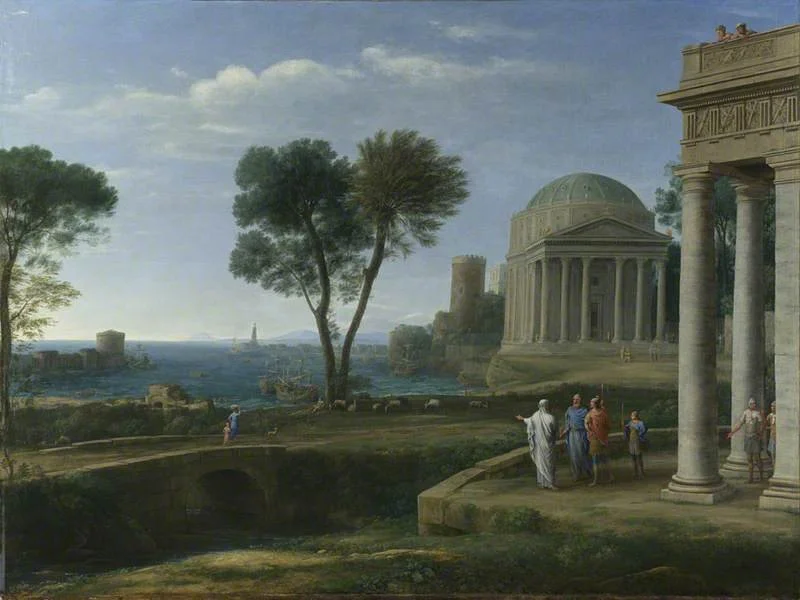
Image credit: The National Gallery, London
Revelation, labor, and the difficult return to the world above
Aeneas leaves the underworld with a vision, but no city exists yet. He still has to return, work, negotiate, fail, grieve, fight, and build. The moral life begins again after the revelation.
The great temptation after revelation is to imagine that the work is complete.
Aeneas has descended to the underworld. He has seen the dead. He has spoken with Anchises. He has learned the future. He has been shown a vision of Rome, its leaders, its laws, its victories, its moral claims, and the generations that will follow.
Surely the story can end there.
It does not.
Aeneas must return.
Italy is still dangerous.
The city does not exist.
The people are not settled.
The alliances are unstable.
The future remains costly.
The vision does not build the city.
It gives Aeneas a reason to continue the labor.
The difference between vision and building
A vision can be true and still incomplete.
A person may understand what should be done and remain unable to do it alone. He may glimpse a better future and still have to work through the ordinary obstacles: money, conflict, weather, fatigue, disagreement, bureaucracy, fear, ego, rival interests, inherited damage, and the simple fact that other people are not always waiting to cooperate with his insight.
This is why Aeneas is a founder rather than merely a visionary.
He must act.
He must negotiate.
He must fight.
He must listen.
He must endure setbacks.
He must make mistakes.
He must bear responsibility for others.
The city is not built by the underworld’s vision.
It is built by the work that follows.
The city as moral architecture
A city is more than streets and buildings.
It is a structure of memory, law, labor, welcome, exclusion, duty, aspiration, commerce, worship, conflict, art, housing, burial, education, and shared life.
Every city asks moral questions through its physical form.
Who is allowed to live here?
Who is pushed to the margins?
What histories are commemorated?
What labor is invisible?
Which buildings are preserved?
Which communities are displaced?
Where are the places of gathering?
Who has access to light, safety, beauty, transportation, work, and dignity?
The city is moral architecture.
This makes Aeneas relevant to local history.
Queens, New York, and every other urban community are not simply collections of streets. They are inherited structures built by people who made choices about land, housing, industry, worship, transportation, ethnicity, class, labor, association, and public memory.
Some of those choices created opportunity.
Some created exclusion.
The historian’s work is to make the structure visible.
The citizen’s work is to ask what should be repaired.
The lodge as a civic building
A lodge does not exist outside the city.
It occupies space. It gathers people. It preserves memory. It contributes to neighborhood life. It may have a building, a meeting hall, a history, a charitable presence, a network of members, and a relationship to the surrounding community.
The lodge is therefore a small civic institution.
Its health cannot be measured only by internal success. It should also ask whether it contributes to a more humane local world.
Does it welcome?
Does it remember?
Does it serve?
Does it preserve?
Does it teach?
Does it offer friendship where isolation has become normal?
Does it create a place where character can be formed?
These are city-building questions.
A lodge may not found Rome.
It can still help build a neighborhood worth living in.
The future as labor
The future is easy to praise.
It is harder to prepare for.
Preparing for the future may mean repairing a roof rather than giving a speech about legacy. It may mean organizing archives, teaching a candidate carefully, maintaining a building, recording oral histories, supporting a struggling family, preserving a cemetery, funding a scholarship, correcting a false historical claim, or simply making an institution more capable of surviving after current members are gone.
This is not glamorous work.
It is what makes continuity possible.
Aeneas returns from the underworld not with a completed city, but with the harder task of becoming one of its builders.
The same is true of us.
The vision matters.
The work matters more.
Endnotes and further reading
Virgil, Aeneid VI.892–901, on Aeneas’ departure from the underworld and return to the world above.
Virgil, Aeneid VII–XII, on the continuing struggle to establish the Trojan future in Italy.
Cicero, On Duties, on public service, civic responsibility, and moral obligation.
Related reading: “The Temple and the Tenement” and “The Future Is a Form of Charity.”