Charles Wesley Hallett, Sr.
Astoria’s Masonic Patriot, Civic Builder, and Heir to Hallett’s Cove
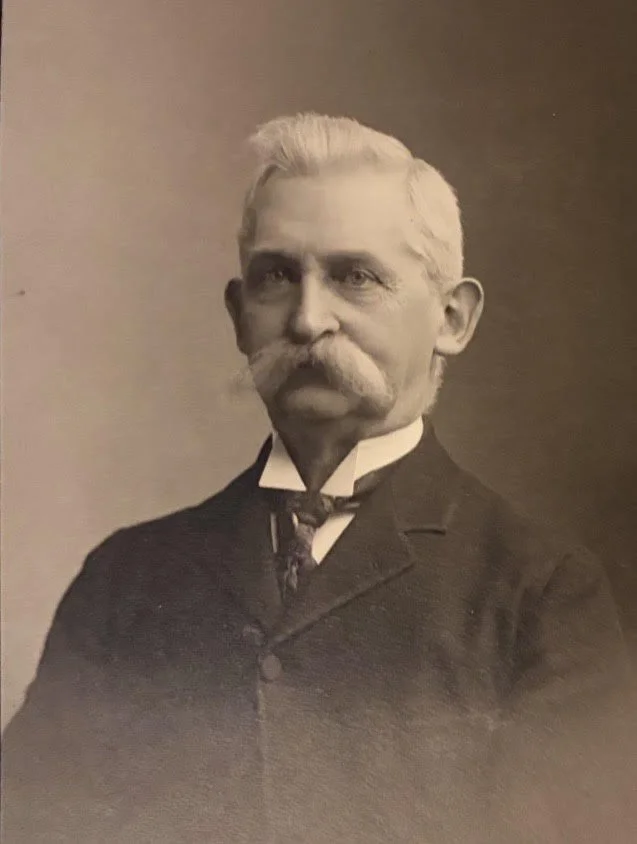
Portrait of Charles Wesley Hallett Sr
Raised a Master Mason in Advance Lodge No. 635 in 1875, Charles Wesley Hallett, Sr. stood at the meeting point of Astoria’s colonial inheritance and its modern civic rise. Veteran, businessman, banker, churchman, and public servant, his life offers a rare window into the making of nineteenth-century Queens.
In Astoria, some names survive on maps. A rarer few survive in the deeper architecture of local memory. Hallett is one of them.
Long before Astoria became one of New York’s defining urban neighborhoods, the area was known as Hallett’s Cove, a shoreline settlement shaped by one of the oldest English families in western Queens. From that lineage came Charles Wesley Hallett, Sr.—Civil War veteran, businessman, civic leader, and Brother of Advance Lodge No. 635, F.&A.M. Raised to the sublime degree of Master Mason on February 23, 1875, at age forty-three, Hallett embodied a distinctly nineteenth-century ideal: the local man whose private discipline, public duty, and fraternal commitments helped build a community.
He did not simply witness Astoria’s transformation. He helped give it shape.
From Colonial Cove to Modern Astoria
To understand Charles Wesley Hallett, Sr., one must begin with the land itself. The Hallett family’s roots in Astoria reach back to the seventeenth century, when William Hallett received a grant of roughly 160 acres from Governor Peter Stuyvesant on December 1, 1652, extending from Sunswick Creek toward Berrian’s Island.[1] That tract became the foundation of Hallett’s Cove, fixing the family permanently in the geography of Queens.
The early family story was marked by both prominence and hardship. William Hallett’s house and plantation were destroyed in a Native attack, forcing a temporary move to Flushing before he returned to rebuild.[2] Over time, the family expanded its holdings, and the Hallett name became inseparable from the district itself. Yet by the early nineteenth century, the old agrarian order was changing. Estates were divided, ferry service improved, and the East River waterfront grew attractive to affluent New Yorkers seeking a retreat from Manhattan.[3]
By the late 1830s, local promoters renamed the village Astoria in hopes of attracting support from John Jacob Astor. His financial contribution proved modest, but the name endured.[4] The moment was telling: the old cove was becoming an ambitious new community, eager to reinvent itself without erasing its past. That was the Astoria Hallett inherited.
An Orphan of Old Astoria
Charles Wesley Hallett, Sr. was born in New York City on July 16, 1831.[5] His parents died when he was only eighteen months old, and he was brought to Astoria to be raised by his maternal grandparents.[6] Though descended from one of the area’s oldest families, he began life not in comfort, but in bereavement.
That early loss deepens the man who later emerges in newspaper accounts. By 1907, when Charles and his wife celebrated their golden wedding anniversary, the local press described their shared life as one of “honor and sweet content” and “supreme usefulness” to the community.[7] Such language suggests not inherited standing alone, but character proved over decades.
Marriage, Family, and Social Standing
On March 19, 1857, Hallett married Christina Crawford Ellison at the Seventeenth Street Methodist Church in Manhattan.[8] Their marriage lasted more than half a century and produced six children: Charles Wesley Hallett, Jr.; Alletta M. Stead; Fred T. Hallett; Walter E. Hallett; Mary E. Evelyn Hallett, who predeceased her parents; and Christina Hallett.[9]
Their fiftieth wedding anniversary was treated not merely as a family celebration, but as a notable Astoria occasion, with relatives, friends, and prominent residents gathering at their home on Remsen Street.[10] That kind of recognition reflected the place the Halletts held in the life of the neighborhood. In the nineteenth century, reputation was a civic asset, and Charles Hallett had earned it.
War and the Making of Public Character
Like many men of his generation, Hallett was shaped by the Civil War. He enlisted on August 22, 1862, at Danby, New York, and was mustered in as a private in Company K of the 137th New York Infantry on August 27.[11] He served until June 9, 1865, when he was honorably mustered out near Bladensburg, Maryland.[12]
The 137th New York was a hard-fighting regiment. It served at Chancellorsville, Gettysburg, Lookout Mountain, Missionary Ridge, throughout the Atlanta Campaign, in Sherman’s March to the Sea, and in the Carolinas Campaign.[13] Its most celebrated action came at Gettysburg on July 2, 1863, when it held the Union right on Culp’s Hill against fierce Confederate assault. That stand became central to the regiment’s reputation and is still marked by its monument on the battlefield, erected in 1888.[14] The inscription records the cost with unsparing brevity: forty killed, eighty-seven wounded, and ten missing.[15]
A wartime photograph in the Library of Congress, later highlighted by WSKG-TV in Binghamton, depicts a young soldier of the 137th New York long believed to be Charles Hallett of Company K, later identified as such through family confirmation.[16] If accepted, the image offers a rare and arresting glimpse of the young man who marched from old Astoria into the national crisis of the Union.
Business, Education, and Earned Trust
After the war, Hallett returned to a Queens undergoing rapid change. Astoria and greater Long Island City were expanding, and men of reliability could rise with the place. Hallett did. Contemporary accounts note that he was engaged in business for many years on Fulton Avenue in Astoria and credit his success to “careful, economic, but at the same time energetic business methods.”[17]
He became associated with hardware and funeral enterprises, businesses tied to the practical necessities of local life. Family-history materials also identify him as a graduate of Columbia University, Class of 1883, and later as a respected accountant and banker in New York.[18] Whether in trade, finance, or administration, the pattern is consistent: Hallett was regarded as a man of discipline, prudence, and trustworthiness.
In the nineteenth century, local leadership depended heavily on precisely those qualities. A community needed known men—men whose judgment could be relied upon, whose books balanced, and whose conduct held steady under responsibility. Hallett appears in the record as one of them.
A Builder of Civic Astoria
That reputation carried into public office. Hallett served for many years as a trustee of the Long Island City Savings Bank.[19] He also served two terms on the Common Council of old Long Island City and was a member of the Board of Water Commissioners.[20] These were not ornamental posts. They touched the central systems that made urban growth possible: savings, municipal governance, infrastructure, and public improvement.
Astoria in the late nineteenth century was passing from village character into urban complexity. Streets, utilities, institutions, and financial systems had to keep pace. Men like Hallett helped manage that transition. They were not always famous beyond their locality, but they formed the practical leadership class on which civic stability depended.
Brother Hallett and Advance Lodge No. 635
Hallett’s Masonic life belongs squarely within that wider pattern of disciplined citizenship. He was raised to the degree of Master Mason in Advance Lodge No. 635 on February 23, 1875, at age forty-three. By then he was already a veteran, husband, father, businessman, and trusted member of the community. His Masonic advancement came at maturity, suggesting a man drawn to the Craft not as ornament, but as an extension of a life already shaped by duty and order.
In nineteenth-century America, the lodge stood among the key institutions of moral fellowship, self-discipline, mutual aid, and memory. In a place like Astoria, where old family roots met urban transformation, Freemasonry provided a structure through which civic-minded men deepened bonds of trust and obligation.
Hallett was also active in Astoria Lodge No. 155, I.O.O.F., and was prominently identified with the Astoria Presbyterian Church.[21] These affiliations mattered. Churches, lodges, benevolent societies, savings institutions, and municipal office often overlapped in the making of a local public man. Together they formed the social architecture of respectability and service.
The Hallett connection to Advance Lodge extended into the next generation. His sons, Charles Hallett, Jr. and Fred T. Hallett, were also members, as was their cousin Samuel Hallett. That continuity reveals something larger than family participation. It shows how fraternal life could function as a vessel of memory and civic identity, transmitting values across generations while Astoria itself changed around them.
The Measure of the Man
Charles Wesley Hallett, Sr. died on June 2, 1914, and was buried at Mount Olivet Cemetery in Maspeth.[22] By the time of his death, the world of his childhood had largely passed. The old cove had become part of a denser, faster, more modern Queens. Yet his life had not been eclipsed by that change. It had interpreted it.
He was descended from the first age of the place, shaped by its village years, tested in war, and useful in its civic expansion. He belonged at once to family history, neighborhood history, and Masonic history. That is what makes him so compelling today. He was not merely a descendant of early settlers, nor simply a successful businessman. He was one of those sturdy nineteenth-century citizens whose lives linked ancestry to service, private discipline to public usefulness, and fraternity to community building.
In Brother Charles Wesley Hallett, Sr., Advance Lodge No. 635 counted not simply a member, but a representative Astorian in the fullest historical sense: rooted, ambitious, dutiful, and enduring.
Endnotes
Author’s note:
I write as an individual Freemason, historian, and researcher. This article reflects my personal research and interpretation and does not represent an official statement of Advance Service Mizpah Lodge No. 586, the Grand Lodge of New York, or any other Masonic organization.
Images:
Portrait of Charles W. Hallett, author's collection.
Sources:
[1] Daily Star (New York), “Astorians Celebrate Golden Wedding,” March 19, 1907; William Hallett family history materials, williamhallett.com.
[2] Daily Star (New York), “Astorians Celebrate Golden Wedding,” March 19, 1907; William Hallett family history materials, williamhallett.com.
[3] “A Walk Around Hallet’s Cove,” The Newtown Pentacle, February 5, 2010; Macaulay Honors College/CUNY, Astoria history materials.
[4] “A Walk Around Hallet’s Cove,” The Newtown Pentacle, February 5, 2010; Macaulay Honors College/CUNY, Astoria history materials.
[5] Daily Star (New York), “Astorians Celebrate Golden Wedding,” March 19, 1907.
[6] “Charles Wesley Hallett, Sr. - Biography,” williamhallett.com.
[7] Daily Star (New York), “Astorians Celebrate Golden Wedding,” March 19, 1907.
[8] Daily Star (New York), “Astorians Celebrate Golden Wedding,” March 19, 1907.
[9] Daily Star (New York), “Astorians Celebrate Golden Wedding,” March 19, 1907.
[10] Daily Star (New York), “Astorians Celebrate Golden Wedding,” March 19, 1907.
[11] New York State Military Museum, 137th New York Infantry service materials.
[12] New York State Military Museum, 137th New York Infantry service materials.
[13] New York State Military Museum, 137th New York Infantry regimental history.
[14] New York State Military Museum, 137th New York Infantry regimental history; Gettysburg monument record.
[15] Gettysburg monument inscription, 137th New York Infantry monument, erected 1888.
[16] WSKG-TV, “Charles Hallet of Company K #TBT,” January 21, 2016; Library of Congress/DPLA image record.
[17] Daily Star (New York), “Astorians Celebrate Golden Wedding,” March 19, 1907.
[18] William Hallett family biography materials, williamhallett.com.
[19] Daily Star (New York), “Astorians Celebrate Golden Wedding,” March 19, 1907.
[20] Daily Star (New York), “Astorians Celebrate Golden Wedding,” March 19, 1907.
[21] Daily Star (New York), “Astorians Celebrate Golden Wedding,” March 19, 1907.
[22] William Hallett family biography materials, williamhallett.com.