Brother Frederick T. Hallett: The Measure of an Astorian
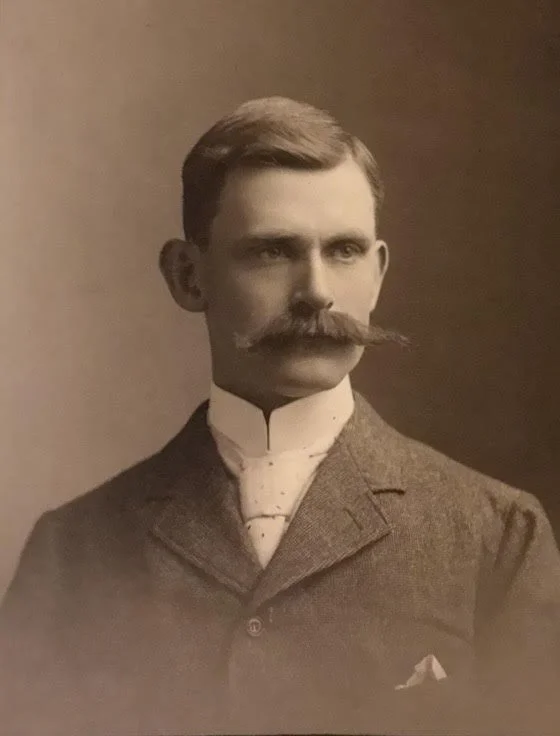
Portrait of Frederick T. Hallett
Merchant, Mason, churchman, political hand, and heir to one of Queens’ oldest names, Frederick T. Hallett lived at the turning point when old Astoria gave way to modern New York. His story is also the story of a borough becoming itself.
Long before Queens was defined by bridges, subways, apartment blocks, and the ceaseless movement of the modern city, it was a place of coves, church steeples, private roads, boat landings, athletic clubs, and old family names. In that world, few names reached deeper into Astoria’s soil than Hallett. And few men embodied the transition from old Long Island village life to twentieth-century civic modernity more completely than Brother Frederick T. Hallett of Advance Lodge No. 635.
Born into ancestry but shaped by service, Hallett belonged to that class of local men who made communities cohere. He was not a national figure, nor a titan of industry, nor a machine boss in the coarser sense. He was something more intimate and, to the historian, often more valuable: a builder of civic life. In the records of his church, his lodge, his businesses, his clubs, his family, and the newspapers of his day, Frederick T. Hallett emerges as a man who stood exactly where his era needed him—between inheritance and progress, memory and momentum, the village and the borough.
The Name on the Shore
To understand Frederick T. Hallett, one must begin not with the man, but with the land.
The Hallett family was woven into the earliest history of Astoria. James and William Hallett, brothers and early settlers, came to the area in 1653, acquiring broad tracts that would one day become Astoria, Steinway, and the district remembered as Hallett’s Cove. Even after centuries of change, the family name remained fixed on the local map, a reminder that before there were borough lines and bridge approaches, this corner of western Long Island belonged to a world of farms, shorefronts, and kinship networks.
Frederick T. Hallett was born into that inheritance on March 19, 1862, in Astoria itself. He was a lineal descendant of William Hallett and the son of Charles W. Hallett, one of Astoria’s oldest residents, a prominent businessman, and a former alderman. In another life, such lineage might have made a man complacent. In Frederick’s, it appears to have made him responsible.
He grew up in a Queens still only partially urban—close enough to Manhattan to feel its pull, far enough away to preserve older habits and social hierarchies. Astoria in his boyhood was a place where local standing mattered, where church affiliation and family reputation carried real force, and where one’s name opened doors only if one’s conduct justified it.
An Education in Place
Frederick was educated in Astoria, attending the schools patronized by its leading families. Those details may seem small, but they matter. In nineteenth-century communities like Astoria, education was often local, social, and reputational all at once. The classroom was not merely where one learned facts; it was where one took one’s place among the people who would someday govern, trade with, marry into, or bury one another.
When he left school, Frederick entered his father’s hardware and undertaking business. That move was both practical and emblematic. In the nineteenth century, hardware was a trade close to the bones of a growing community. It supplied builders, householders, churches, tradesmen, and institutions. Undertaking, meanwhile, was a calling that placed a man inside the deepest rituals of communal life. Between those two professions ran a kind of civic intimacy. The Halletts were present when homes were built, when goods were needed, when ceremonies were arranged, and when the dead were laid to rest.
That sort of work does not make a man famous. It makes him known.
And Frederick T. Hallett was very well known.
The Business of Being Useful
By the 1890s and 1900s, Hallett was recognized as one of Astoria’s leading businessmen. He remained associated with the family enterprise all his life, continuing in hardware, undertaking, storage, and related interests. This was not the abstract wealth of distant capital. It was neighborhood wealth—visible, rooted, serviceable, and tied to place.
The older Queens rewarded that kind of usefulness. A man who served families in both daily needs and moments of sorrow became more than a merchant. He became part of the local fabric. He knew people across class lines and through every stage of life. His business reputation and his moral reputation often became inseparable.
That may help explain why Hallett appears so often in the civic life of his time. He was the sort of businessman to whom people turned not merely for goods or services, but for leadership.
Advance Lodge and a Family Masonic Tradition
Brother Frederick T. Hallett’s Masonic story belongs within a larger Hallett family tradition at Advance Lodge No. 635, F. & A.M., Astoria.
His father, Charles W. Hallett Sr., the 107th member of Advance Lodge, received the Entered Apprentice degree on January 26, 1875, the Fellow Craft degree on February 9, 1875, and the Master Mason degree on February 23, 1875, at age 43.
Charles Wesley Hallett Jr., the 128th member of Advance, was 22 when he received the Entered Apprentice degree on March 30, 1880, the Fellow Craft degree on April 13, 1880, and the Master Mason degree on April 27, 1880.
Frederick T. Hallett himself, the 209th member of Advance Lodge, was 30 years old when he received the Entered Apprentice degree on May 23, 1893. He was passed to the Fellow Craft degree on September 12, 1893, and raised to the sublime degree of Master Mason on September 26, 1893.
The connection continued into the next generation as well. Howard L. Hallett, Frederick’s cousin and the 505th member of Advance Lodge, was 23 years old when he received the Entered Apprentice degree on September 17, 1912, the Fellow Craft degree on October 15, 1912, and the Master Mason degree on December 3, 1912.
This is more than a pleasing family sequence. It reveals Advance Lodge as one of the institutions through which the Halletts expressed continuity, fraternity, and public character. In Astoria, Masonry was not removed from civic life. It was one of the places where civic life was formed, tested, and reinforced.
A Mason in a Borough of Associations
Frederick Hallett belonged to the great age of associations. Men of standing in late nineteenth- and early twentieth-century America often lived through institutions: lodges, clubs, churches, political committees, volunteer companies, business associations, and social orders. These were not incidental memberships collected for vanity. They were the machinery through which communities governed themselves.
Hallett was a member of Advance Lodge No. 635, Banner Chapter, Royal Arch Masons, and a Knights Templar commandery. He was also connected with the Royal Arcanum, the Knights of Pythias, the Elks, veterans’ firemen’s organizations, and major civic and business bodies in Queens. He was one of those men who appear everywhere in the public record because he truly was everywhere in the public life of his community.
That breadth of involvement says something essential about his character. He was not merely sociable. He was dependable. Institutions tend to draw in many names, but they entrust their work to relatively few people. Hallett was repeatedly among the latter.
Astoria Before the Skyline
It is tempting, standing in modern Astoria, to imagine that the neighborhood’s past was merely a rough draft of what exists now. It was not. It was a different world.
In Frederick Hallett’s lifetime, Astoria was still marked by water views, prominent family homes, small commercial centers, athletic clubs, church societies, horse-drawn traffic, and intensely local politics. The newspapers chronicled regattas, banquets, ward fights, sewer disputes, weddings, funerals, church dedications, club elections, and transportation schemes with the breathless seriousness of a place conscious that it was becoming something larger.
Hallett moved comfortably in all of it.
In 1888, for example, he appeared in reports of the Astoria Athletic Club’s regatta, rowing in single-gig and double-scull races off Steinway. It was a world of clubrooms dressed for “ladies’ day,” of races on the water, suppers afterward, and dancing until late. Such scenes remind us that civic leadership in that era was social as well as political. Public men were expected not only to deliberate, but to participate—to host, compete, attend, and represent.
That same year, a newspaper admiringly reported the near completion of his new home on Woolsey Street, a handsome Queen Anne residence on the waterfront. The article lingered on its architecture, its hardwood interior finishes, its landscaping, and the prized view up the Sound. Frederick and his bride, Addie Sadtler of Baltimore, expected to move in by Christmas. It was the home of a rising man of substance—tasteful, established, and thoroughly of Astoria.
The Republican, the Reformer, the Clubman
Hallett’s public life was deeply tied to Republican politics, but he was not a simple ward partisan. He belonged to that older type of local political man: club-centered, improvement-minded, organizationally tireless, and closely attuned to the needs and rivalries of his district.
He was one of the first members of the Lincoln Club, a leading Republican organization, and served four years as its president. Upon retiring, he was presented by fellow members with a costly gold-headed cane, a splendid period token that spoke to esteem more than ceremony. He presided, organized, endorsed, seconded, chaired, and campaigned. His name turns up repeatedly in primary fights, committee proceedings, county meetings, and convention slates.
And yet politics alone does not explain him. He was also the sort of Republican whose concerns spilled naturally into broader civic life. He served on the Queens County Republican General Committee, but he also sat where practical questions lived: public improvements, transit, utilities, business growth, and neighborhood organization.
That overlap is central to understanding men like Hallett. In his era, politics and civic reform were often joined in the same person. The same man who argued over county committee control might spend the next week studying water supply problems or organizing business leaders around transit access. In rapidly changing Queens, those spheres were inseparable.
Queens on the Cusp
Frederick T. Hallett lived at one of the most dramatic turning points in western Queens history.
The consolidation of Greater New York in 1898 changed everything. Places that had once been semi-independent villages and municipalities were now pieces of a vast metropolis. Long Island City and its neighborhoods—including Astoria—were forced to think differently about themselves. No longer merely local, they had become strategic. Transit, water, sanitation, borough administration, and commercial development took on new urgency.
Hallett was one of the men who understood that shift.
He participated in efforts to organize business interests in Long Island City. He helped support campaigns for public improvements. He belonged to the Long Island City Business Men’s Association and the Astoria Taxpayers’ Association, serving as a leader in both. When water supply conditions needed examination, he was part of the work. When transit questions loomed, he was there too.
One obituary noted, with evident admiration, that he spent days inspecting water plants and studying the details of the system in order to help prepare a serious report on local needs. That is a revealing detail. It shows a man who did not regard public service as a matter of posture. He did the homework.
The Future Arrives by Bridge
If one image symbolizes the world that Frederick Hallett inhabited in his final years, it is the Queensboro Bridge.
To modern eyes the bridge is part of the background, nearly inevitable. To Hallett and his contemporaries, it was an event of destiny. It promised not merely convenience, but transformation. Neighborhoods would change. Land would rise in value. New residents would arrive. Old patterns of isolation would give way to new metropolitan interdependence.
Hallett saw this clearly. In 1909, as part of the excitement surrounding the bridge’s opening, he spoke memorably about the future of Queens, and did so in language at once comic, practical, and uncannily perceptive. He argued that much of Long Island’s residential development had been driven by an urban desire for a semi-rural life—for gardens, yards, and, as he delighted in saying, chickens. His remarks on “the great American hen” were more than a novelty. They captured the psychology of Queens on the eve of mass suburbanization.
He understood what many planners did not: people were not moving merely for transportation efficiency. They were moving for a dream of domestic space. The bridge, and the transit links that would follow, would make that dream newly attainable.
In that sense, Hallett was not merely commenting on change. He was interpreting it.
A Citizen of Church and Community
No portrait of Frederick T. Hallett would be complete without the church.
He served as a trustee of the Astoria Presbyterian Church and as its treasurer. These were not honorary placements. In communities like Astoria, church trusteeship implied seriousness, trustworthiness, and continued engagement. It connected a man not only to worship but to finance, stewardship, and community order.
Church, lodge, and club together formed the moral architecture of men like Hallett. Each reinforced the other. The upright businessman was expected to be religiously respectable; the churchman was expected to be civically useful; the Mason and clubman were expected to conduct themselves in a manner worthy of trust. By all surviving accounts, Hallett satisfied those expectations with unusual consistency.
The Character of the Man
So what kind of man was Frederick T. Hallett?
The language used about him after his death is telling. He was described as public-spirited, active in civic affairs, known by almost everybody, and “a friend and loved companion of all who knew him.” Another account praised his “highest ideals as to his duties as a citizen and business man.”
Such phrases can become formulaic in old newspaper obituaries. Yet in Hallett’s case, they ring true because the record beneath them is so full. He did not simply belong to organizations; he worked through them. He did not merely lend his name to causes; he helped carry them. He appears less as a seeker of prestige than as a man repeatedly asked to shoulder practical responsibility.
Even the political record suggests a certain sobriety. Though he was nominated in 1901 as a Republican candidate for coroner and was appointed Commissioner of Jurors in 1899, one later tribute observed that he had often declined opportunities for office, believing he could do his duty as a citizen without becoming a career officeholder. Whether always or not, the sentiment suits the life.
The Last Illness
In March 1911, news spread through Long Island City that Frederick T. Hallett had entered St. Luke’s Hospital in Manhattan. He had expected what was thought to be a minor operation. Instead, surgeons discovered a far more serious condition. Reports soon became grave. There was little hope for recovery.
He died on March 26, 1911, at the age of 48, from cancer of the stomach following surgery.
The press treated his death not as a mere notice, but as the passing of a figure in whom Astoria recognized itself. He was called one of the best-known businessmen of the section, a leading resident, an active worker in public affairs, and a man whose family name stretched back to the earliest settlement of the neighborhood. He left behind his wife, Addie, two sons, and two daughters.
That he died relatively young only sharpened the sense of loss. He had seemed built for continuity. Instead, his life closed at the very threshold of the city that was about to reshape his beloved Astoria even more dramatically.
The Family Line Endures
But the Hallett story did not end with Frederick’s death.
The family remained active in both business and community life. His widow, Adelaide S. Hallett, appears in later records. In 1912, “Frederick T. Hallett, Inc.” was incorporated, with family members among the directors, including Howard L. Hallett, his cousin and a fellow member of Advance Lodge. Frederick’s son Stanley later married in Brooklyn in 1918, with the family’s place in the social fabric still apparent.
The older generation passed, but the name endured—in business, in family, in lodge memory, and on the landscape itself.
Why Frederick T. Hallett Still Matters
There are men whose fame fills books and leaves surprisingly little behind. Frederick T. Hallett was the opposite. He never became a national celebrity, and because of that, his life remains wonderfully useful to history.
Through him, we can still see Astoria and Queens at human scale. We can see how an old Long Island family adapted to a new urban age. We can see how local business, politics, religion, fraternity, and reform once belonged to a single web of obligation. We can see what it meant to be a Mason not only in lodge, but in public life. We can see the borough before it was fully a borough, the city before it fully recognized Queens, and the sort of man who made that transition workable.
Brother Frederick T. Hallett was not simply descended from Astoria’s past. He was one of the men who carried it forward.
And perhaps that is the truest measure of him: he belonged to an old place without being trapped by it. He honored inheritance, but he did not live on it alone. He worked, organized, worshiped, argued, built, served, and imagined. He lived where the old cove met the new bridge.
That is why he still feels vivid. And that is why his story still deserves to be told.
End Notes
Author’s note:
I write as an individual Freemason, historian, and researcher. This article reflects my personal research and interpretation and does not represent an official statement of Advance Service Mizpah Lodge No. 586, the Grand Lodge of New York, or any other Masonic organization.
Images:
Portrait of Fred T. Hallett. author's collection.