John Bowne
The Flushing man who defied a governor and helped change the history of religious freedom
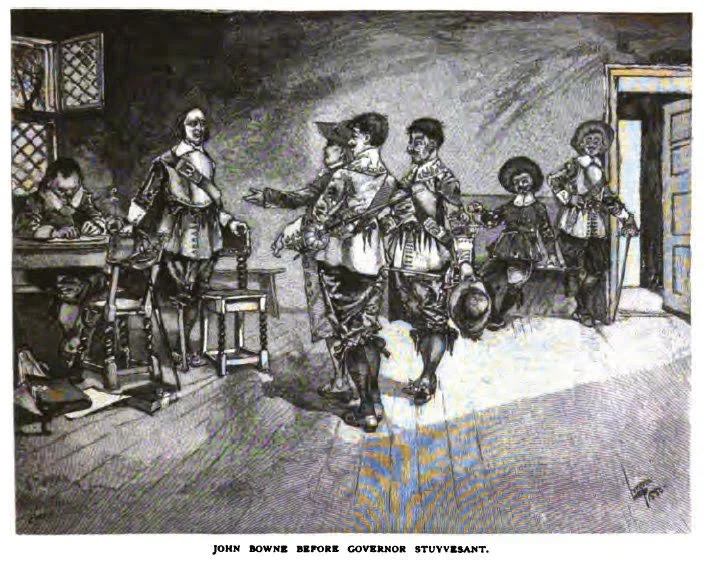
John Bowne appearing before Governor Stuyvesant, 1881 illustration from Scribner’s Magazine.
History often remembers liberty through grander scenes than the ones in which it is actually won.
It favors battlefields, assemblies, declarations, and famous names. Yet some of the most consequential struggles begin on a much smaller scale: in a town meeting, in a private room, in a house whose door remains open when authority demands that it be shut.
In seventeenth-century Flushing, that house belonged to John Bowne.
Bowne was not a soldier, and he was not a revolutionary in the later American sense. He was a resident of a small town in colonial Queens, a landowner, a family man, and eventually one of the most important defenders of liberty of conscience in early American history. His offense, in the eyes of the colonial government, was deceptively simple. He allowed Quakers to gather in his home for worship.
That decision brought him into direct conflict with Peter Stuyvesant, director-general of New Netherland. What followed was more than a local quarrel. It became a test of whether civil authority could police religious conscience, whether ordinary residents could resist that power, and whether an appeal from the colonial edge could force the imperial center to reconsider its own policies.
Remarkably, it could.
Flushing and the problem of authority
To understand John Bowne’s importance, it helps to understand Flushing itself.
Founded in 1645 as Vlissingen under Dutch rule, Flushing was unusual from the beginning. Although part of New Netherland, it had a substantial English population and occupied a kind of cultural borderland: Dutch in government, English in much of its settlement, and shaped by a local spirit that did not always submit easily to outside control. It was the sort of place where questions of power were rarely abstract. They appeared in everyday conflicts over law, religion, and the extent of local autonomy.
The town’s 1645 patent, granted under the Dutch West India Company, was especially important because it included language associated with liberty of conscience. That promise would later become central to Flushing’s resistance.
By the late 1650s, that resistance had already taken written form. In 1657, residents of Flushing signed the Flushing Remonstrance, protesting Stuyvesant’s persecution of Quakers and insisting that they should not be forced to participate in religious oppression. The petition was bold, morally serious, and historically significant. But it did not end the conflict. Stuyvesant ignored its central appeal and continued to enforce restrictions on dissent.
It was in that sharpened atmosphere that John Bowne emerged as the town’s most consequential dissenter.
John Bowne enters the story
Born in England in 1627, Bowne eventually settled in Flushing and became part of a prominent local network through his marriage to Hannah Feake. He was not initially a Quaker. But as Quakerism spread through the region, Bowne became increasingly connected to the movement. His wife Hannah joined the Society of Friends and became a minister, and Bowne himself came to share, or at least strongly defend, the principle that peaceful worship should not be punished by the state.
What mattered most was what he did with that belief.
Bowne opened his home to Quaker meetings.
That may sound modest from a modern distance, but in the seventeenth century it was a direct act of resistance. Religious dissent in colonial America often unfolded not in public squares but in private houses—real rooms, among real families, under the watch of suspicious authorities. To host a prohibited meeting was to turn domestic space into contested ground. It meant that a home could become the site of surveillance, arrest, and punishment.
Bowne understood the risk. He acted anyway.
The arrest, imprisonment, and exile
Stuyvesant’s government took notice.
In 1662, John Bowne was arrested for allowing Quakers to gather in his house. He was fined and imprisoned. When he refused to stop, the colonial authorities escalated further. Bowne was sentenced to banishment from New Netherland and sent across the Atlantic to answer for himself before the directors of the Dutch West India Company.
At first glance, this might have seemed the end of the matter. A local dissenter had been overpowered by colonial government. The machinery of enforcement had functioned exactly as intended.
But this is where Bowne’s story becomes extraordinary.
Instead of disappearing into silence, he appealed.
That appeal was neither automatic nor easy. Bowne was not seeking leniency from a local magistrate. He was taking his case to the highest corporate-imperial authority over the colony, arguing in effect that Stuyvesant had exceeded his rightful power. It required money, endurance, connections, and unusual confidence that a distant authority might be more reasonable than the governor who had expelled him.
It was, in every sense, a daring move.
The appeal to Amsterdam
In 1663, Bowne presented his protest to the Dutch West India Company in Amsterdam. His case drew on more than personal grievance. It rested on a principle: that the liberties granted to Flushing, including its liberty of conscience, had been violated by Stuyvesant’s policy. In that sense, Bowne was not simply pleading for himself. He was forcing the imperial center to confront the inconsistency between the colony’s governing promises and the governor’s conduct.
He won.
The directors rebuked Stuyvesant and ordered greater moderation in religious matters. Their reasoning was not purely idealistic. The Dutch West India Company was a commercial body, and practical considerations mattered. A colony that drove away settlers through arbitrary persecution was not serving its own interests. Religious severity, in this view, could weaken population growth, social stability, and economic development.
Still, whatever mixture of motives informed the decision, the result was historically important. Stuyvesant could not suppress dissent without limit. Bowne’s appeal succeeded where local protest alone had failed.
He returned to Flushing vindicated.
Why Bowne mattered
That victory did not create full religious freedom overnight. New Netherland did not become a modern pluralist society in a single decision, and tolerance in the seventeenth century remained conditional, uneven, and often pragmatic. But Bowne’s case established something crucial in practice: colonial authority could be checked, conscience could be defended, and religious repression could be challenged successfully.
This is why John Bowne deserves more attention than he usually receives.
If the Flushing Remonstrance is the great text of early religious liberty in Queens, Bowne is one of its clearest human embodiments. He made the issue concrete. He showed what it meant not simply to condemn persecution in principle, but to refuse compliance in daily life, under pressure, with real penalties attached.
There is something strikingly modern in that, even though Bowne himself was not modern in worldview. He was a seventeenth-century man shaped by a deeply religious society. Yet his story asks questions that still feel familiar: What happens when the state intrudes into belief? What does it cost to defend unpopular people? When should a citizen refuse? And what remains when direct power lies overwhelmingly on the other side?
Bowne’s answer was persistence.
The Bowne House as historical witness
His house still carries that answer forward.
Today the Bowne House in Flushing is one of the most important surviving historic homes in New York City. Its importance lies not only in its age, but in what happened there. Within its walls, Quaker meetings were held that colonial authorities wanted suppressed. The house became an active site of nonviolent resistance, a place where the principle of liberty of conscience was not merely discussed but enacted.
That gives the house unusual historical force.
It is not simply an old structure preserved for architectural interest. It is a witness to one of the earliest successful struggles for religious freedom in what would become the United States. It reminds visitors that large historical changes are sometimes rooted in intensely local acts: a family deciding whom to welcome, a host refusing to exclude, a room filled with worshippers despite official prohibition.
In that sense, Bowne House is not just connected to history.
It is part of the argument itself.
Why John Bowne still matters to Queens
Bowne’s life also reminds us of something essential about Queens history.
So much of New York’s past is told through Manhattan institutions, national myths, or founding stories centered elsewhere. Queens can too easily be treated as peripheral, as though it simply received the forces of history after they were shaped somewhere more famous. But John Bowne’s story shows otherwise. In Flushing, ordinary residents confronted imperial power directly and, in this case, forced it to bend.
That makes Bowne more than a local curiosity.
He belongs to the larger American tradition of principled resistance long before the American Revolution. Long before independence was declared, people in places like Flushing were already arguing that power had limits, that promises of conscience mattered, and that government could not rightly command belief by force.
There is something especially compelling about the scale of his story.
No battlefield. No army. No high office. No monument raised in his own century.
Just a house, a meeting, an arrest, an exile, a voyage, an appeal, and a return.
Yet from those elements emerged something enduring.
John Bowne did not overthrow a government. He did something quieter and, in some ways, more lasting. He exposed the weakness of a government that believed force could govern faith. He proved that punishment did not always secure obedience. And he helped establish Flushing as one of the earliest proving grounds of religious liberty in American history.
All because he opened his door.
End Notes
Image
Unknown author. “John Bowne Appearing Before Governor Stuyvesant.” Scribner’s Magazine, May 1881. Public domain. File:John Bowne before Stuyvesant.jpg - Wikipedia
Literary
Bowne House Historical Society, “The Bownes,”
https://www.bownehouse.org/the-bownes
Bowne House Historical Society, “John Bowne’s Protest to the Dutch West India Company, 1663,”
https://www.bownehouse.org/john-bowne-petition
Bowne House Historical Society, “The Trials of John Bowne,”
https://www.bownehouse.org/trials-of-john-bowne
New York State Archives, material on the Flushing Remonstrance and John Bowne,
https://www.archives.nysed.gov
National Park Service, background on early religious liberty in Flushing,
New York History Blog, articles on Bowne, Flushing, and religious tolerance in New Netherland,
https://www.newyorkhistoryblog.org
Editor’s Note
This article is part of the Flushing local history series for the Queens History section of BreteMurphy.com.