Anchises and the Burden of the Future
Ancestry, descendants, and the responsibility of leaving material for others to build with
Anchises shows Aeneas the souls of future Romans. The future becomes a duty placed upon the living by those who will never meet them.
Aeneas descends to the underworld to find his father.
Anchises has died before reaching Italy. Aeneas mourned him deeply. Now, beyond the river and the fields of the dead, he finds him again.
Anchises is not merely waiting to embrace his son.
He is waiting to show him the future.
In a great pageant, Anchises points out the souls of Romans yet unborn: kings, lawgivers, generals, statesmen, reformers, ancestors, and figures of national memory. The vision culminates in Rome’s future mission—an ideal of governance, order, mercy, and power expressed in the famous command to “spare the conquered and subdue the proud.”
It is stirring.
It is also heavy.
Aeneas learns that his life is not only his own.
It belongs, in part, to people he will never meet.
The ancestors behind us
Every person inherits something.
A family story.
A language.
A neighborhood.
A faith.
A building.
A craft.
A debt.
A tradition.
An injury.
A civic institution.
A body of work begun by people who are now dead.
Inheritance is not always pleasant. Some of what we receive must be repaired, resisted, or refused. Not every tradition deserves preservation merely because it is old.
But no one begins from nothing.
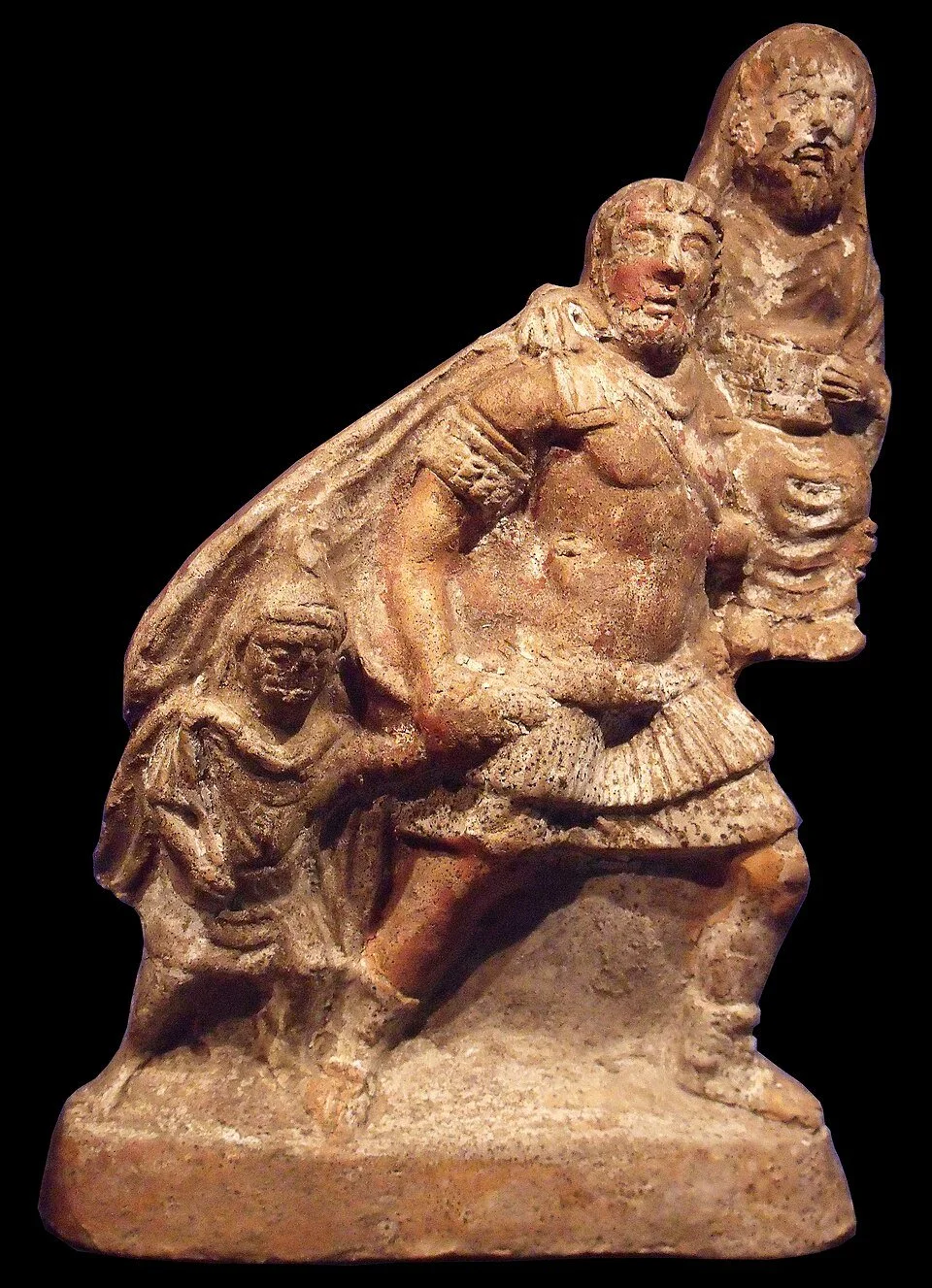
Aeneas carries his father out of burning Troy. This image becomes one of the great symbols of Roman pietas: the son bearing the past while leading his child, Ascanius, toward the future.
Anchises represents ancestry not as decoration, but as obligation.
The past is carried.
It must not be worshiped blindly. It must not be discarded casually. It must be understood.
The descendants ahead
Anchises’ vision introduces the other half of the moral equation.
The descendants are not yet born.
They cannot vote, complain, praise, thank, or defend themselves.
Yet their lives will be shaped by what Aeneas does.
This is one of the most difficult forms of charity: responsibility toward people who cannot reciprocate.
A person may restore a building he will never use.
Preserve an archive he will never read.
Plant trees under which he will not sit.
Maintain a lodge whose future members he will never meet.
Tell the truth about the past even when it complicates the story his own generation prefers.
Train younger people who may one day exceed him.
Build institutions strong enough to outlast his personality.
This is civic love.
It is not glamorous because the beneficiaries are absent.
That is why it matters.
Rome’s promise and danger
Virgil’s vision of Rome is not innocent.
The command to spare the conquered and subdue the proud is noble in aspiration. It is also spoken within an epic connected to imperial power. The reader knows that Rome’s history will include greatness and brutality, law and conquest, order and violence, mercy and domination.
A responsible reading should not turn the vision into simple celebration.
The future city is a moral claim, not a guarantee.
Every community tells itself that it exists for justice. The question is whether its institutions, laws, buildings, habits, and treatment of weaker people make that claim credible.
Rome may say it will spare the conquered.
Will it?
A lodge may say it forms better men.
Does it?
A city may say it welcomes newcomers.
Whom does it exclude?
A historical society may say it preserves memory.
Whose memory is absent?
The future vision is not self-congratulation.
It is a standard against which the living must be judged.
The Masonic inheritance
A lodge inherits more than furniture, rituals, charters, portraits, minutes, and building expenses.
It inherits a duty.
Those who came before maintained something long enough for the present members to receive it. They met, paid dues, performed ritual, taught candidates, cared for one another, endured hard times, adapted to change, and left records—sometimes imperfectly, sometimes nobly, but enough to make continuity possible.
The question is what present members will leave.
Not only a building.
Not only a list of officers.
Not only a photograph.
Will they leave a lodge more capable of teaching?
More welcoming?
More historically honest?
More charitable?
More serious?
More alive?
The future does not ask us to predict it.
It asks whether we will leave it better material to build with.
Endnotes and further reading
Virgil, Aeneid VI.679–892, on Anchises, the future Roman souls, and Rome’s mission.
Virgil, Aeneid II.707–729, on Aeneas carrying Anchises from Troy while leading Ascanius.
Servius, commentary on Aeneid VI, on Roman history, prophecy, and Virgil’s future pageant.
Related reading: “The Builders We Never See” and “The Future Is a Form of Charity.”