The Box From the Underworld
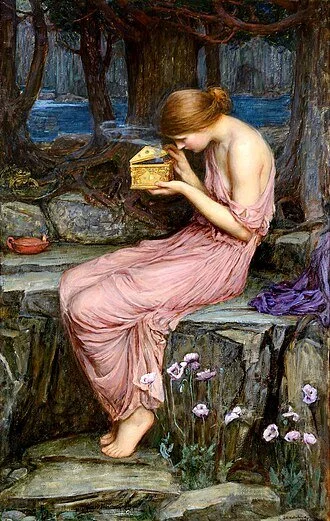
Psyche Opening the Golden Box (1903). Oil on canvas, John William Waterhouse
Why the soul always wants to open what it has been told to carry but not possess
Psyche succeeds at the underworld’s gate, receives the box, and is told not to open it. Then she opens it. The story is not about simple disobedience. It is about vanity, exhaustion, and the temptation to seize beauty rather than become worthy of it.
Psyche has come very far.
She has survived the sisters’ envy. She has lost Cupid. She has submitted herself to Venus’ cruelty. She has sorted the seeds, gathered the golden wool, and fetched the deadly water.
Then Venus gives her one final task.
Psyche must descend toward the realm of the dead, visit Proserpina, receive a box of beauty, and carry it back unopened.
It is a dangerous journey.
A tower gives Psyche instructions. Do not give in to pity at the wrong moments. Do not accept certain offers. Do not eat the food of the dead. Do not open the box.
Psyche succeeds.
Then she opens it.
This is not merely because she is curious.
It is because she is tired, wounded, insecure, and vain.
In other words, she is human.
The temptation of borrowed beauty
Psyche reasons that she should take a little beauty from the box for herself.
She has suffered. She has been worn down by labor. She wants to look more beautiful when she sees Cupid again. She wants to become worthy of his love by improving her appearance.
The reasoning is understandable.
It is also tragic.
Psyche still believes beauty can be possessed as an object. She thinks it can be taken, applied, worn, and used to secure love.
The box contains no cosmetic reward.
It contains deathlike sleep.
The image is sharp.
The soul that tries to seize beauty as a possession falls asleep to real beauty.
A person can become so concerned with appearing desirable, successful, virtuous, enlightened, powerful, or admired that he loses contact with the qualities that would make him genuinely lovable or worthy.
He wants the appearance of transformation without the patience of transformation.
He wants the wings without the soul’s education.
He wants the Fleece without the obligations.
He wants the title without the work.
The box closes.
The sleep begins.
Carrying versus possessing
Some things are given to us to carry, not to possess.
A responsibility.
A confidence.
A symbol.
A tradition.
A grief.
A piece of knowledge.
A title.
A person’s trust.
A person may be entrusted with these things. He may have to protect, transmit, interpret, or serve them. But the moment he treats them as his private property, he risks corrupting the gift.
Psyche is asked to carry the box.
She tries to possess its contents.
That is the difference.
The Masonic connection is clear but should not be exaggerated. A Mason receives symbols, teachings, duties, and responsibilities. He is not their owner. He is their steward.
The question is not, “What can I get from this?”
It is, “What has been placed in my care, and what does that care require?”
The soul becomes mature when it learns the difference.
The sleep of vanity
Vanity is not merely liking one’s reflection.
It is the belief that one’s appearance to others is the final measure of worth.
It can take many forms.
The person who needs to be seen as intelligent.
The person who needs to be seen as humble.
The person who needs to be seen as indispensable.
The person who needs to be seen as spiritually advanced.
The person who needs to be seen as wounded, dangerous, successful, fashionable, authentic, or misunderstood.
Vanity is inventive. It can wear work clothes or ceremonial dress. It can appear in an expensive suit or in the proud refusal to own one.
Psyche’s sleep is vanity’s natural condition.
The self becomes so absorbed in the image it wants to project that it loses wakefulness to what is real.
A person may spend years cultivating an appearance and never ask whether he has become more truthful, loving, courageous, or wise.
He has beauty in the box.
He is asleep beside it.
Cupid’s return
Cupid eventually returns.
He has recovered from the wound caused by Psyche’s lamp. He finds her asleep, brushes away the sleep, returns it to the box, and awakens her.
This is not a reward for her flawless performance.
Psyche has failed again.
But the story does not end with failure.
Love awakens what vanity has put to sleep.
This is one of the tale’s most generous insights. The soul’s development is not a straight line. It learns, fails, repeats, falls asleep, receives help, and begins again.
The goal is not never to err.
The goal is to become capable of being awakened.
The box contains no beauty for Psyche because beauty cannot be stolen from the underworld and worn like perfume.
Beauty must become a form of life.
Endnotes and further reading
Apuleius, Metamorphoses 6.17–6.22, on Psyche’s descent, the box from Proserpina, and her deathlike sleep.
On Psyche’s curiositas and her moral development, see scholarship on the tale’s philosophical ambiguity.[2][4]
Related reading: “The Symbol Is Not the Thing” and “The Apron, the Garment, and the Person Wearing It.”