Cupid and Psyche Inside the Donkey’s Story
Love, humiliation, and Apuleius’ double education of the soul
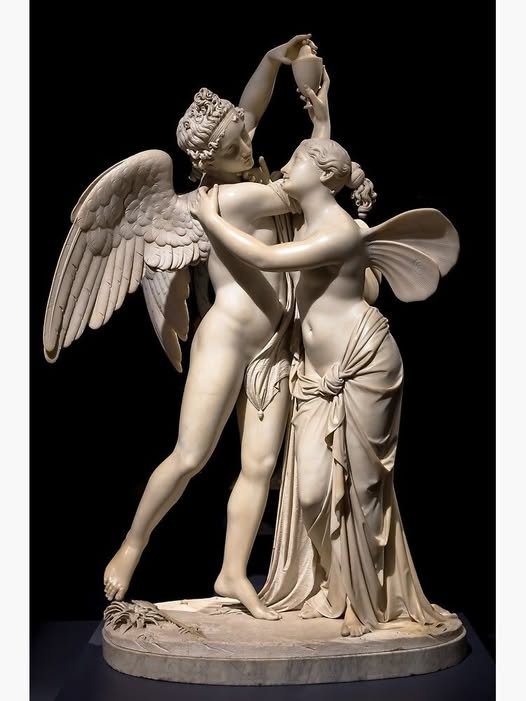
Apuleius places the tale of Cupid and Psyche inside Lucius’ larger story. One narrative follows a soul learning to love; the other follows a man learning, through degradation, to become human again.
Apuleius does something remarkable.
In the middle of Lucius’ donkey story, he places the long tale of Cupid and Psyche.
At first, this may seem like a delightful interruption. The novel already contains multiple embedded stories, gossip, adventures, frauds, sexual mishaps, magical incidents, and enough narrative turns to make a modern streaming service nervous. Cupid and Psyche is the grandest of these inset tales.
But its placement matters.
Lucius is listening to a story about Psyche while he is himself on the path toward becoming something like a soul in need of rescue.
Psyche learns through love, loss, labor, humility, and divine help.
Lucius learns through curiosity, degradation, fear, endurance, religious conversion, and divine help.
The tales do not mirror each other perfectly.
They illuminate each other.
Two kinds of curiosity
Psyche wants to see Cupid.
Lucius wants to become an owl.
Both believe that hidden knowledge or extraordinary experience will solve something in them.
Psyche’s curiosity arises from fear, jealousy, and the desire to know the beloved on terms she can control.
Lucius’ curiosity arises from vanity, restlessness, excitement, and the desire to escape ordinary humanity.
Both cross a boundary.
Both suffer.
Both learn that knowledge cannot be possessed safely without moral preparation.
The difference is in their journeys afterward.
Psyche is given tasks that gradually form discernment, patience, restraint, humility, and courage.
Lucius is subjected to an ass-life that strips away status, control, dignity, and the fantasy of self-sufficiency.
Psyche is educated through labor.
Lucius is educated through humiliation.
Neither path is easy.
Both reveal that transformation is not the same as getting what one initially wants.
Two forms of desire
Cupid and Psyche concerns love that begins in concealment and possession but becomes capable of union.
The Golden Ass concerns curiosity that begins in appetite and spectacle but becomes capable of devotion.
Psyche must learn that love cannot be seized by a lamp and knife.
Lucius must learn that hidden power cannot be seized by ointment.
Psyche opens a box and falls asleep because she wants beauty for herself.
Lucius reaches for wings and receives hooves because he wants transformation for himself.
Both stories expose the danger of desire that has not yet become wise.
But both stories also preserve hope.
Desire can be educated.
The soul can recover.
The self can become capable of relation to something greater than appetite.
The divine help neither can command
Psyche is helped by ants, a reed, an eagle, Cupid, Jupiter, and finally the gods.
Lucius is helped by Isis.
Neither earns divine aid in a simplistic sense. Neither completes a moral checklist and receives a stamped certificate of spiritual maturity.
They are helped because the stories insist that the soul cannot rescue itself by private cleverness alone.
This is one of Apuleius’ deepest themes.
Human effort matters. Psyche must complete tasks. Lucius must endure, pray, obey, and enter a new life.
But effort is not self-sufficiency.
A person may need help from friends, teachers, traditions, communities, beauty, ritual, discipline, grace, or whatever language best names the reality that draws him beyond his private limits.
The prideful self wants to be self-made.
The restored self learns gratitude.
Love and humanity
Psyche’s final gift is immortality.
Lucius’ final gift is human form.
These are not the same. Yet they belong together.
Psyche learns that the soul cannot live by possession alone. Love becomes something larger than appetite, fear, and control.
Lucius learns that humanity cannot be taken for granted. Human form is not merely a biological category. It involves responsibility, gratitude, moral attention, and the capacity to respond to another person as more than an instrument.
Psyche learns to love.
Lucius learns to become human again.
Both learn that the self is not completed by getting what it wants.
It is transformed by becoming capable of what is good.
The reader’s place
Apuleius does not allow the reader to stand comfortably outside either story.
We are Psyche when we let fear turn inquiry into betrayal.
We are Lucius when we mistake novelty for wisdom.
We are the sisters when envy calls itself concern.
We are Venus when wounded vanity gives others impossible tasks.
We are the people who treat the ass as a useful object rather than a suffering creature.
We are, at times, Cupid asleep and wounded by the lamps we invited into our lives.
The novel is comic because human beings are ridiculous.
It is philosophical because the ridiculousness matters.
Psyche learns that love cannot be possessed.
Lucius learns that humanity cannot be taken for granted.
The reader is left with the harder question:
What, exactly, are we learning from the desires that currently govern us?
Endnotes and further reading
Apuleius, Metamorphoses Books 4–6, on Cupid and Psyche; Books 1–3 and 11, on Lucius’ curiosity, transformation, and restoration.
On the philosophical relationship between the Psyche tale and Lucius’ larger narrative, see scholarship on Apuleius’ literary and Platonic complexity.[2][4]
On Platonic readings of Psyche and the soul’s education through love, curiosity, and transformation, see modern studies of Apuleius’ Cupid and Psyche.[5]
Related reading: “The Soul and Love” and “The Symbol Is Not the Thing.”