The Builder of the Labyrinth
Daedalus, Minos, and the moral problem of useful skill
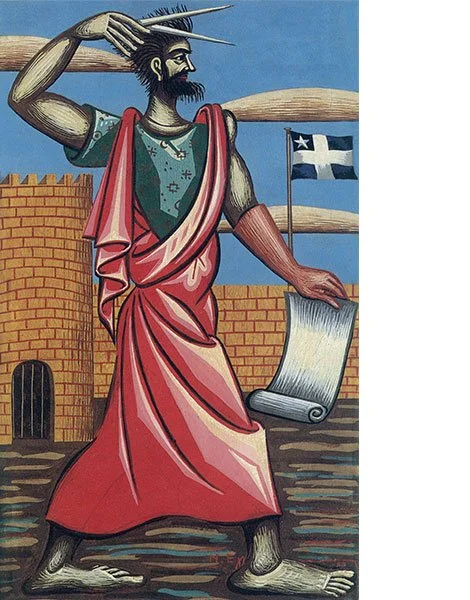
Daedalus builds the most famous prison in mythology. It is technically brilliant, politically useful, and morally horrifying. The Labyrinth asks what a craftsman owes to the people trapped inside his work.
The Labyrinth is one of the great architectural achievements of myth.
It has no obvious walls in the ordinary sense. Its corridors turn and return. It defeats memory. It removes orientation. A person may walk for hours and discover that every path has led him back toward confusion. It is a building designed not simply to contain a prisoner, but to make escape conceptually impossible.
It is also a prison.
King Minos commissions Daedalus to build it after the birth of the Minotaur: the monstrous offspring of Minos’ wife Pasiphaë and a bull sent by Poseidon. The creature is dangerous, shameful, politically embarrassing, and impossible to display at court without ruining the atmosphere.
Minos’ answer is architectural.
Hide the problem.
Daedalus provides the design.
This is the first Daedalian question:
What does a craftsman owe to the people who will live—or die—inside what he creates?
A problem solved without being healed
The Labyrinth is technically successful.
It contains the Minotaur.
It protects Minos’ reputation.
It conceals scandal.
It solves the immediate problem.
But it does not heal the disorder that produced the problem. It does not restore justice. It does not free the innocent. It does not address Minos’ failures, Poseidon’s anger, Pasiphaë’s suffering, or the terrible human cost of the Athenian youths sent into the maze as tribute.
It merely builds a more elaborate structure around the consequences.
This is an ancient problem with a modern career.
A city can solve homelessness by moving people out of sight.
An institution can solve misconduct by burying records.
A family can solve conflict by refusing to speak of it.
A company can solve a moral problem by hiring better public relations.
A lodge can solve declining participation by improving refreshments while avoiding the harder question of whether members are receiving meaningful instruction, fellowship, and purpose.
The Labyrinth is not only a building.
It is the architecture of avoidance.
The craftsman and the king
Daedalus does not create the moral disaster. Minos does not become innocent because he delegates the construction.
This is the difficult relation between power and craft.
The king commands.
The craftsman makes possible.
A builder may say, “I only built what I was asked to build.”
The ruler may say, “I only used the tools available.”
Neither statement settles the matter.
Daedalus possesses skill. Minos possesses authority. Together they create a structure that becomes more powerful than either man’s original intention.
This is why technical work is never purely technical.
An architect designs a building that shapes how people move, gather, enter, leave, see, hide, and belong.
An engineer designs systems that distribute risk and safety.
A writer builds narratives that may dignify or diminish people.
A historian builds a public memory.
A ritualist builds patterns of attention.
A leader builds conditions in which others can flourish or become trapped.
The craftsman cannot control every use of his work. But he cannot pretend that use is none of his concern.
The Minotaur as the hidden cost
The Minotaur is often treated as the monster inside the maze.
But the monster is also the reason the maze exists.
It represents a hidden consequence: a truth the powerful do not wish to confront openly.
Every Labyrinth has a Minotaur.
A hidden debt.
An unexamined grievance.
A structure of exploitation.
A public lie.
A wound passed through generations.
A person or group made invisible because their suffering would complicate the official story.
The maze becomes necessary when the truth has become inconvenient.
This is why the myth remains useful for moral reflection. It asks whether we are building structures to solve human problems—or merely to hide the people and consequences those problems produce.
The Masonic builder
Freemasonry uses the language of building because building is moral.
A structure requires plan, measure, labor, relation, materials, skill, and responsibility. The working tools remind the builder that he is not merely shaping stone. He is shaping conduct.
Daedalus offers the darker side of that image.
A building may be impressive and still be unjust.
A plan may be ingenious and still be cruel.
A solution may work and still leave the moral problem untouched.
The question is not only, “Can this be built?”
It is, “What kind of life will this building make possible?”
The Labyrinth is a masterpiece of design.
It is also a reminder that a structure can be perfectly built and morally wrong.
Endnotes and further reading
Apollodorus, Library 3.1.4, on Daedalus, the Labyrinth, and the Minotaur.
Ovid, Metamorphoses Book 8, on Daedalus, the Labyrinth, and the flight from Crete.
Pausanias, Description of Greece, on Daedalus’ reputation as a craftsman and inventor.
Plato, Gorgias and Republic, on the difference between technical skill and justice.
Related reading: “The Craftsman’s Responsibility.”