Icarus and the Failure of Measure
Why flying too high is not the whole story
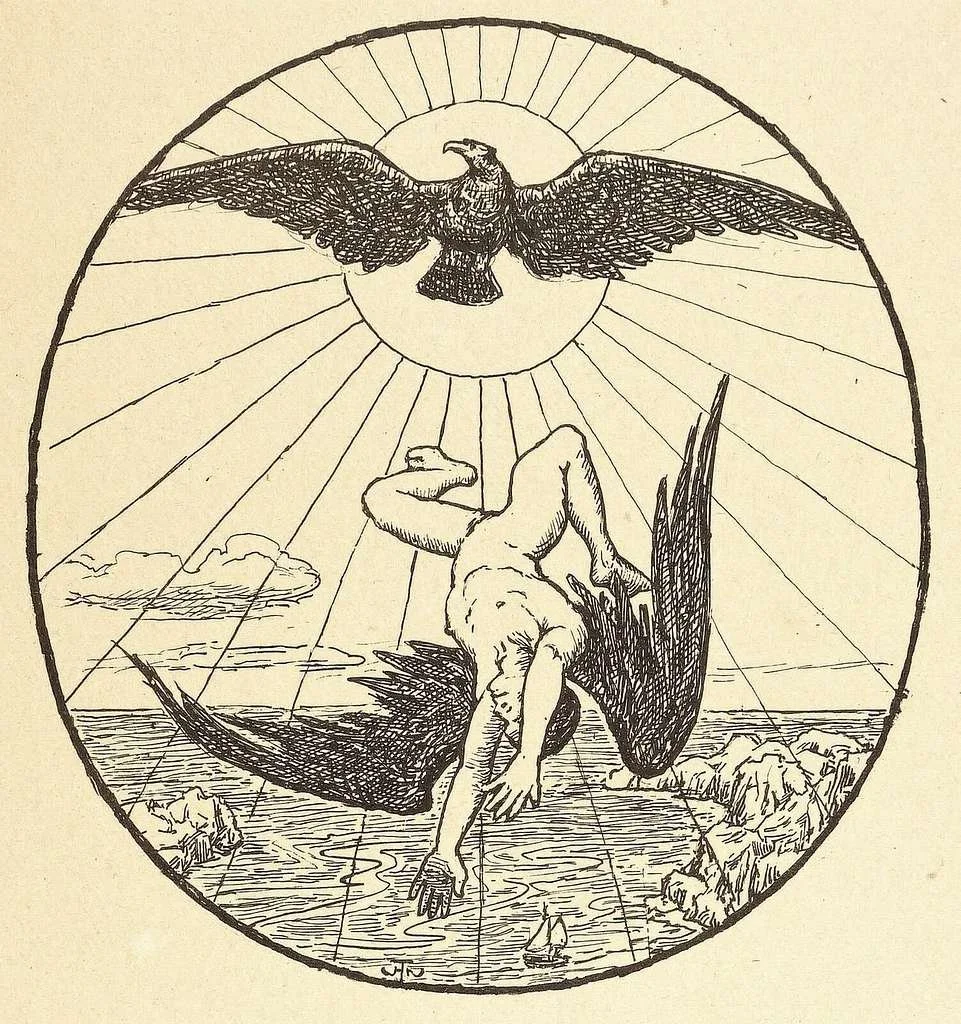
Icarus does not fail because he aims upward. He fails because he cannot yet understand the relation between freedom, power, risk, and measure.
The familiar version of Icarus is simple.
He flies too close to the sun.
The wax melts.
He falls.
Do not be ambitious.
This is a tidy moral. It is also too small.
Daedalus does not tell Icarus merely not to fly high. He tells him to fly neither too low nor too high. Too low, and the sea’s moisture will weigh down the wings. Too high, and the sun will melt the wax.
The instruction is about measure.
Icarus must learn to fly in the middle.
This is not mediocrity.
It is proportion.
The danger of power before judgment
Icarus receives an extraordinary power before he has acquired the judgment necessary to use it.
This is familiar.
A young person receives money, influence, attention, freedom, technology, authority, charisma, sexual power, social status, or professional opportunity before he fully understands what each can do to his character.
The power is real.
The danger is not imaginary.
A person may use it well. Or he may become intoxicated by the sensation of having exceeded ordinary limits.
Icarus feels the exhilaration of flight. The ground recedes. The sea becomes small. The limits that once contained him appear conquered. He rises.
The problem is not that he experiences joy.
The problem is that joy becomes self-forgetfulness.
He no longer remembers the wax.
He no longer remembers the instruction.
He no longer remembers that freedom includes conditions.
The wings feel like his own power rather than a fragile craft held together by material, knowledge, and care.
This is the failure of measure.
The wax in every achievement
Every achievement has wax.
A position of authority has limits.
A body has limits.
A relationship has limits.
A reputation has limits.
A technical system has limits.
A tradition has limits.
A person may become very successful and still depend upon fragile things: health, trust, time, friendship, public confidence, moral credibility, institutional support, and the willingness of others to continue working with him.
The successful person often forgets the wax.
He begins to think that his ascent proves invulnerability.
Then the structure fails—not necessarily because ambition was wrong, but because ambition stopped asking what holds it together.
This is one reason humility is practical.
Humility remembers the wax.
It knows that achievement depends upon materials, people, conditions, and forms of support that cannot be taken for granted.
Daedalus’ responsibility
The story also raises a question about Daedalus.
He gives Icarus wings.
He gives him instruction.
But is instruction enough?
A parent, teacher, mentor, leader, or institution may equip someone with power. It may provide rules, warnings, and procedures. But it must also ask whether the person has been formed enough to use what he has been given.
This does not mean refusing all freedom until no risk remains. That would leave everyone in the Labyrinth.
It means recognizing that education is more than technical instruction.
A person may be taught how to use a tool without being taught what it is for.
He may be taught how to rise without being taught how to remain human at altitude.
This is why moral formation matters.
The wings must be matched by judgment.
The Masonic middle
The Masonic reader will see a natural analogy in the idea of due bounds.
The compasses do not forbid desire, ambition, or action. They place them within limits appropriate to a well-ordered life.
The level does not flatten human differences. It reminds us that distinction must not erase dignity.
The plumb does not prevent movement. It establishes uprightness.
The square does not make every angle identical. It tests relation.
Icarus does not fall because he seeks height.
He falls because power arrives before judgment has learned how to guide it.
The lesson is not “Never fly.”
It is “Learn what flight requires.”
Endnotes and further reading
Ovid, Metamorphoses 8.183–235, on Daedalus’ wings, his warning to Icarus, and Icarus’ fall.
Aristotle, Nicomachean Ethics Book II, on virtue as a mean relative to us.
Plato, Phaedrus, on the winged soul, ascent, and the need for reason to govern the soul’s powers.
Related reading: “Why the Middle Way Is Not Mediocrity.”