Why Orpheus Looked Back
Doubt, possession, and the need for proof before trust has ripened
Orpheus has almost succeeded. He has sung before the dead, been granted Eurydice’s return, and reached the final stretch. Then he turns. The question is not merely why he failed, but what human need makes looking back so difficult to resist.
Orpheus has done the impossible.
He has entered the underworld alive.
He has sung before the rulers of death.
He has moved Hades and Persephone.
He has received permission to lead Eurydice back to the world of the living.
All he must do is walk forward.
Do not look back.
It is a simple instruction.
That is why it is impossible.
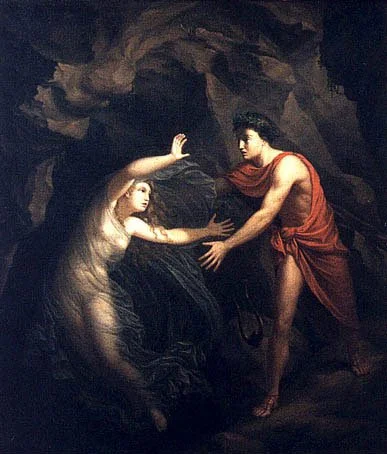
Near the end of the journey, Orpheus turns.
Eurydice vanishes.
The myth leaves us with one of the most painful gestures in literature: the lover who almost brings back what he has lost, then loses it again because he needs to see.
The hunger for proof
Why does Orpheus look back?
The sources and later interpreters have supplied many answers.
He fears that the gods have deceived him.
He doubts whether Eurydice is truly following.
He wants to see her.
He cannot bear the uncertainty.
He is impatient.
He is possessive.
He loves too much.
He trusts too little.
The story’s power comes from the fact that all of these may be true.
Orpheus has been asked to trust what he cannot verify.
This is difficult for anyone.
We want proof.
We want to know that the person is still there, that the promise is still valid, that the unseen good is real, that the future will arrive as expected, that the work has not been wasted.
The instruction “do not look back” asks Orpheus to live for a time without this proof.
He cannot do it.
Love and possession
The deeper problem is not sight.
It is possession.
Orpheus wants Eurydice near him. He wants to see her. He wants the assurance that she is really returning and belongs again to the visible world he inhabits.
This is understandable.
It is also the point at which love becomes trapped by fear.
A mature love does not cease to desire presence. It does not become indifferent to loss. But it learns that another person cannot be possessed as an object of certainty.
Eurydice is not a thing to be verified.
She is a person moving behind him under conditions he cannot control.
The act of turning transforms her from someone he must trust into something he must confirm.
The confirmation destroys the return.
This is a harsh myth because it gives us no easy comfort. The impulse to look back is deeply human. We want evidence. We want reassurance. We want to know that the person, promise, future, or healing we hope for is actually following us.
But some forms of return require walking forward before the proof arrives.
The return after grief
The story can also be read as a discipline of grief.
A grieving person often looks back. He revisits the last words, the last room, the final photograph, the missed sign, the alternate future, the detail that might have changed everything.
This is not wrong. Memory is part of love.
But there is a point at which looking back becomes a refusal to return to life.
The person keeps turning toward the underworld, trying to make the lost thing visible again. The result is not recovery. It is renewed disappearance.
The myth does not tell us to forget.
It tells us that memory must be carried differently.
Eurydice cannot be brought back through the demand that she become physically present again.
The task is to allow love to become memory, gratitude, song, moral commitment, and a changed way of living.
This is not a lesser form of love.
It is the only form grief can sustain.
The Masonic discipline of trust
Freemasonry uses images of darkness, Light, passage, labor, and gradual instruction. The Masonic reader may recognize that some forms of understanding cannot be forced by immediate demand.
A person may want to know everything at once. He may want proof before practice, certainty before trust, illumination before discipline, result before labor.
But moral education often works differently.
One must walk.
One must do the next right thing.
One must keep faith with the work before receiving every assurance that the journey will end as hoped.
This is not blind obedience. It is disciplined trust.
Orpheus does not look back because he does not love Eurydice.
He looks back because love has not yet learned how to trust what it cannot possess.
Endnotes and further reading
Virgil, Georgics 4.490–527, on Orpheus’ backward glance and Eurydice’s second loss.
Ovid, Metamorphoses 10.55–85, on the prohibition and Orpheus’ turning.
Plato, Symposium and Phaedrus, on desire, possession, beauty, and the education of eros.
Related reading: “Why Psyche Was Told Not to Look” and “The Soul and Love.”