The Black Horse Is Not the Enemy
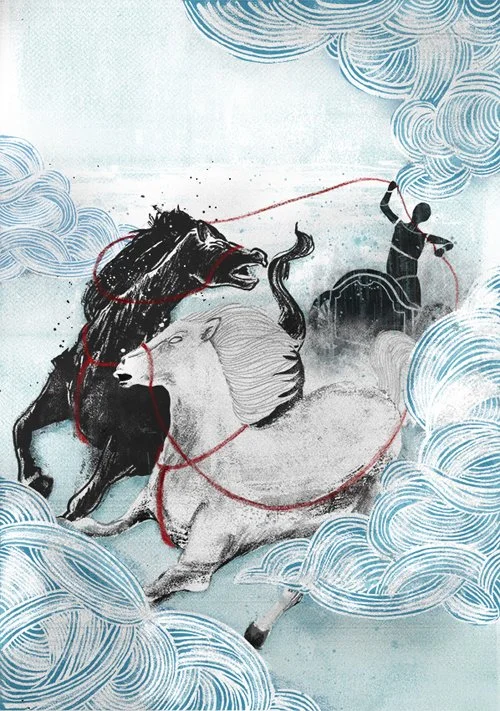
Dwie Judha Satria, Animalia
Plato, desire, and the difference between discipline and repression
Plato’s unruly horse is not a creature to be killed. It is energy without education. The work of the soul is not to become less alive, but to become capable of directing its strength.
There are two common mistakes about self-mastery.
The first is that a good life means doing whatever one desires.
The second is that a good life means desiring nothing.
Plato rejects both.
In the Phaedrus, the unruly horse pulls toward immediate beauty, bodily possession, gratification, and self-willed pleasure. It is difficult to govern. It resists shame. It does not enjoy being told that there is a larger purpose than its current enthusiasm.
The temptation is to treat this horse as the enemy.
But Plato does not tell the charioteer to kill it.
He tells him to govern it.
Desire gives the soul motion
A person without desire does not become wise automatically.
He may simply become tired.
Desire is what makes a person seek, love, study, create, build, serve, compete, pursue beauty, raise children, defend friends, write books, and leave a warm chair for a difficult but necessary task.
The problem is not desire.
The problem is desire without order.
The black horse has strength. It has urgency. It has appetite. It has the power to move the chariot. But it does not know where it ought to go. Left unguided, it confuses intensity with truth and possession with love.
This is why Plato’s image remains useful. A person may have tremendous energy and still move in the wrong direction. He may be passionate, charismatic, productive, ambitious, romantic, spiritually intense, and entirely governed by what he wants at the moment.
This is not freedom.
It is being pulled.
Repression is not discipline
Discipline is often described as though it were a grim campaign against everything enjoyable.
It is not.
Discipline does not say, “I have no appetite.”
It says, “My appetite does not decide everything.”
It does not say, “I never become angry.”
It says, “My anger must answer to justice before it acts.”
It does not say, “I have no ambition.”
It says, “My ambition must serve something more than my need to be seen.”
It does not say, “I do not want pleasure.”
It says, “Pleasure is a guest, not the sovereign of the house.”
This is what the charioteer learns.
The lower horse must not be annihilated. It must be trained. Its force must become available for the journey rather than destructive of it.
The same principle appears in the symbolic language of the rough ashlar. The stone is not worthless. It is material capable of form. To smash it into dust would not improve it. The work is to shape it, square it, fit it, and place it in relation to the larger structure.
So too with desire.
The goal is not to become less human.
It is to become less governed by the least mature part of one’s humanity.
The force that becomes love
The Phaedrus is a dialogue about eros—love, desire, longing, attraction, and the soul’s response to beauty.
Plato’s argument is not that bodily attraction is meaningless. It is that beauty can awaken something deeper than possession. The sight of beauty may remind the soul of what it once saw before embodiment: the intelligible realities of justice, temperance, wisdom, and true beauty.
This is why desire can become a source of ascent.
It begins with attraction.
It need not end there.
The charioteer who sees beauty may initially struggle because the lower horse wants to seize and possess. But the higher horse responds with reverence. Reason remembers. A conflict begins. If the charioteer succeeds, desire is gradually transformed from appetite into a more disciplined love.
This is not easy. Plato is too honest to suggest that it is.
But it is possible.
A person can learn to admire without consuming, to love without possessing, to desire excellence rather than merely recognition, and to allow beauty to raise rather than enslave him.
The black horse in ordinary life
The black horse does not appear only in romance.
It appears whenever immediate satisfaction begins making moral decisions.
It appears when anger wants the last word.
When hunger for praise makes a person betray a friend.
When fear of embarrassment prevents an apology.
When comfort becomes an excuse not to act.
When the need to win becomes more important than the truth.
When distraction makes a person forget what he claims to value.
When a title becomes more important than the responsibility attached to it.
The black horse is not some strange creature that lives in myth.
It is the part of us that says, “Now,” when wisdom says, “Wait.”
It is the part that says, “Mine,” when justice says, “Consider.”
It is the part that says, “I deserve,” when humility says, “What do I owe?”
The reins are habits
No one learns to govern desire through a single heroic act.
The reins are habits.
They are formed through study, friendship, reflection, prayer or meditation, bodily discipline, honest conversation, service, beauty, good example, and the small repeated decisions by which a person proves to himself that he need not obey every impulse.
The charioteer does not become competent by shouting at the horses.
He becomes competent by learning their nature.
A person who knows where he becomes reckless, needy, proud, resentful, seductive, frightened, or easily flattered is not weak. He has begun the work of driving.
The black horse is not the enemy.
The enemy is the soul that has forgotten it is meant to hold the reins.
Endnotes and further reading
Plato, Phaedrus 253c–254e, on the differing qualities of the two horses and the charioteer’s struggle to govern them.
Hermias, Commentary on Plato’s Phaedrus, on the soul’s powers and the philosophical meaning of the chariot image.[2][3]
Plotinus, Ennead I.2, “On Virtues,” on civic and purificatory virtue.[5][6]
Porphyry, Sentences 32, on the hierarchy of virtues and the purification of passion.[7][8]
Related reading: “Heracles Within: The First Monster Is Already Inside the House.”