The Sisters Who Explain Everything
Envy, suspicion, and the voices that make the soul betray what it loves
Envy rarely announces itself as envy. More often, it arrives with concern, a warning, and a detailed explanation of why someone else’s happiness cannot possibly be real.
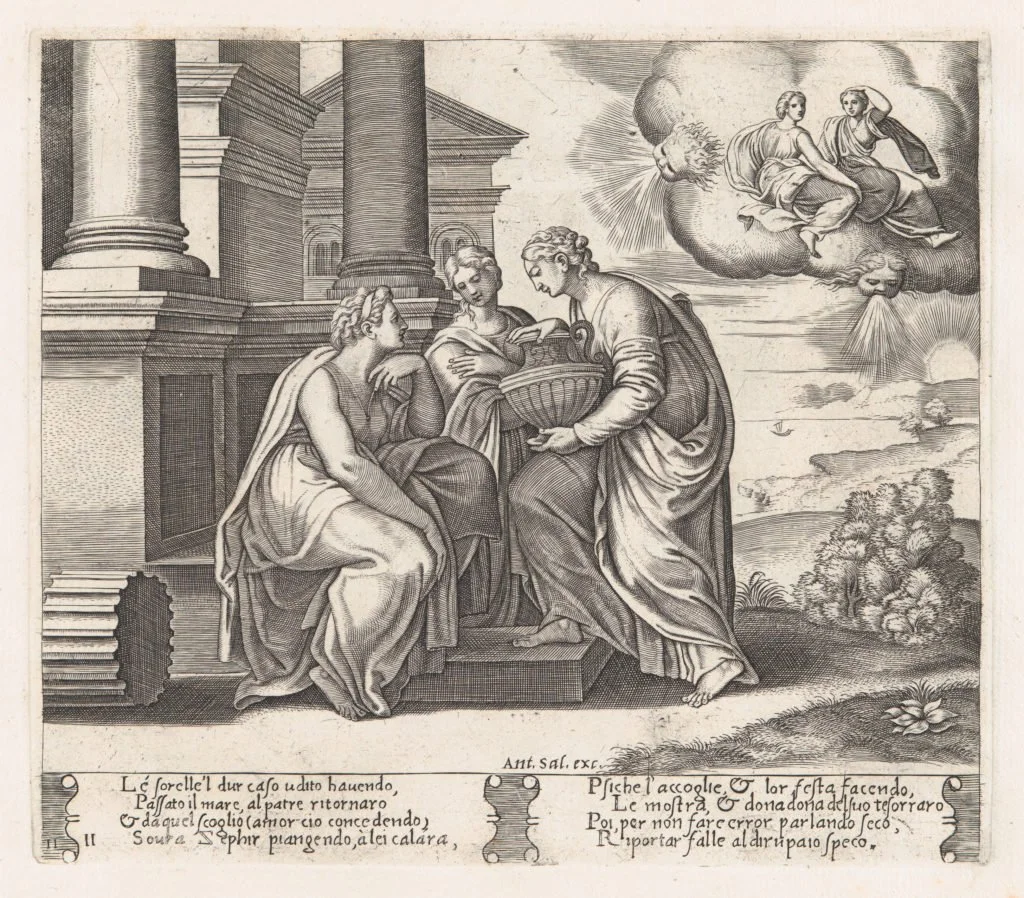
Psyche’s sisters are not villains in the uncomplicated sense.
They arrive at the palace grieving for a sister they believe has been sacrificed to a monster. They find her alive, richly cared for, and living in a splendor they had not imagined. This should be cause for relief.
Instead, it becomes intolerable.
Psyche is younger, more beautiful, and now apparently happier than they are. She has escaped the fate they expected. She possesses wealth, love, attention, and a mysterious happiness that they cannot share.
The sisters have a choice.
They can rejoice.
Or they can explain why Psyche’s happiness must be fraudulent.
They choose explanation.
Envy’s preferred vocabulary
Envy is rarely honest enough to say, “I am unhappy because you have received something good.”
It prefers more respectable language.
“I am concerned.”
“I only want to protect you.”
“This seems too good to be true.”
“You should not trust someone who keeps secrets.”
“You deserve to know what is really happening.”
There is enough truth in these statements to make them dangerous.
Of course Psyche should not be naïve. Of course secrecy can conceal harm. Of course a person should not surrender judgment merely because circumstances appear pleasant.
But the sisters do not speak from disinterested wisdom.
They speak from envy.
Their goal is not Psyche’s safety. It is the destruction of the good she has received because it has become a painful mirror of what they lack.
This is a difficult truth about human counsel.
The advice that sounds most concerned is not always the advice most concerned with our good.
The poison of interpretation
The sisters do not need to enter Psyche’s bedroom, seize the lamp, or compel her to act.
They only need to give her a different interpretation.
They take the unseen husband and turn him into a monster.
They take secrecy and turn it into evidence of predation.
They take Psyche’s uncertainty and turn it into fear.
The facts have not changed. The emotional meaning of the facts has changed completely.
This is how much damage interpretation can do.
A person can live in a good friendship until someone convinces him that kindness is manipulation.
He can work in a healthy lodge until someone persuades him that every correction is a personal attack.
He can value a tradition until another person teaches him to see only hypocrisy.
He can appreciate a symbol until someone tells him that he has not truly understood it unless he adopts their suspicion, superiority, or private theory.
The soul is often not overthrown by argument alone.
It is overthrown by an interpretation that makes fear feel intelligent.
Plutarch’s flatterer and the envious counselor
Plutarch’s essay on distinguishing a flatterer from a friend belongs beside Psyche’s sisters.
The flatterer says what a person most wants to hear. The envious counselor says what a person most fears may be true. Both exploit something already present within the soul.
The flatterer feeds vanity.
The envious counselor feeds anxiety.
Both bypass judgment.
A true friend does neither. A true friend may warn, correct, or question, but he does so without the private pleasure of making another person smaller. He does not need the other’s happiness to fail in order to feel secure.
This is one of the tests of counsel:
Does the advisor become calmer when you flourish, or more agitated?
Does he help you see more clearly, or merely make you more suspicious?
Does he ask what is good for you, or does he make every situation confirm his own grievance?
The sisters cannot bear Psyche’s good fortune because they have allowed comparison to become a form of poison.
Brotherhood and the moral use of speech
This has an obvious relevance to fraternal life.
A lodge should be a place in which brethren can offer honest counsel. That requires trust. It also requires the discipline not to use concern as a disguise for rivalry, resentment, or the hunger to control.
A brother may need warning.
He may need correction.
He may need someone to tell him that he is making a mistake.
But the person who gives such counsel must examine his own motive. Does he seek the other’s good, or does he enjoy being the one who sees through him?
This is the difference between friendship and subtle cruelty.
The sisters’ tragedy is that they become unable to love Psyche’s happiness. Her good appears to them as an accusation against their own lives.
This is envy’s final cruelty: it makes another person’s joy feel like a personal insult.
Learning to hear wisely
Psyche’s story does not tell us to ignore all warnings.
It tells us to examine the source of the warning.
The wise listener asks:
Who is speaking?
What do they gain from my fear?
Are they offering evidence, or only atmosphere?
Are they helping me become more truthful, or more suspicious?
Does their counsel enlarge my judgment, or make me smaller?
Would they be glad if my life became more whole?
These are not cynical questions.
They are questions of moral hygiene.
Envy rarely says, “I want what you have.”
It says, “I am worried about you.”
Endnotes and further reading
Apuleius, Metamorphoses 5.9–5.27, on Psyche’s sisters, their envy, and their persuasion of Psyche.
Plutarch, Moralia, “How to Tell a Flatterer from a Friend,” on self-love, flattery, and false friendship.[5][6]
Aristotle, Nicomachean Ethics VIII–IX, on friendship and goodwill.
Related reading: “The Friend Who Will Not Applaud at the Wrong Time.”