Eurydice and the Lost Part of the Soul
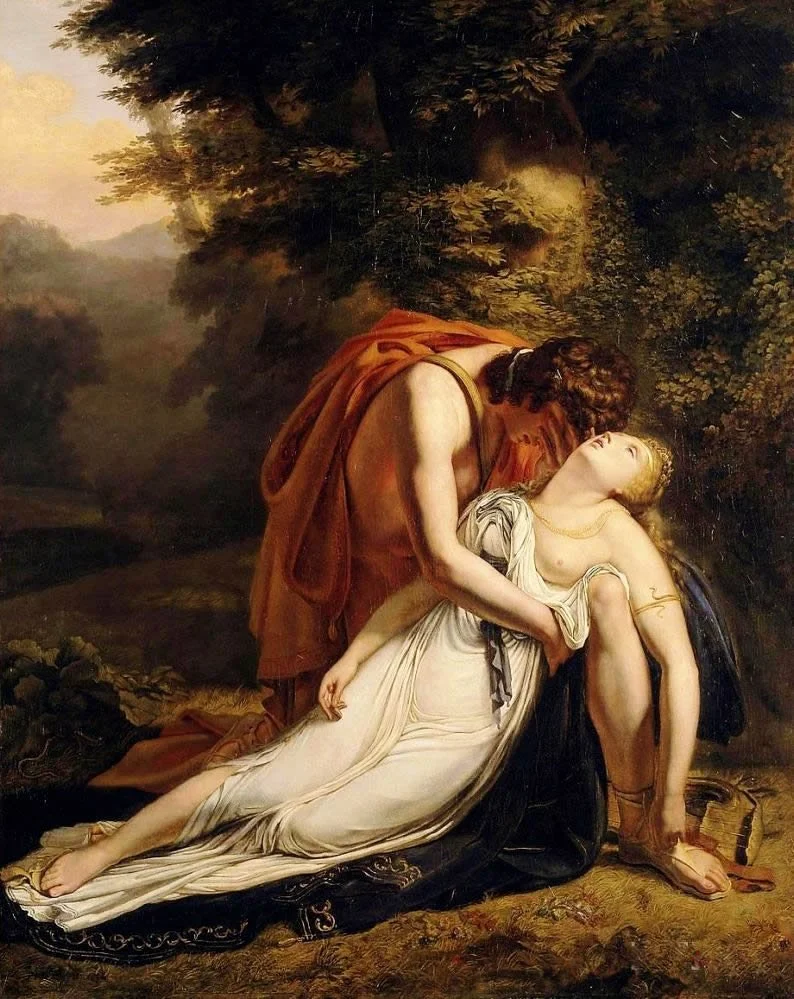
Memory, beauty, and what cannot be recovered by force
Eurydice may be read as memory, beauty, wholeness, or the part of the self lost through grief and time. But she cannot be restored through force, cleverness, or possession. The deepest loss requires another kind of fidelity.
Eurydice is often silent.
This is one of the difficulties of the myth.
Orpheus sings. Orpheus descends. Orpheus persuades the dead. Orpheus turns. Orpheus grieves. Orpheus becomes the subject of art, theology, poetry, opera, philosophy, and every later interpretation.
Eurydice appears, disappears, and leaves.
A careful reader should resist turning her into a mere symbol for the development of Orpheus.
She is a person in the story. She dies. She is desired. She is brought almost to the world of the living. She is lost again because of another person’s action.
That should remain visible.
At the same time, later philosophical and literary traditions have found in Eurydice an image of what grief makes inaccessible: beauty, memory, wholeness, innocence, youth, a lost future, or a part of the self that cannot be restored on command.
The interpretation can be fruitful if it is held lightly.
The lost self
There are losses after which a person says, “I am not the same.”
Sometimes this is spoken in despair. Sometimes in gratitude. Often in both.
A death, betrayal, illness, disaster, failure, migration, war, or profound change can divide the self into before and after. The earlier self remains in memory, but it cannot be recovered as though one were retrieving an object from a shelf.
Eurydice can become an image of that lost part.
Not because she is merely an idea.
But because loss often feels like walking ahead of something one loves, knowing it is near, unable to see it, and terrified that a single wrong movement will make it vanish.
The temptation is to recover the earlier self exactly.
To return to the old life.
To make the dead present in the old way.
To restore the relationship as it once was.
But some returns are impossible.
The question becomes whether the lost thing can take a different form in the life that remains.
The lost part and the music that remains
Orpheus cannot bring Eurydice back.
He can sing.
This is not consolation in the cheap sense. Music does not solve death.
But music gives loss form.
It makes grief communicable. It allows memory to become something shared rather than merely private pain. It turns the absent person into a presence within art, language, ritual, story, and moral commitment.
A person may not recover what was lost.
He may still become faithful to it.
He may live differently because of it.
He may preserve what was beautiful in the relationship.
He may protect others from the harm that caused the loss.
He may create something that carries the memory forward.
This is not the return Orpheus wanted.
It is the return available to mortals.
The danger of forcing recovery
The story warns against forcing recovery.
Orpheus has extraordinary gifts. He can charm the dead. He can move the rulers of Hades. Yet even he cannot command Eurydice’s return as if love entitled him to abolish every limit.
This is a difficult lesson for the modern imagination, which often assumes that every problem has a solution if we apply enough effort, technology, therapy, planning, money, or determination.
Some wounds need action.
Some injustices need repair.
Some relationships need honest work.
But some losses cannot be solved.
They must be carried.
The mature soul does not surrender to this fact passively. It learns to transform relation without pretending the loss is unreal.
It honors the dead.
It remembers.
It makes music.
It continues walking.
A careful Masonic reflection
The Masonic tradition is deeply concerned with memory, mortality, continuity, and the passage of human life. It teaches that death should not make life meaningless, nor should remembrance become merely sentimental.
Eurydice’s story can deepen this reflection.
The lost part of the soul is not recovered by pretending it was never lost.
It is honored by allowing memory to make us more faithful, more compassionate, more serious, and more alive to the duties that remain.
Some things return only when we stop trying to seize them.
Others do not return at all, but become part of the music by which we learn to live.
Endnotes and further reading
Virgil, Georgics Book 4, on Orpheus, Eurydice, and grief.
Ovid, Metamorphoses Book 10, on the second loss of Eurydice and Orpheus’ mourning.
Later Platonic and Renaissance readings of Orpheus may support symbolic interpretation, but they should be identified as later reception rather than direct ancient exegesis.[1]
Related reading: “Descent Is Not Defeat.”