The first time I really noticed the square and compasses, it wasn't in a lodge room. It was on a weathered headstone in a Queens cemetery, half-hidden by ivy, next to a name I didn't recognize. I knew it meant "Mason." I didn't know what that meant.
Years later, sitting in a lodge room for the first time, I learned that the square is not just a stonemason's tool. It is a reminder to square my actions with everyone I meet. The compasses, I was told, are about boundaries: knowing where my freedoms end and my responsibilities begin.
None of that was whispered in a dark room. It is written on Grand Lodge websites, in public books, and in plain view on buildings all over the world. What changed me wasn't the information. It was realizing I was expected to live it.
I'm a Freemason who leans toward the observant and symbolic style of lodge work: the kind that takes its time with ritual, sits with the symbols, and asks what they demand of us in ordinary life. On this site I write about Masonic symbols the way I try to understand them: honestly, conversationally, and without giving away anything that belongs inside the lodge.
This essay is the personal half of a two-part introduction. It covers what the symbols are, what Grand Lodges publicly say about them, how I read one, and where I stop. Part 2 asks the broader question of why tools and stones work as teachers at all.
It's written for three kinds of readers:
- outsiders who are curious, or wary, and want a plain explanation;
- men considering joining who want to know what they'd be stepping into;
- brethren who may see their own experience here, or want to argue with it.
What Masonic symbols are, and what they're not
At its simplest, Masonic symbolism uses stonemasons' tools, architecture and a few moral images to teach ethical lessons. The square, compasses, level, plumb, trowel, and the rough and perfect ashlars are not secret codes. They are working tools turned into moral teachers.[1][2]
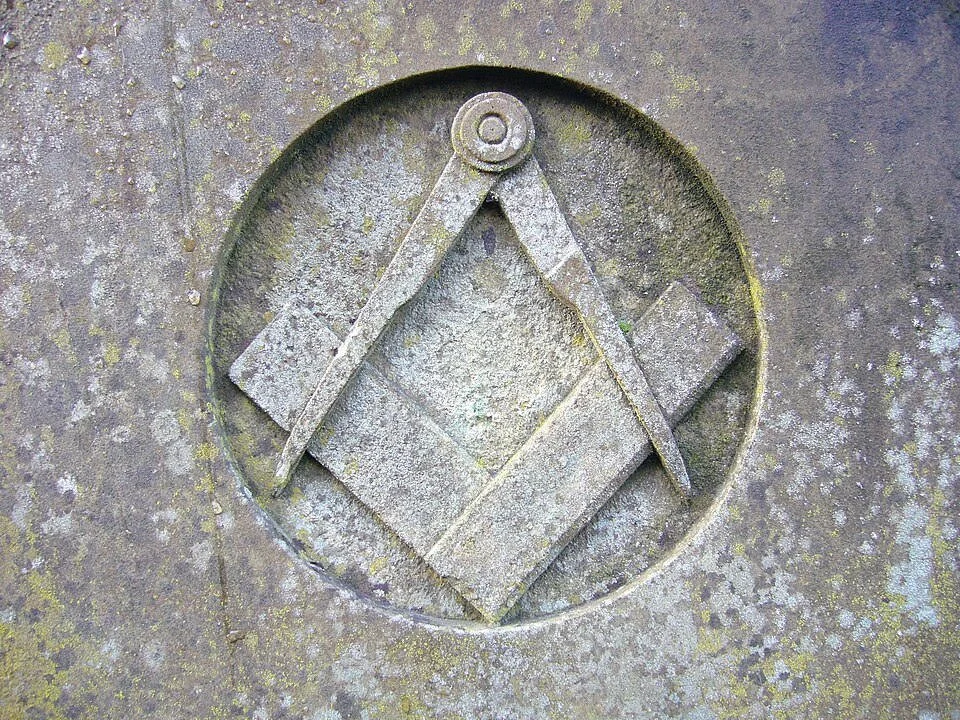
Masonic cornerstone, Great Falls, Montana.
One lodge makes the point bluntly on its website: Masonic symbols are there to reveal the Craft's teaching, not to conceal it.[3]
That's the key. Masonic symbols are not meant to hide truth from outsiders. They are meant to make it memorable, and usable, for the people who work with them.
What Grand Lodges publicly say
Regular Grand Lodges describe the core symbols in remarkably similar terms.
- The Grand Lodge of Ohio explains the square as a reminder to be "right and just" in one's actions, the level as a lesson in equality, and the plumb as rectitude of conduct.[1]
- The Masons of California describe the square and compasses as morality and boundaries, the apron as a badge descended from the working garment of operative masons, and the trowel as spreading "the cement of brotherly love."[2]
- On the letter G, public sources agree that it stands for Geometry, the science behind both stonemasonry and speculative Masonry. Many Masons also associate it with God, the Great Architect, and public sources usually present that as a common reading rather than a fixed rule.[2][4]
Visit most regular Grand Lodge websites and you'll find the same basic set of symbols explained in much the same way. That isn't an accident. It is the public face of a shared teaching.
Why symbols at all?
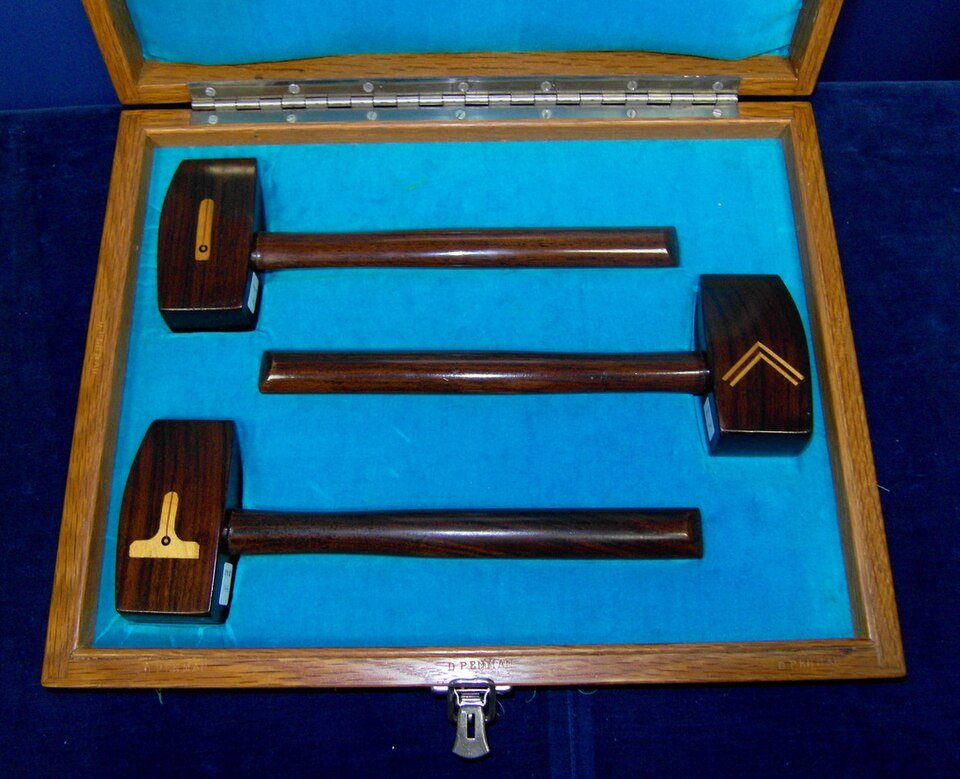
Lodge master's and wardens' gavels.
Freemasonry could hand out a pamphlet: Be honest. Be fair. Be charitable. It doesn't, because symbols do three things a list can't.
They stick. "Be moral" is abstract. "Square your actions" is concrete, visual and repeatable. A writer in The Square reads the square and compasses, with the point within a circle, as a map of the relation between the Great Architect and creation, with each life drawn on the circumference.[5] Put plainly, the symbol is a map you can carry.
Writers who took symbols seriously
Freemasonry has drawn men of letters, and some of them wrote about its symbols directly.
- Albert G. Mackey, in The Symbolism of Freemasonry (1869) and his Encyclopedia, treated symbolism as the Craft's main method of teaching.[6] He is influential, not infallible.
- Albert Pike, in Morals and Dogma (1871), a Scottish Rite text, pushed symbolic and philosophical interpretation further than most. He is controversial, but even his critics grant that he treated symbols as a system of thought, not decoration.
- Rudyard Kipling, initiated at Lahore in 1886, worked Masonic themes into "The Man Who Would Be King," the poem "The Mother Lodge" and the story "In the Interests of the Brethren."[7] He doesn't lecture about symbols. He lets them work through story, which is a very Masonic move.
- Mark Twain was initiated in Polar Star Lodge No. 79 in St. Louis in 1861 and took his demit in 1869.[8] His Masonic career was short. His eye for pretense and power, which symbolic thinking is supposed to sharpen, lasted a lifetime.
Outside the Craft, Carl Jung and C. S. Lewis thought hard about why images carry what plain statements cannot. Neither wrote about Masonic symbols, and neither should be drafted as a witness for them. They simply help explain why the method isn't peculiar to Masons.
How to read a Masonic symbol
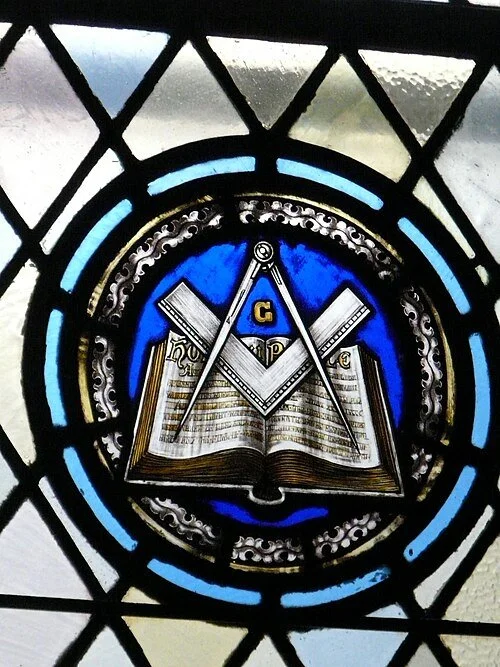
Square and compasses, stained-glass window.
If you’re not used to symbolic thinking, it can feel vague or mystical. It doesn’t have to be. Here’s a simple way to approach a Masonic symbol:
1. Start With the Tool’s Original Use
Ask: What did this tool do for a stonemason?
- Square: Checked that corners were true, that stones fit together properly.
- Level: Ensured a surface was horizontal, that things were even.
- Plumb: Verified that a wall was vertical, straight up and down.
- Trowel: Spread mortar to bind stones together.
- Compasses: Drew circles, set boundaries, laid out proportions.13
2. Ask: What Moral Lesson Does That Suggest?
Then ask: If this tool were about character instead of stone, what would it measure?
- Square → Morality, fairness, “squaring your actions” with others.2
- Level → Equality; “meeting on the level” regardless of outside status.
- Plumb → Integrity, uprightness, justice in how you live.2
- Trowel → Spreading brotherly love to unite people instead of dividing them.3
- Compasses → Boundaries, self-restraint, keeping passions within due bounds.5
3. Bring It Into Your Own Life
Finally: Where does this apply right now?
- “Where am I cutting corners instead of using the square?”
- “Am I treating this person as an equal, or am I letting status get in the way?”
- “Is my life ‘plumb’ in this situation, or am I leaning toward convenience?”
- “Am I using my trowel to build bridges or walls?”
- “Where do I need to draw a compass line and say, ‘This far, no further’?”
That’s symbolic thinking in practice: not vague mysticism, but concrete moral reflection using a shared image.
A Few Core Masonic Symbols, Briefly
Here are the symbols I’ll return to often on this site, all of which are publicly explained by Grand Lodges and Masonic authors:13
Square and Compasses (with or without the G)
Level and Plumb
- Level = equality, “meeting on the level.”
- Plumb = uprightness, integrity, rectitude of conduct.2
Rough and Perfect Ashlar
- Rough = the unpolished person we start as.
- Perfect = the person we’re trying to become through moral work.3
Trowel
- Spreading the cement of brotherly love to unite the fraternity.3
Apron
- A badge of a Mason, historically linked to operative masons’ work garments, now a symbol of innocence and participation.3
Pillars (often seen in Masonic art and architecture)
- Publicly associated with strength and establishment, often linked to the two great pillars at the entrance of King Solomon’s Temple.
All-Seeing Eye / Eye of Providence
- Often associated with Freemasonry in popular culture; present in Masonic art, but not exclusively Masonic. Many conspiracy claims (e.g., about the Great Seal) are historically dubious.3
I won’t use these symbols as secret signals or claim they give Masons special powers. I’ll use them the way our public literature does: as moral images to think with.
What I Won’t Write About (and Why)
I want to be explicit about limits, because trust matters.
As a Mason, I’ve taken obligations not to reveal certain things — not because they’re scandalous, but because they’re meant to be experienced in lodge, not explained on a website. Those include:
- Modes of recognition (grips, signs, tokens).
- Passwords or “secret words.”
- Detailed ritual sequences and exact wording of obligations.
- Internal lodge layouts or officer stations in ways that reveal ritual work.[8]
A good rule I follow: If a symbol and its moral meaning are explained on official Grand Lodge websites or in public Masonic books, I can discuss it. If it’s clearly part of the “secrets” we’re obligated to conceal, I won’t.[8]
That doesn’t make Masonry mysterious in a sinister way. It just means that some parts of the work are like a play: you can read the synopsis, but the impact comes from being in the room when it’s performed.
How I’ll Write About Symbols on This Site
Going forward, when I write about a Masonic symbol, I’ll usually:
Start with a story or image – how I encountered the symbol in real life.
Give the public meaning – what any Grand Lodge website would say about it.13
Offer my personal take – where I struggle with it, where it challenges me.
Speak to three audiences:
- Outsiders: “This is what it actually means, minus the myths.”
- Men considering joining: “This is the kind of inner work you’ll be doing.”
- Brethren: “Here’s how I’m trying to live it; how about you?”
Close with an invitation – to ask questions, read more, or visit a lodge’s public site.
If you’re a Mason reading this and you disagree with my take on a symbol, that’s fine. Part of working with symbols is that they’re never fully exhausted by one person’s interpretation. If you’re not a Mason, I hope this gives you a clear, honest picture of what we’re doing when we talk about squares, compasses, levels, and stones.
Where to Go From Here
This page is the foundation for a larger series on Freemasonry: its history, symbols, members, and legacy. From here, you might:
- Read the overview of what Freemasonry is (and isn’t), including Anderson’s 1723 Constitutions, the fundamental principles, and how observant/symbolic lodge work fits in.
- Dive into individual symbol articles (square and compasses, level and plumb, rough and perfect ashlar, etc.).
- Explore pieces on Masonic history, notable Masons, and how lodges actually function.
If you’re curious, skeptical, or already in the Craft, my hope is that this site treats symbols the way they deserve: not as decorations, not as secrets to be hoarded, but as tools for thinking and living.
Selected Public Sources Mentioned
- Grand Lodge of Ohio: “Masonic Working Tools,” “What is the Masonic Cipher?”2
- Freemason.org (California): “Freemasonry Symbols”3
- The Square Magazine: articles on 1723 Constitutions and Masonic structure
- General Masonic resources on Square and Compasses, symbolism, and public meanings15
- Discussions on what may be publicly disclosed about Masonry[8]
Sources
Author’s note:
I write as an individual Freemason, historian, and researcher. This article reflects my personal research and interpretation and does not represent an official statement of Advance Service Mizpah Lodge No. 586, the Grand Lodge of New York, or any other Masonic organization.
Images
Stone Carved Square & Compasses - Public domain (Nabokov), via Wikimedia Commons.
Gavel Image - © Chelm261, CC BY-SA 3.0, via Wikimedia Commons.
Stained Glass Window with Square & Compasses - © Robert Adamski, CC BY-SA 4.0, via Wikimedia Commons.
1 Masonic Symbols in America: A 250th Anniversary Reflection https://www.freemason.com/masonic-symbols-american-founding-blog/
2 Masonic Working Tools - Freemasonry - Grand Lodge of Ohio https://www.freemason.com/masonic-working-tools/
3 Freemasonry Symbols - Masons of California https://freemason.org/freemasonry-symbols/
4 Symbolism in Freemasonry - Sam P Cochran Masonic Lodge https://www.sampcochran1335.org/symbolism-in-freemasonry.html
5 Learn About Freemasonry Symbols - Freemason blog https://blog.freemason.org/2026/06/21/freemasonry-symbols/
6 Decoding the Square and Compasses https://www.thesquaremagazine.com/mag/article/202109decoding-the-square-and-compasses/
7 The Meaning Behind 15 Common Masonic Symbols - George H Lilley https://www.ghlilley.com.au/blogs/news/freemason-symbols
[8] What are we allowed to discuss openly about Masonry? - Reddit https://www.reddit.com/r/freemasonry/comments/uj1lrl/what_are_we_allowed_to_discuss_openly_about/
Continue This Two-Part Introduction
This is Part 1 of Why Masons Talk in Stones, Tools, and Symbols. It begins with a personal encounter and the public meanings of the symbols. Part 2 asks why working tools make good teachers, and where the comparison stops.
Next: Part 2, From Working Tools to Inner Work
Browse the symbols one by one: Masonic Symbols: Stones, Tools, and the Work of Character
Explore the Freemasonry Reader's Guide
Related Articles
- What Freemasonry Is: From Anderson's Constitutions to the Symbolic and Observant Lodge: the broader introduction to the fraternity.
- Rough and Perfect Ashlar: The Masonic Work of Self-Improvement — Begin exploring an individual symbol through questions of character and formation.
- The Two Pillars: Strength, Established, and the Architecture of Meaning — Continue from tools and stones to the symbolic possibilities of architecture and thresholds.