Steinway: How a Piano Factory Built a Village in Queens
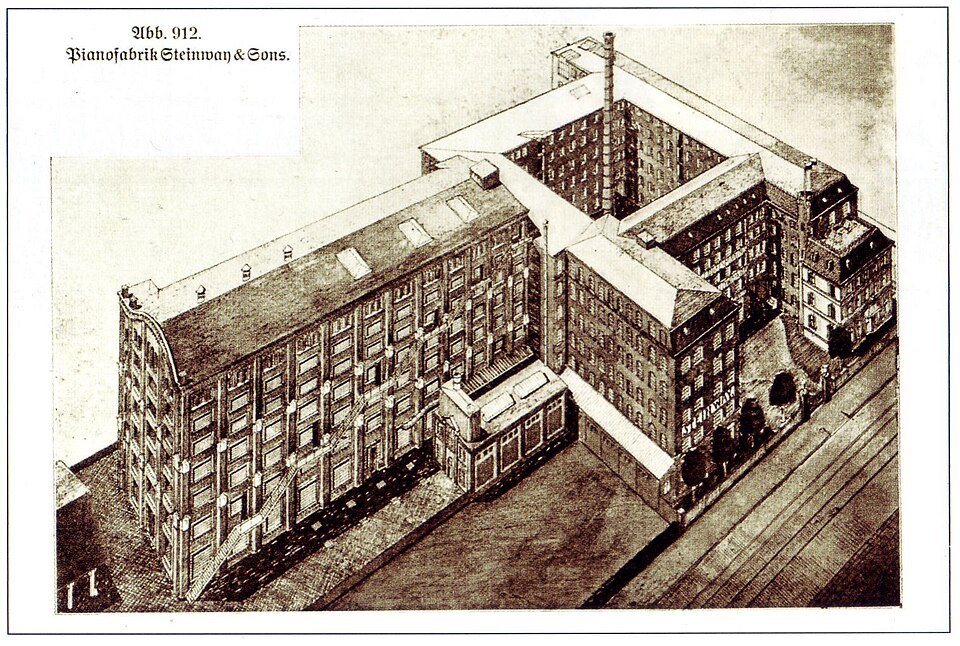
Steinway Piano Factory Drawing , Astoria
In the nineteenth century, the name Steinway came to mean more than a piano.
It described a factory district, a waterfront manufacturing complex, a working-class community, a network of housing and public amenities, a street railway, a library, a bathhouse, and an ambitious experiment in the relationship between capital and labor. The village of Steinway, later absorbed into Long Island City, was one of the most distinctive industrial communities ever created in Queens.
Its story begins long before the famous piano makers arrived. The land near Bowery Bay and the East River had been part of the old “Poor Bowery,” a colonial district of farms, creeks, and shoreline estates. But after 1870, the Steinway family transformed more than four hundred acres into an industrial village whose name became known throughout the musical world.[1]
Before the piano factory
The northeastern portion of Long Island City, later known as Steinway, was among the earliest settled parts of old Newtown.
In the seventeenth century, the land included what later writers called the Poor Bowery—property first associated with a Dutch Reformed Church poor farm. It also included land held by families whose names remained prominent in local history: Luyster, Riker, Rapelye, Moore, Lawrence, Berrian, and Kouwenhoven.[1]
The region was rich in natural features that later development would radically alter. Luyster Island once occupied ground near the future Steinway Mansion and piano factory. Bowery Bay, the East River, and nearby inlets shaped local travel and trade. Farms extended across land that would eventually be graded, filled, subdivided, and industrialized.[1]
Peter Luyster purchased the Poor Bowery property in 1656. Over the generations, the land passed through family ownership and agricultural use. Abraham Rycken, ancestor of the Riker family, also held land in the area. The old estate landscape survived well into the nineteenth century, even as the industrial city approached from Hunter’s Point and Astoria.[1]
The region’s earlier history included Indigenous occupation and colonial dispossession, themes that older local histories often treated inadequately. Nineteenth-century writers noted shell heaps, burial sites, and artifacts, but their interpretations must be approached carefully. The land that became Steinway was part of an Indigenous landscape long before it became a Dutch poor farm, a family estate district, or an industrial village.[1][2]
The Steinway family arrives
The men who created Steinway village came from a family already famous for piano making.
Henry Engelhard Steinway, born Heinrich Engelhard Steinweg in Germany, emigrated to New York with much of his family in 1850. In 1853, Henry and his sons founded Steinway & Sons in a modest workshop in Manhattan. Their success came through craft, innovation, business discipline, and an increasingly sophisticated approach to piano construction.[1]
By the 1860s, Steinway & Sons had become a major name in American music. The company’s pianos won medals at exhibitions in the United States and Europe. Its Manhattan factory expanded. Steinway Hall became a central venue in American musical life. The firm’s founders and their sons had built a global reputation.[1]
But success created a practical problem: the company needed more room.
The Manhattan factory could not easily accommodate every stage of production. Piano manufacture required lumber yards, sawmills, foundries, drying kilns, workshops, storage facilities, docks, and specialized machinery. The company also needed access to water for receiving logs and other raw materials.[1]
William Steinway, who handled the commercial and financial side of the family enterprise, looked across the East River to Queens.
Steinway & Sons factory, c. 1900.
Building a factory village
In 1870 and 1871, Steinway & Sons acquired more than four hundred acres of land along the East River and a navigable canal. The property provided roughly a mile of waterfront, room for industrial expansion, and an opportunity to create a community around the factory.[1]
The company built a steam sawmill, iron and brass foundries, boiler and engine houses, drying kilns, storage sheds, docks, bulkheads, a lumber basin, and a major piano-case factory. By 1877, the keyboard-making and wood-carving operations had moved from Manhattan to the new Queens works.[1]
The factory was a system, not a single building.
Logs were selected, cut into veneers, dried, glued, bent, and pressed into piano cases. Iron and steel were brought to the waterfront and transformed into frames and other components. Finished parts were sent to the Manhattan factory for final assembly and adjustment. Telegraph and telephone connections linked the Queens plant with the company’s New York operations.[1]
By the late nineteenth century, hundreds of workers were employed at the Steinway works. The factory was not merely an employer; it was the organizing force of the surrounding neighborhood.
The area took the company’s name.
William Steinway’s industrial vision
William Steinway presented the creation of Steinway village as both a business decision and a social experiment.
According to Kelsey’s account, Steinway had been looking for land outside Manhattan because the company needed space, waterfront access, and facilities for lumber storage, sawmilling, and foundry work. He also believed that removing workers from the dense tenement districts of Manhattan would reduce the influence of labor agitation and improve the stability of the workforce.[1]
The company’s plan combined industry with housing and community services. Workers could live near their jobs. The neighborhood would have better water, drainage, housing, schools, recreation, and public amenities than many industrial districts of the period.
This model was not purely philanthropic. It also served the company’s interests by encouraging a stable, skilled workforce close to the factory. But it was more substantial than a typical speculative real-estate development. The Steinway enterprise invested in the physical and social structure of the village.[1]
The company helped create a community with:
- Worker housing.
- A public school.
- A free circulating library.
- A kindergarten.
- A public bathhouse.
- A riverside park.
- Churches.
- Water and sewer connections.
- Transportation links to the rest of Long Island City and Manhattan.[1]
By the 1890s, the village had a population of more than 7,000, according to Kelsey. The neighborhood’s growth demonstrated both the scale of Steinway & Sons and the power of industrial capital to shape urban life.[1]
Housing, schools, and public life
The company’s worker housing became one of the defining features of Steinway village.
Kelsey described the houses as model dwellings with ventilation, drainage, and water service. The company also supported a schoolhouse for roughly one thousand children and supplemented public instruction with German-language and music education.[1]
The Steinway Free Circulating Library and Free Kindergarten offered cultural and educational resources in the center of the village. A public bathhouse with fifty dressing rooms opened near the river in 1881. Nearby parkland created a place of recreation for workers and families.[1]
These institutions deserve to be understood in context. They represented genuine investment in community infrastructure, but they also formed part of a paternalistic industrial order. The company’s influence extended beyond wages and employment into housing, education, recreation, transportation, and civic life.
For workers, this could mean improved conditions compared with overcrowded Manhattan tenements. It could also mean that the employer’s presence was nearly inescapable.
That tension is central to the history of company towns everywhere, and Steinway was no exception.
The street railway and the making of connections
A factory village could not remain isolated.
William Steinway was deeply involved in transportation improvements linking the neighborhood with Astoria, Hunter’s Point, Flushing, and ferry connections to Manhattan. The Steinway Railway Company expanded streetcar routes through Long Island City and toward the village. Later, electric traction accelerated the integration of the district into the wider city.[1]
The railway system made it possible for workers, customers, and visitors to reach Steinway more easily. It also increased the value of land and helped turn a company-centered settlement into a more complex urban neighborhood.
Transportation was essential to the Steinway model. The factory needed access to raw materials and shipping. Workers needed access to jobs. The village needed access to markets, ferries, schools, churches, and other communities. The rails tied all of these together.
Beyond pianos: Steinway and the Daimler Motor Company
The industrial ambitions of William Steinway did not end with pianos.
In the 1890s, Steinway became associated with the Daimler Motor Company, which manufactured gasoline engines for boats, carriages, fire engines, stationary machinery, and other uses. William Steinway had encountered Gottlieb Daimler’s motor technology in Germany and recognized its potential.[1]
The Queens factory became an early American center of motor manufacture. The enterprise produced engines for launches, commercial vehicles, and experimental horseless carriages. It was part of the wider shift from horse power to mechanical power that would define the twentieth century.[1]
The presence of the Daimler works added another layer to Steinway’s identity. The village was not simply a piano-manufacturing center. It was a laboratory of industrial modernity, where music, metalworking, steam, gasoline, transportation, and manufacturing converged on the Queens waterfront.
Steinway joins Long Island City
The Village of Steinway was absorbed into Long Island City in 1870, before much of the company’s later development had reached its full scale.
Its inclusion in the new city reflected the consolidation of western Newtown’s growing settlements: Astoria, Hunter’s Point, Ravenswood, Dutch Kills, Blissville, Middletown, Bowery Bay, and Steinway. The merger joined communities with different histories and different levels of infrastructure under one municipal government.[1]
Steinway remained distinctive because its development was unusually concentrated. While other Long Island City districts evolved through a mixture of private estates, small industry, transportation expansion, and municipal improvement, Steinway developed around one powerful firm.
The company’s influence was visible in the street plan, factories, homes, schools, transportation, and public amenities. Few Queens neighborhoods were so closely linked to a single family and industrial enterprise.
The legacy of Steinway village
Steinway’s legacy is complicated but unmistakable.
The Steinway family created a famous piano business. They also created a Queens industrial community whose name remains attached to the surrounding area. Their factory helped establish western Queens as a manufacturing center. Their investments in transit, housing, education, and civic infrastructure shaped the development of northern Long Island City.[1]
The village was not a utopia. It depended on industrial discipline, employer control, and the assumptions of nineteenth-century paternalism. Yet it offered many workers material advantages that were not universal in the industrial city.
Steinway remains an important example of how a business can reshape a landscape. The land had been a colonial poor farm, a family estate district, and a stretch of waterfront fields. By the end of the nineteenth century, it had become a factory village connected to the world by music, manufacturing, and transportation.
The pianos made there traveled far beyond Queens. But the village that made them remains one of the borough’s most important industrial stories.
End Notes
Images
Steinway factory drawing - Source: National Museum of American History, Archives Center, Steinway & Sons Records and Family Papers, 1857–1919.
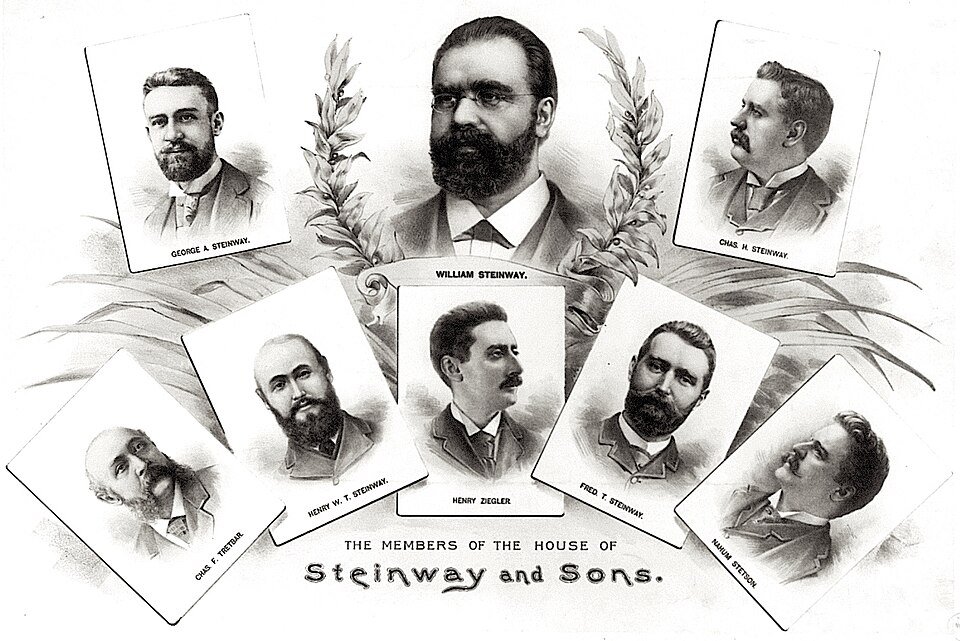
Steinway & Sons Portrait Image - Public domain, via Wikimedia Commons.