Francis Doughty and the Lost Colony of Mespat
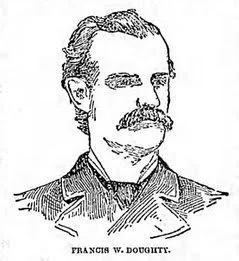
Portrait of Francis Doughty
In the early 1640s, a dissenting English minister named Francis Doughty tried to build a new life on Long Island under Dutch rule. He obtained an enormous land patent at Mespat, gathered a small colony of settlers, and began the work of creating a town. Within a few years, that settlement had been destroyed by war, fractured by internal dispute, and effectively dissolved by the Dutch government.
James Riker Jr.’s 1852 Annals of Newtown preserves the most detailed surviving narrative of this episode. Riker’s account is shaped by nineteenth-century assumptions, but it also draws on colonial records, patents, court proceedings, and family materials that give the story real historical weight.[1]
A dissenting minister in search of liberty
Francis Doughty first appears in the colonial record as a clergyman who had followed the path of the Pilgrims to New England, only to find that religious freedom there had limits. According to Riker, Doughty settled at Cohannet (later Taunton) but quickly fell into conflict with the local ministers over baptismal practice. He argued that all children of baptized parents should be baptized, a position that was rejected by the established clergy.[1]
The dispute escalated. Riker quotes a contemporary description in which Doughty was “dragged out of the assembly” by the constable after speaking publicly on the issue. Overruled by a panel of ministers and magistrates, Doughty left Taunton with his wife and children, first seeking refuge in what is now Rhode Island. There, he and a group of associates decided to move into Dutch territory, hoping to find greater freedom of conscience under New Netherland.[1]
The 1642 Mespat patent: a town on paper
In March 1642, Director-General Willem Kieft and the Council of New Netherland granted Doughty and his associates a patent for roughly 13,332 acres at Mespat. Riker reproduces a translation of the patent, which describes the tract in detail and confers sweeping powers: the right to establish towns, erect churches, exercise the Reformed religion, and administer civil and criminal jurisdiction within defined limits.[1]
The patent authorized Doughty and his partners to nominate local magistrates, subject to confirmation by the Director, and to exercise judicial authority in civil suits up to a specified amount. It also granted hunting, fowling, fishing, and trading privileges consistent with other colonial immunities. In return, the patentees were required to acknowledge Dutch sovereignty, use Dutch measures, and after ten years pay one-tenth of the produce of cultivated land.[1]
On paper, this was not merely a farm grant but the charter for a self-governing township. Riker emphasizes that the patent embraced “nearly the whole of the present town of Newtown,” making it one of the most ambitious early land grants on western Long Island.[1]
Settlement, war, and the burning of Mespat
Endowed with these rights, Doughty and his associates began to settle Mespat. Riker notes that within a year, several families were established along the most easterly branch of Mespat Kill (Newtown Creek). Among them was Richard Smith of Taunton, described as a man of means and standing. Doughty served as pastor, and for a time the colony appeared to be prospering.[1]
That prosperity was cut short by the outbreak of violent conflict between Director Kieft and surrounding Indigenous communities. In February 1643, Dutch forces attacked Indigenous settlements at Pavonia and Corlear’s Hook, killing many sleeping residents. In retaliation, Indigenous warriors struck back against Dutch and English settlements around New Amsterdam.[1]
Mespat was not spared. Riker writes that “in an evil hour the savages broke in upon the settlement with merciless vengeance,” killing at least one inhabitant, John Smith, and burning the dwellings to the ground. The survivors fled to New Amsterdam, where they joined other refugees from across the region. Doughty himself lost nearly everything but continued to minister to the displaced settlers, supported in part by public contributions.[1]
Return, dispute, and the end of Doughty’s authority
After a peace was concluded between the Dutch and Indigenous leaders, some planters returned to their ruined holdings at Mespat. Doughty followed, but his confidence in the situation remained low, and within months he moved back to New Amsterdam, where he preached to the English population in the church within Fort Amsterdam.[1]
As the settlement slowly reconstituted itself, a new conflict emerged—this time within the colony. Riker explains that Doughty appears to have interpreted the Mespat patent as giving him near-patroon powers, including the right to dispose of land and demand payments and quit-rents from settlers. Other patentees resisted, insisting that the grant was a joint tenancy, not a personal domain.[1]
The dispute went to court in New Amsterdam. In April 1647, the Director and Council ruled against Doughty’s claims, ordering that the co-partners should enter upon their property while reserving to Doughty only the bouwery and lands he personally occupied. Doughty regarded the decision as unjust and appealed. Kieft, who had previously abolished appeals to Holland, treated the appeal as defiance, fined Doughty, and imprisoned him for twenty-four hours.[1]
Discouraged and effectively stripped of authority, Doughty sought permission to leave New Netherland. That request was initially denied. He then accepted a call to Flushing, where he served for about a year at a fixed salary. When his preaching was judged critical of the government, Captain John Underhill ordered the church doors shut against him. Only after promising not to publicize his mistreatment by Kieft and Stuyvesant was Doughty allowed to depart, leaving for the “English Virginias” around 1648 or 1649.[1]
From Mespat to Flushing—and beyond
Doughty’s personal story did not end with his departure. Riker notes that his Flushing farm passed through his daughter Mary to her husband, Adriaen Van der Donck, and later to other owners, leaving a trace in local place names such as “Stevens’ Point” and “Yonker’s Island.” Doughty’s sons Elias and Francis remained in the region for time; Elias became a magistrate in Flushing and left descendants there.[1]
The colony he had tried to establish at Mespat, however, never recovered. Riker writes that the settlement “never recovered from the shock of savage warfare, and the no less fatal blows of intestine strife.” Richard Smith, one of its leading figures, eventually returned to Rhode Island. By 1649, only a few patentees remained. The grand vision encoded in the 1642 patent had collapsed into scattered farms and abandoned hopes.[1]
Reading Riker’s account with care
Riker’s narrative is indispensable, but it is also a product of its time. He relies heavily on colonial records and family papers, yet he frames Mespat’s early history in nineteenth-century language that contrasts “civilization” with a “wild” landscape and uses terms for Indigenous people that are no longer acceptable. His account also reflects the biases of colonial documents that often minimize Indigenous political authority and land rights.[1]
A modern reading keeps Riker’s evidence while correcting his framework. The 1642 patent did not create land out of nothing; it overlaid an existing Indigenous geography. The destruction of the Mespat colony was not simply a tragedy of frontier life but part of a larger pattern of violence initiated by Kieft’s policies. And Doughty’s conflict with his associates and the Dutch government reveals how fragile colonial self-government could be when it clashed with the Director’s authority.[1]
Even with these caveats, the core story stands: Francis Doughty’s Mespat colony was the first serious attempt to create an English town in what would become Newtown. Its failure left the landscape open for the next wave of settlement—the 1652 founding of Middelburg, which would eventually take the name Newtown and carry forward the region’s colonial history.[1]
Endnotes
Images
Francis Doughty. Source: “A Relic of Village Days,” Brooklyn Eagle, June 7, 1891.