What Damascius Saw in the Chain
Myth, necessity, and the possibility of freeing the higher self
A late Platonist read Prometheus and Heracles as more than a story of punishment and rescue. The chain becomes a condition of soul under necessity, and liberation becomes the recovery of a higher power that has not been destroyed—only bound.
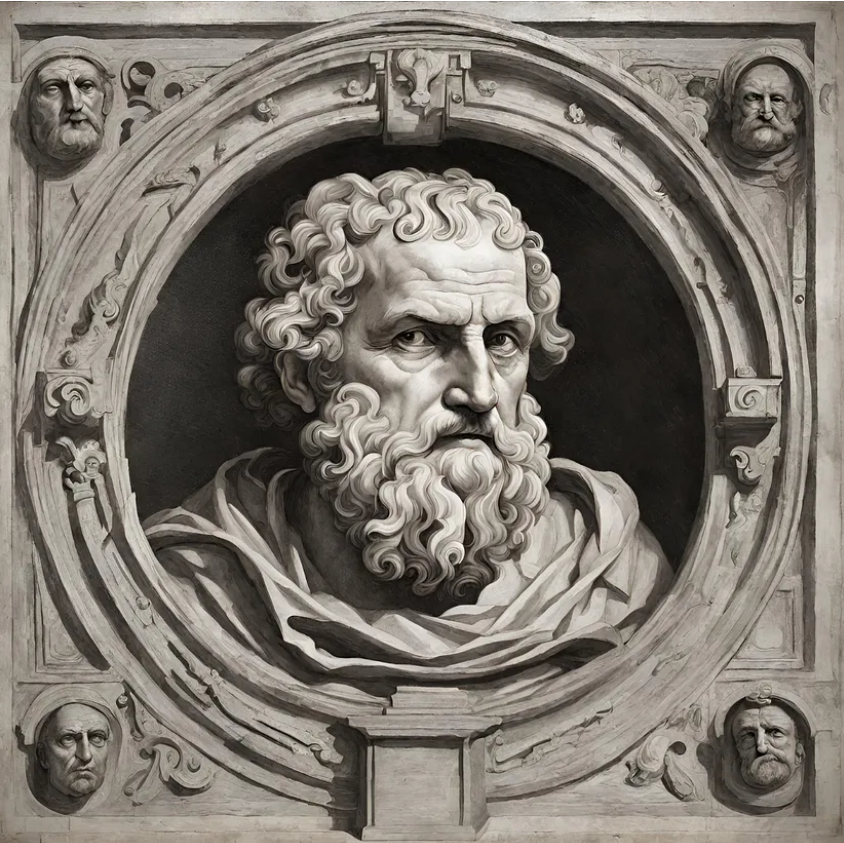
Damascius was the last head of the Platonic Academy at Athens.
He lived in the late fifth and early sixth centuries CE, at the end of the long pagan philosophical tradition that had begun with Plato nearly a thousand years earlier. He wrote commentaries on Plato, especially on the Phaedo, and pursued questions that were not small: first principles, the soul, death, divine order, ritual, intellect, and the difficulty of saying anything adequate about the ultimate source of reality.
He also interpreted myths.
This is important.
For the late Platonists, myth was not childish material to be discarded once one had acquired philosophical vocabulary. Nor was it a puzzle in which every figure had a single fixed answer. Myth could speak at several levels at once: divine, cosmic, psychic, ethical, political, ritual, and literary.
The Prometheus story became meaningful because it contained a structure that could be read through these levels.
Prometheus bound.
The eagle returning.
Heracles liberating.
The chain is not merely an object.
It is a condition.
The soul under necessity
The late Platonist does not deny that human beings live under necessity.
We are embodied.
We age.
We suffer.
We are born into conditions we did not choose.
We experience appetite, pain, loss, time, social obligation, material limitation, and the complicated demands of living among other people.
This is the lower world—not necessarily evil, but difficult.
The soul enters it and becomes involved in it. Its higher powers may remain present, but they can become obscured, weakened, or bound by the conditions of embodied life.
Prometheus, as Forethought, can represent the higher rational power that sees beyond immediate sensation.
The chain represents its captivity within necessity.
The eagle represents what repeatedly attacks or consumes that power: the afflictions of mortal life, recurring pain, the demands of embodiment, destructive passions, or the lower forces that leave little room for the soul’s higher activity.
Heracles represents liberation.
Not necessarily escape from the world.
Rather, recovery of the soul’s ability to act from what is highest in it.
Why the myth is not a decoder ring
It would be easy to turn this into a chart.
Prometheus equals reason.
The eagle equals anxiety.
The chain equals trauma.
Heracles equals therapy.
The rock equals capitalism, bad parenting, or the unread emails in one’s inbox.
This may be entertaining. It is not late Platonism.
Damascius and the later Platonists understood myths to be layered. A symbol can speak at many levels without collapsing into one modern equivalent.
The chain can be cosmic necessity, bodily life, recurrent affliction, historical circumstance, moral ignorance, or the experience of a soul unable to act according to its own higher judgment.
The eagle can be passion, pain, time, fate, bodily vulnerability, or the recurring costs of living in the world.
Heracles can be heroic moral action, liberating intellect, divine aid, friendship, philosophy, courage, or a force of restoration.
The myth does not tell us that only one reading is correct.
It asks whether we can recognize the structure of bondage and liberation in our own lives.
Providence and responsibility
The late-Platonic world is ordered by providence, but providence is not a lazy answer to suffering.
To say that the cosmos has order is not to say that every pain is easy to understand, deserved, or good. The eagle is still terrible. The chain still binds. Prometheus still suffers.
The point is that suffering does not prove that the higher self has been extinguished.
The soul may be bound without being destroyed.
It may be wounded without losing every capacity for truth.
It may be reduced in outward power while preserving an inward orientation toward what is higher.
This is the hope contained in the myth.
Prometheus endures because Forethought survives even in chains.
Heracles arrives because liberation remains possible even when the captive cannot secure it alone.
The chain and the lodge
A lodge cannot remove every chain in a person’s life.
It cannot cure illness, erase grief, undo injustice, prevent aging, guarantee employment, restore every relationship, or make the world proportionate to human wishes.
But it can help free the higher powers of the person.
It can provide friendship against isolation.
Instruction against confusion.
Ritual against forgetfulness.
Service against despair.
Shared work against passivity.
A place where a person is known as more than his wound, job, title, failure, or fear.
This is not small.
A man may arrive bound by circumstances outside the lodge room. He may leave not entirely unbound, but more able to remember that he possesses judgment, dignity, moral agency, and a claim upon fellowship.
Damascius did not read the chain as a metaphor to be solved.
He read it as a condition of soul to be understood.
And perhaps, where possible, to be broken.
Endnotes and further reading
Damascius, commentary on Plato’s Phaedo, for the late-Platonic interpretation of the Prometheus–Heracles material.
Modern scholarship identifies Damascius’ interpretation as philosophically developed and rooted in earlier traditions of reading Heracles and Prometheus.[1]
On the late-Platonic interpretation of Platonic myths more broadly, see the Stanford Encyclopedia of Philosophy overview of Plato’s myths and their reception by Porphyry, Proclus, Damascius, and Olympiodorus.[3]
On Damascius as the last head of the Athenian Platonic school, see modern reference accounts of his life and thought.[4]
Related reading: “The Two Gates of the Soul” and “What Proclus Saw in Er’s Vision.”