Heracles Frees Forethought
Strength becomes moral when it liberates rather than dominates
Heracles does not merely kill an eagle. In a late-Platonic frame, he liberates the higher, foreseeing power from bondage. Strength becomes moral when it frees what suffering has bound.
Heracles is usually remembered for confronting monsters.
He kills the lion. He defeats the Hydra. He captures the boar. He cleans the stables. He brings Cerberus from the underworld. He does difficult things in a manner that makes ordinary people feel insufficiently muscular.
But one of his most significant acts is not a Labor.
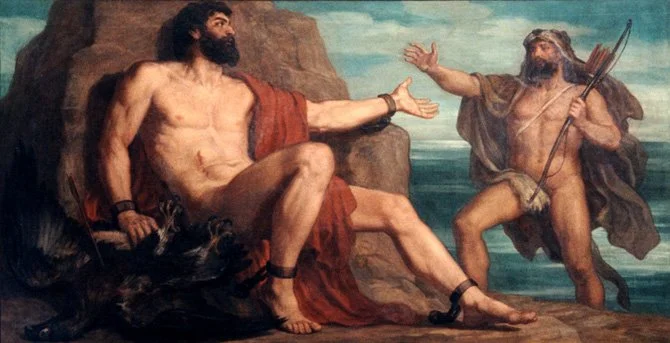
He frees Prometheus.
Heracles kills the eagle. He breaks or removes the bonds. The Titan who gave fire and forethought to humanity is released from the rock.
This is strength used differently.
Heracles is not gaining a trophy.
He is not proving himself superior to a weaker opponent.
He is not acquiring a title, a kingdom, or public applause.
He is liberating another being from recurring suffering.
That is why the episode has such philosophical power.
The liberation of forethought
Prometheus is Forethought.
He is the power that sees beyond the immediate. He anticipates. He imagines consequences. He preserves the possibility of human craft, planning, culture, and reflective action.
When Prometheus is bound, forethought is bound.
The higher capacity to see, judge, plan, and create is trapped in a condition of recurring affliction.
Heracles’ rescue can therefore be read as the liberation of what is noblest in human nature from the forces that consume it.
This is not merely psychological optimism.
A person may know what is good and still be unable to act upon it because fear, exhaustion, shame, habit, oppression, grief, addiction, social pressure, or despair has tied his higher judgment to a rock.
He has not lost the capacity for forethought.
He has lost freedom to use it.
Heracles represents the force that helps break the chain.
Strength as service
This is one of the finest ancient corrections to the worship of strength.
Strength is not moral merely because it is strong.
A person may be powerful and cruel.
He may be competent and selfish.
He may be influential and destructive.
He may dominate every room he enters and leave everyone worse for having been there.
That is not heroic strength.
It is merely force.
Heracles becomes morally significant when his force serves liberation.
He kills the eagle not to display his aim but to end another being’s torment. He uses power to restore a capacity for thought, foresight, and life.
This is a model for every kind of strength.
Physical strength can protect rather than intimidate.
Institutional strength can serve rather than exclude.
Intellectual strength can clarify rather than humiliate.
Financial strength can relieve suffering rather than create dependence.
Social strength can make room for those who have been overlooked.
Masonic strength can be measured not by the grandeur of the lodge room or the number of titles held, but by whether the fraternity helps free members from ignorance, isolation, despair, and moral confusion.
The strongest act is not domination.
It is the freeing of what suffering has bound.
Heracles and the helper
Heracles does not free Prometheus by becoming Prometheus.
He does not tell the Titan that he should simply think more positively, admire his own resilience, or recognize that the eagle is really a growth opportunity.
He acts.
This is worth emphasizing because moral and spiritual language can sometimes become an excuse for inaction. We tell suffering people to learn a lesson from pain when what they need is help. We praise resilience because we do not wish to change the conditions that require so much resilience.
Heracles offers another model.
Sometimes the most philosophical act is practical liberation.
Break the chain.
Remove the source of injury.
Protect the vulnerable.
Provide the material help.
Speak when silence has become complicity.
Use strength where strength is needed.
The myth does not deny inner work. Prometheus has endured. Heracles has become strong through his own Labors. But the encounter shows that self-mastery and service belong together.
A person who has learned to govern himself becomes more capable of helping free others.
The Masonic brother as Heracles
This does not mean every Mason must develop a lion skin and begin patrolling the neighborhood with a club.
The principle is subtler.
A brother may become Heraclean when he helps another person recover the use of his higher powers.
He listens without flattery.
He offers counsel without domination.
He helps a newer member find confidence.
He protects someone being treated unfairly.
He refuses to let gossip, neglect, or bureaucracy crush a person’s dignity.
He recognizes when a brother is bound by grief, illness, fear, shame, or isolation and helps create conditions in which that brother can think, act, and participate again.
This is strength in service of freedom.
It does not make headlines.
It may save a life.
Heracles frees Prometheus because strength has reached its proper purpose.
It has become useful to what is higher.
Endnotes and further reading
Hesiod, Theogony, on Heracles’ eventual release of Prometheus.
Aeschylus, Prometheus Bound, for the dramatic world in which Prometheus’ liberation is anticipated.
Damascius’ late-Platonic interpretation of Prometheus and Heracles in his commentary on Plato’s Phaedo provides a major philosophical context for reading the myth as liberation of a higher element from bondage.[1]
Related reading: “Heracles Within” and “Why the Prisoner Must Return.”