Brother John Anderson Leach of Advance Lodge No. 635
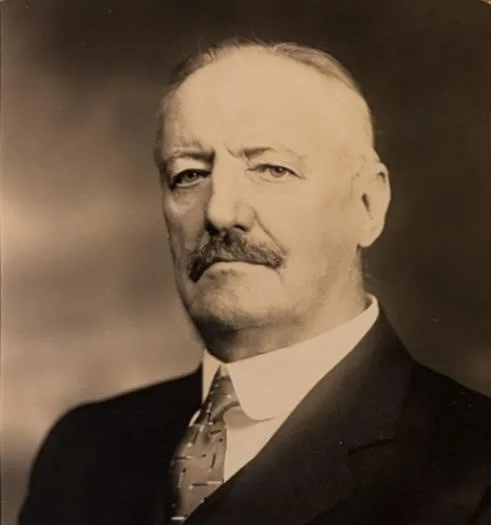
Portrait of John Anderson Leach
Raised in 1905, John Anderson Leach rose from Astoria lawyer to magistrate, civic leader, and senior police official—becoming one of the most distinguished public men associated with Advance Lodge No. 635.
When John Anderson Leach entered the records of Advance Lodge No. 635 on October 17, 1905, the entry was brief: 39 years old, born in Astoria, living in Astoria, occupation—lawyer.1 He became the lodge’s 326th member, one more name in a ledger that gave little hint of the life that would follow.
Yet behind that plain notation stood a man already shaped by duty. In the decades that followed, Leach would rise through the legal, civic, and governmental life of Queens, becoming a leader in the bar, a central figure in Long Island City’s improvement campaigns, a magistrate, and eventually one of the New York Police Department’s most respected legal and administrative officers.2 By the mid-1930s, he was publicly described as a prominent Mason and past master of Advance Lodge, a self-made man whose fairness, judgment, and humanity had earned unusual trust.2
His is not the story of sudden fame. It is the story of something steadier and more durable: a life built through usefulness.
A Self-Made Man
Later newspaper accounts called Leach “in every sense a self-made man,” and the phrase appears fully deserved.2 He was the eldest son of Bailey Leach, a Yorkshire-born nurseryman in Astoria. After his father’s death, family responsibility fell heavily upon him. He helped manage the nursery business while studying law at night, and he was admitted to the New York bar in June 1897.2
That early combination of work and study seems to explain much about the man who emerges from the record. Leach was not simply ambitious. He had been trained by circumstance to carry burdens quietly, master practical details, and move forward without display.
By 1903, his name was already appearing in civic proceedings. At a Citizens’ Union convention in Long Island City, he called the meeting to order and served as secretary—small evidence, perhaps, but telling.3 He was becoming one of those men regularly entrusted to help organize public life.
A Lawyer Whose Work Moved Into Public Life
Leach’s legal career advanced quickly. In 1906, less than a decade after his admission to the bar, he was serving as First Vice President of the Queens County Bar Association.4 He was no longer merely building a practice; he had already won the respect of his professional peers.
His work also drew him into the contentious civic questions of a fast-changing borough. A later profile credits him with fighting improvement and utility arrangements that would have imposed unfair costs on property owners in Astoria and Long Island City, and with helping save taxpayers substantial sums in disputes over assessments and infrastructure.2
These were not glamorous battles, but they mattered. Sewers, assessments, street improvements, and the allocation of public costs were among the basic forces shaping modern Queens. Leach’s instinct was to move toward that kind of work—toward the practical mechanics of governance, where law met daily life.
The Bridge, the Celebration, and a Growing Borough
To follow Leach’s rise is also to watch Queens stepping into modernity. In 1909, as the borough prepared to celebrate the opening of the Queensboro Bridge, Leach appeared among the organizers on the Plan and Scope Committee and was also named chairman of the dinner committee.56 These were not ornamental roles. The opening of the bridge was one of the defining civic events in Queens history, and the men entrusted with its celebration were men already recognized as capable and influential.
That same year, Leach was active in planning the Queens portion of the Hudson-Fulton celebrations. Reports place him on the borough executive committee and identify him with important responsibilities in ward organization, ways and means, and the securing of support for Queens’s participation.78
What matters in all this is not simply that his name appears, but how often and in what company. Leach was not a spectator to borough life. He was repeatedly selected for consequential work.
President Leach and the Business of Long Island City
That pattern became unmistakable in 1910, when Leach was elected president of the reorganized Long Island City Business Men’s Association.9 The association was not a social club. It was a serious civic body concerned with transportation, taxation, legislation, local improvements, bridge access, commercial development, and water supply—the great practical questions of a growing city.9
Under Leach’s presidency, the organization adopted a more systematic structure, divided itself into active committees, and set an ambitious course of public engagement. He named committee chairmen across a wide range of subjects and helped direct the association’s efforts on transit, infrastructure, and neighborhood development.10 Later that same year he was re-elected, with reporting crediting the officers for “the large amount of good work” done during the year.11
To modern readers, such topics can sound procedural. In fact, they were the bloodstream of borough growth. They determined whether commerce flowed, whether neighborhoods prospered, and whether Queens developed in an orderly and equitable way. Leach had made himself useful where usefulness counted most.
From the Bar to the Bench
Public office followed naturally. In 1911, Mayor William J. Gaynor appointed Leach a magistrate, a step later remembered as recognition of the impression his public work had made.2 From then on, newspapers increasingly referred to him as Magistrate John Anderson Leach, and by 1912 and 1913 he was appearing among the recognized dignitaries of Queens public life.12
Even here, the record suggests continuity rather than transformation. Leach does not emerge as a showman on the bench. He appears, rather, as what he had long been: steady, procedural, discreet, and trusted.
From Magistrate to Police Headquarters
The next major turn came in January 1918, when Leach was appointed Acting Deputy Police Commissioner during a reorganization of the department.13 The account announcing his appointment sketched a life already broad in service: Astoria resident, lawyer, former magistrate, president of a mortgage company, chamber of commerce member, churchman, and former president of the Long Island City Business Men’s Association.13
The same report also captured the essence of his rise. He and Mayor Hylan had studied law together at night; after his father’s death, Leach had helped shoulder family burdens; and through diligence in business he had built one of the largest law practices in Long Island City.13 This was the background he brought into the Police Department: legal training, administrative experience, borough credibility, and a reputation for self-command.
The Police Department’s Legal Mind
Leach’s police career became long, influential, and unusually respected. He later served as First Deputy Police Commissioner and was especially associated with the department’s legal and trial work. By 1935, a substantial newspaper profile reported that he had presided over more than 50,000 police trials, with very few reversals on appeal.2 The same profile portrayed him as more than a technician. He was shown as a man valued for independence of judgment, breadth of experience, and an uncommon sense of fairness.
According to that account, Leach sometimes softened the practical effect of discipline when he believed an officer’s family should not suffer too harshly, and he did not forget good conduct after a minor failing.2 Whether read literally or as a character sketch grounded in long observation, the portrait is consistent: he was remembered as exacting, but humane.
Other glimpses reinforce the point. In 1920, when he encountered a patrolman struggling with an intoxicated prisoner in Long Island City, Leach stopped his car and helped complete the arrest himself.14 In 1921, he publicly warned that while police could preserve order at a large Astoria meeting, they could not guarantee the safety of unattended automobiles on public streets.15 In 1923, he was involved in discussions over conditions at the Woodside transfer point, again showing his connection to the practical administration of city life.16
He remained the same sort of man in high office that he had been in lower ones: concrete, reliable, and useful.
A Prominent Mason and Trusted Man
For Advance Lodge No. 635, perhaps the most meaningful public testimony is also the simplest: by 1935, Leach was described in the press as a prominent Mason and a past master of the lodge.2 That public characterization suggests real standing in the Craft, not merely nominal membership.
His life aligns closely with the virtues lodges most hoped to cultivate in practice: steadiness, integrity, loyalty to institutions, seriousness of duty, and charity without display. The same profile that traced his public achievements also described him as a lecturer, world traveler, churchman, charter member of the Queens Borough Chamber of Commerce, and a man of substantial but quiet generosity.2
Trust marked his private life as well as his public one. In 1931, he was named among the executors and trustees connected with the substantial estate of banker William Boardman, evidence of confidence at the highest personal level.17 In 1936, he served as executor of his mother Susan R. Leach’s estate.18 Such responsibilities are among the strongest proofs of character a life can leave behind.
Remembering Brother Leach
The lodge record of 1905 preserved only the beginning: a name, an age, a residence, a profession. History restores the fuller measure of the man. Brother John Anderson Leach was a son of Astoria who rose through law, civic leadership, and public office to become one of the most respected men associated with Advance Lodge No. 635.
He helped organize the celebrations that marked Queens’s emergence into modern urban life. He led one of Long Island City’s principal civic organizations. He served on the bench. He brought legal judgment and administrative humanity to Police Headquarters. He earned the confidence of colleagues, superiors, private associates, and his Masonic brethren alike.
He was, in the fullest sense, a builder: of institutions, of trust, and of civic order.
“He was, in every sense, a self-made man.”13
Endnotes
Author’s note:
I write as an individual Freemason, historian, and researcher. This article reflects my personal research and interpretation and does not represent an official statement of Advance Service Mizpah Lodge No. 586, the Grand Lodge of New York, or any other Masonic organization.
Image
- Portrait of John A. Leach, from author's collection.
Sources:
- Advance Lodge No. 635 membership record as summarized in the lodge history material supplied by the user: John Anderson Leach, raised Oct. 17, 1905, age 39, 326th member, recorded as born and living in Astoria, occupation lawyer.
- “Leach Due to Quit But May Keep Job,” Daily News, Sept. 22, 1935, p. 138.
- “Citizens’ Union Hold Their Opening Meeting,” Brooklyn Daily Times, Sept. 15, 1903, p. 9.
- “History of Queens County Bar Association,” Brooklyn Daily Times, July 28, 1906, p. 11.
- “Queens’ Celebration Committees Merge,” Brooklyn Eagle, Feb. 14, 1909, p. 55.
- “Queensboro Bridge Committee Chairmen Named by Williams,” Times Union, Feb. 14, 1909, p. 5.
- “Queens Committee Named,” Brooklyn Eagle, Aug. 21, 1909, p. 4.
- “Queens Will Celebrate,” The Chat, Sept. 4, 1909, p. 22.
- “John Anderson Leach Is Chosen President,” Brooklyn Eagle, Feb. 18, 1910, p. 7; “Leach in the Lead,” Brooklyn Daily Times, Feb. 18, 1910, p. 8.
- “President Leach Names Committee Chairmen,” Brooklyn Eagle, Mar. 4, 1910, p. 7.
- “Getting Facts as to Queens Water Supply,” Brooklyn Daily Times, Nov. 11, 1910, p. 9.
- “Court Attaches on Merry Frolic,” Brooklyn Eagle, June 16, 1912, p. 58; “Rockaway Opens Its New Firehouse,” Brooklyn Eagle, May 25, 1913, p. 73.
- “Bugher Ousted as Police Head,” Brooklyn Daily Times, Jan. 23, 1918, p. 10.
- “Leach Effects Arrest of a Bona Fide Drunk,” Times Union, June 7, 1920, p. 3.
- “Police Won’t Guard Autos at Meeting,” New York Times, Feb. 13, 1921, p. 18.
- “Andrews on Job, Tackles Problems,” Brooklyn Eagle, Jan. 20, 1923, p. 3.
- “Y.M.C.A. to Get $450,000 by Boardman Will,” Brooklyn Eagle, Jan. 11, 1931, p. 3; “Boardman Leaves $1,000,000 Estate,” Brooklyn Daily Times, Jan. 11, 1931, p. 40.
- “Mrs. Susan Leach Left an Estate of Over $10,000,” Brooklyn Eagle, Sept. 12, 1936, p. 12.