Ulysses on Tuesday Afternoon
Thomas Taylor, the ordinary voyage, and the daily practice of coming home
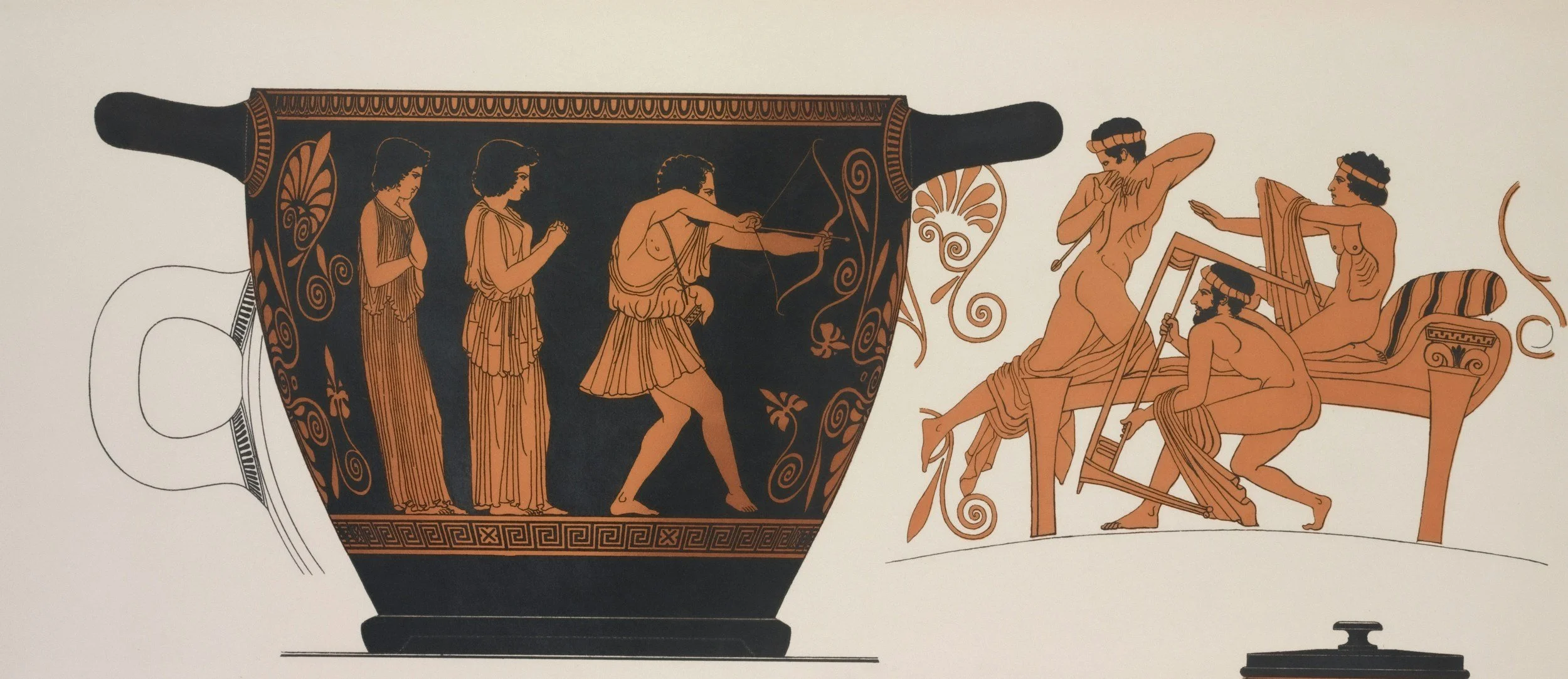
Most of us do not encounter Sirens, Cyclopes, or enchantresses before lunch. We do meet distraction, vanity, resentment, comfort, fear, and the endless temptation to call delay “preparation.” Ulysses remains useful because the voyage is ordinary.
The trouble with Ulysses is that he makes ordinary life look under-equipped.
He has Sirens, Cyclopes, witches, sea monsters, storms, a god who dislikes him personally, and an island full of people who eat a flower and immediately forget the point of going home.
Most of us have email.
And yet Thomas Taylor’s Neoplatonic reading of the Odyssey remains useful because the monsters are not the point. The point is navigation.
Taylor reads Ulysses as the rational soul traveling through the “stormy sea of generation”—the unstable world of embodiment, pleasure, pain, chance, fear, desire, memory, and change. The voyage is difficult not because Ulysses is weak, but because the world contains many places where a person can stop moving while believing he is still alive.[17]
This is the condition of Tuesday afternoon.
The Sirens of attention
The Sirens promise knowledge.
They sing of Troy, heroes, history, suffering, and all that occurs on the fertile earth. They offer the irresistible suggestion that if you only listen a little longer, you will finally know what is really going on.
Odysseus wants to hear them. He does not pretend otherwise. But he has himself tied to the mast and orders his crew not to release him, no matter how persuasive he becomes.
This is one of the oldest descriptions of practical self-knowledge.
A person does not master temptation merely by announcing that he is above temptation. He masters it by recognizing where he becomes foolish and arranging his life accordingly.
The modern Sirens are not difficult to find.
They sing through endless news cycles, arguments designed to provoke outrage, social media applause, mystery theories, flattering information, professional gossip, compulsive research that never becomes action, and the intoxicating illusion that consuming more material is the same as becoming wiser.
The Sirens do not usually ask us to do something obviously wicked. They ask us to give them our attention.
Attention is life’s most valuable currency. Whatever receives it repeatedly begins to shape the soul.
The wax in the ears may now be a schedule, a closed tab, a walk, a book, a friend, a rule of silence, a refusal to answer immediately, or the modest discipline of putting the telephone in another room.
Odysseus teaches that freedom sometimes begins with tying oneself to the mast.
Circe and the animal life
Circe turns men into swine.
The point is not that pigs are morally inferior. Pigs have not been offered philosophy, literature, ritual instruction, or a chance to attend a committee meeting. They are doing what pigs do.
The human problem begins when a rational being gives appetite complete authority.
Circe’s magic represents the condition in which desire changes the shape of life. The man who once had purposes, duties, friendships, standards, and a sense of direction begins to live from the next satisfaction. He becomes reactive. He consumes. He forgets.
The transformation is rarely as visible as Homer makes it.
No one wakes up with a tail.
But a person may notice that he is now ruled by food, drink, sex, money, praise, anger, shopping, resentment, convenience, or the need to be reassured. He may still speak intelligently. He may still wear good shoes. Yet the government of the soul has changed hands.
The remedy is not self-hatred. It is the recovery of reason.
Ulysses receives moly, the herb that protects him from Circe’s spell. In philosophical terms, this is the higher principle that prevents appetite from becoming sovereign. It may be moral training, friendship, prayer, study, ritual, discipline, memory, or a rule of life.
A man who knows where he is enchantable should not enter the witch’s house empty-handed.
Calypso and the seduction of comfort
Calypso offers Ulysses immortality.
He declines.
This decision becomes more interesting as one gets older.
Calypso gives him safety, beauty, eternal youth, sexual comfort, freedom from ordinary obligation, and a life in which no one expects him to repair anything, decide anything difficult, disappoint anyone, or return to a house full of complicated human beings.
It is not a bad offer.
It is also captivity.
The danger of Calypso is not pleasure itself. It is comfort without purpose. Ulysses is preserved, but he is not fulfilled. He is removed from danger, but also from the work that makes his life properly his.
Most people have a Calypso island.
It may be a habit of postponement. It may be a screen. It may be the idea that one will begin living once one is more prepared, more admired, less anxious, more secure, or somehow no longer subject to the ordinary conditions of being human.
Comfort becomes captivity when it persuades us to abandon the duties that would make us more whole.
Ulysses leaves Calypso because Ithaca, for all its difficulty, contains his proper work.
The Cyclops and the single eye
Polyphemus has one enormous eye.
This is not no vision. It is insufficient vision.
The Cyclops sees only from the center of his appetite. He has no hospitality, no civic sense, no reciprocity, no recognition that others possess dignity or interior lives. He sees food, threat, possession, and obstacle.
The single eye is a useful image for self-centeredness.
A person can be intelligent, successful, powerful, and single-eyed. He may understand his own needs very well while remaining unable to see how his actions appear from another person’s position. He may call this realism. Everyone else calls it exhausting.
Odysseus survives the Cyclops not through strength alone, but through language, timing, cooperation, and the ability to understand relation. “Nobody” is not merely a joke. It is a victory of intelligence over brute self-certainty.
The lesson is simple: the person who sees only himself sees badly.
Ithaca and the work of return
The great temptation in symbolic reading is to make everything abstract.
Ithaca is not merely the soul’s homeland. It is also a real home with duties, memories, relationships, land, inheritance, injustice, aging parents, a wife who has suffered, a son who has grown up without a father, servants who must be recognized, and a household that must be restored.
That is why Ulysses matters.
The end of the voyage is not escape. It is return to responsibility.
Taylor’s Ulysses is the soul trying to find its way home through the stormy sea of generation. But the return does not mean abandoning the world. It means ceasing to mistake every temporary island for the final destination.
The work of self-mastery happens in ordinary places:
Answering a message honestly instead of strategically.
Doing the work one has delayed.
Apologizing before the explanation becomes a fortress.
Refusing to feed resentment.
Turning off the Sirens.
Remembering that comfort is not always peace.
Asking whether one is seeing with one eye.
Returning to the people and duties that make a life real.
The voyage of the soul is rarely dramatic.
More often, it is a Tuesday afternoon and a decision about what will be allowed to govern the next hour.
Endnotes and further reading
Homer, Odyssey Books 9–12, on the Cyclops, Circe, the Sirens, and Calypso’s island; Book 13 and following, on Ulysses’ return to Ithaca.
Thomas Taylor, “An Explanation of the Allegory of the Wanderings of Ulysses,” appended to his 1823 Select Works of Porphyry.[17]
Porphyry, On the Cave of the Nymphs, preserving Numenius’ image of Ulysses’ passage over the “stormy sea of generation.”[11]
For the historical place of Porphyry’s Homeric allegory, see Robert Lamberton, Homer the Theologian.[18][19]
For a related article, see “The Long Way Home: Ulysses, the Soul, and the Philosophy of Return.”