Service Lodge and the Work of Relief
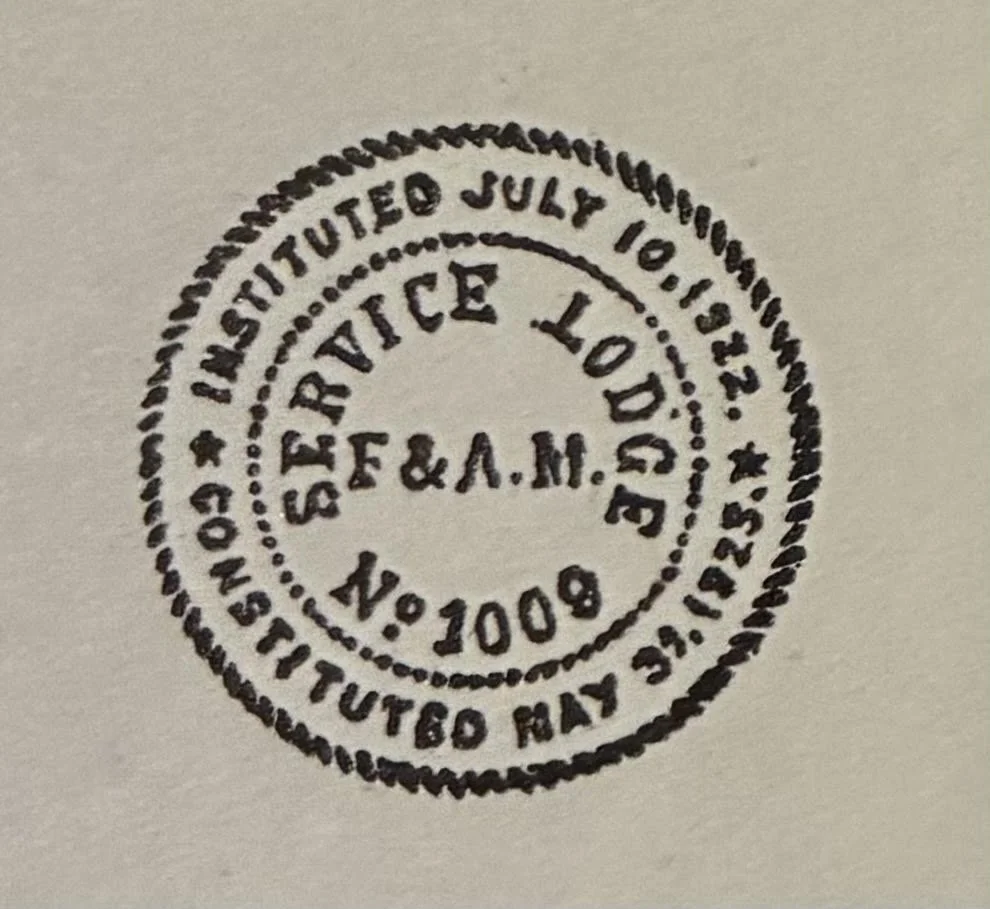
Official seal of Service Lodge No.1009, Flushing, Queens
How a Flushing Lodge Made Charity, Fellowship, and Everyday Usefulness Part of Its Masonic Identity.
Founded in 1923, Service Lodge No. 1009 grew from the civic and commercial life of Flushing. Its history was shaped not only by ritual and formal meetings, but by charitable giving, family events, public education, relief work, and a deeply practical belief that fraternity should be useful.
Some lodges are remembered for a famous building, a renowned member, or a dramatic historical event. Service Lodge No. 1009 carried a simpler word in its name—and spent decades trying to live up to it.^1
Service.^2
It was an ambitious name for a Masonic lodge, because it implied more than regular meetings and ceremonial work.^3 It suggested usefulness: to brethren, to families, to neighbors, to charitable institutions, and to the wider community.^4 The surviving records of Service Lodge show that its members took that obligation seriously.^5 They raised money, organized dinners and dances, supported hospitals and camps, participated in Masonic education, welcomed families, and maintained a culture of fellowship through the ordinary events that hold a voluntary institution together.^6
When Service Lodge eventually became part of Advance Service Mizpah Lodge No. 586, it brought with it more than a name and a number.^7 It carried a tradition of practical charity that remains one of the central features of the present lodge’s inheritance.^8
A Lodge for a Growing Flushing
Service Lodge No. 1009 was founded in Flushing in 1923, when Queens was entering one of the most transformative periods in its history.^9
The borough had become part of Greater New York only twenty-five years earlier, but its growth was accelerating.^10 New transportation connections, real-estate development, business districts, schools, civic organizations, and immigrant communities were reshaping Queens.^11 Flushing, long one of the borough’s historic centers, was becoming a more densely populated and commercially active neighborhood while retaining its local civic identity.^12
A new Masonic lodge in Flushing was therefore more than an additional meeting place.^13 It was part of a wider network of institutions helping residents create continuity amid rapid change.^14
Service Lodge joined a Queens Masonic world that already included older bodies such as Jamaica Lodge, Cornucopia Lodge, Island City Lodge, Mizpah Lodge, Advance Lodge, and others.^15 Yet its name distinguished it.^16 The word “Service” announced an ideal that could be measured not in speeches, but in action.^17
Its members would later build their fellowship through charity drives, educational programs, social events, district work, and support for the needs of brethren and their families.^18
The Useful Work of a Lodge
Masonic charity is often described through the word “relief.”^19 In practice, that relief may take many forms: assistance to a brother in distress, support for widows and children, contributions to hospitals, help for veterans, donations to youth programs, aid to a community organization, or funds raised for a family facing hardship.^20
Service Lodge made such work central to its identity.^21
Its records describe contributions to the Jewish Settlement House of the West Side, Camp Louemma, the Masonic Foundation for Medical Research and Human Welfare, hospitals, veterans’ causes, Jewish communal organizations, temples and synagogues, and other charitable efforts.^22 These donations were made through both regular lodge funds and special fundraising campaigns.^23
The lodge also supported the Masonic Brotherhood Fund, relief work, and a range of local and statewide Masonic causes.^24 Its charitable activity was not confined to one constituency or one neighborhood.^25 It reflected the broad civic outlook of postwar Queens, where fraternal organizations often served as bridges between members’ private lives and the wider public need.^26
This practical ethic was especially visible in the lodge’s annual charity dinners and journals.^27 Such events combined social life with fundraising.^28 Members and guests came together for food, music, recognition, and fellowship, while the proceeds supported causes beyond the lodge room.^29
The social event was never merely social.^30 It became a mechanism for relief.^31
Flushing Fellowship Beyond the Lodge Room
Service Lodge did not build community only through formal communications.^32
Its records include fishing trips, bowling leagues, family dinners, ladies’ nights, anniversary dances, joint communications, reunions, testimonial events, and outings that brought Masons, spouses, children, relatives, and friends into the life of the lodge.^33
These gatherings may seem secondary when compared with the formal work of a lodge.^34 In reality, they were essential.^35 Voluntary institutions survive when members develop friendships, when families feel welcome, and when the organization becomes part of the rhythm of ordinary life.^36
One Service Lodge fishing trip took members and their families to Freeport aboard the Corsair.^37 The details were straightforward: bring lunch and rods, reserve a place, enjoy a day on the water.^38 But the event represented something larger.^39 It gave brethren a chance to know one another outside formal attire and ritual surroundings.^40
The lodge also organized mixed bowling leagues, dances, raceway outings, and weekend trips.^41 Such activities created a social culture that encouraged members to return, bring their families, and sustain ties across generations.^42
This was not an escape from the lodge’s Masonic purpose.^43 It was part of how that purpose became durable.^44
Ritual, Education, and Public Programs
Service Lodge valued ritual work, but it also treated education as an important Masonic responsibility.^45
In 1956, the lodge marked the 175th anniversary of the Grand Lodge of New York with a program on the formation and development of the Grand Lodge.^46 Such occasions gave members a chance to understand their own institution not merely as a local body, but as part of a larger historical tradition.^47
The lodge also reestablished a Fellowcraft team in 1952 after a twenty-five-year lapse.^48 The team performed the dramatic work associated with the Master Mason degree, reflecting a commitment to ritual proficiency and the educational value of well-presented degree work.^49
Lectures, special programs, anniversary events, and visiting speakers further connected Service Lodge to broader Masonic and civic conversations.^50 The lodge participated in joint events with other Queens lodges, including Geba and King David, and took part in observances connected with George Washington, Masonic history, and public service.^51
This emphasis on education had a practical purpose.^52 A lodge was not meant to be a club whose members simply attended meetings.^53 It was meant to be a place where men could learn, reflect, develop leadership, and understand the values behind the ceremonies they performed.^54
Max Rosenzweig and the Meaning of Service
One figure who captures the character of Service Lodge was Max S. Rosenzweig.^55
Raised in 1942 and serving as Master in 1949, Rosenzweig was later appointed Assistant Grand Lecturer for the district.^56 He served on the board of the Queens Masonic Association and had earlier participated in the Queens Masonic Study Club.^57
His life extended beyond lodge office.^58 He was active in Temple Gates of Prayer, known among Flushing merchants, and involved in Scottish Rite Masonry.^59 After moving to Florida, he became president of the Empire State Club of Florida, an organization of New York Masons living in southern Florida.^60
Rosenzweig’s career illustrates an important feature of Masonic life in the mid-twentieth century.^61 A brother’s lodge membership often connected with other forms of service: religious life, professional associations, educational work, charitable organizations, and civic activity.^62
Service Lodge honored him not simply because he had held office, but because he had continued to assist successive Masters and remained deeply engaged in the life of the Craft.^63
The lesson was clear: service did not end when a term of office expired.^64
City Lodge Comes to Flushing
In 1973, Service Lodge entered a new stage in its history when it consolidated with City Lodge No. 408.^65
City Lodge had been founded in Manhattan in 1856 and brought with it a very different but complementary history.^66 In the nineteenth century, City Lodge had held public balls, formal presentations, commemorative dinners, and charitable events in the highly visible culture of Manhattan Masonry.^67 Its famous 1870 ball at the Academy of Music raised funds for distressed Master Masons in Cuba.^68
City Lodge’s traditions of public ceremony, charity, and metropolitan fellowship joined Service Lodge’s Flushing tradition of practical local service.^69
The consolidated body became Service City Lodge No. 1009.^70
The name itself told a story.^71 “Service” came first, preserving the Flushing lodge’s ethic of usefulness.^72 “City” carried forward the older Manhattan body whose members had practiced charity through public ceremony and civic presence.^73
The merger did not erase either lodge.^74 It created a shared inheritance.^75
Geba Joins the Lineage
In 1982, Service City Lodge No. 1009 consolidated with Geba Lodge No. 954.^76 The union created Service City Geba Lodge No. 1009.^77
That merger joined three distinct New York histories:^78
City Lodge’s Manhattan tradition of formal public philanthropy.^79
Service Lodge’s Flushing-centered culture of charity and fellowship.^80
Geba Lodge’s Elmhurst story of professionals, merchants, entertainers, and modern Queens life.^81
The combined lodge carried members and traditions from all three places.^82 It also reflected the changing structure of fraternal life in late twentieth-century New York.^83 Lodges were learning to preserve their work by combining resources, memories, and memberships rather than allowing individual histories to disappear.^84
For Service Lodge, consolidation was not a retreat from its founding ideal.^85 It was another form of service: preserving Masonic life for future members.^86
A Living Ethic in Lodge No. 586
In 2018, Service City Geba Lodge No. 1009 consolidated with Advance Island City Mizpah Lodge No. 586.^87 The result was Advance Service Mizpah Lodge No. 586.^88
The present lodge now carries the history of six earlier lodges.^89 But Service Lodge’s contribution is especially clear in the title itself.^90
Service remains visible because it remains relevant.^91
The history of a lodge is not only found in cornerstone ceremonies, Grand Lodge titles, and famous names.^92 It is also found in the less dramatic work: organizing a dinner, visiting a brother, sending a donation, welcoming a family, preparing a degree, supporting a charity, arranging a ride, or making sure that someone who has been absent knows that he is remembered.^93
That was the work Service Lodge took seriously.^94
Its inheritance survives whenever Advance Service Mizpah Lodge No. 586 treats fraternity not as an abstraction, but as a responsibility to be practiced.^95
End Notes
Author’s note:
I write as an individual Freemason, historian, and researcher. This article reflects my personal research and interpretation and does not represent an official statement of Advance Service Mizpah Lodge No. 586, the Grand Lodge of New York, or any other Masonic organization.
Image:
Author's private collection.
Literary:
Sources to come - Researchers feel free to request on my contact page