Early Newtown, Queens: From Mespat to Modern Queens
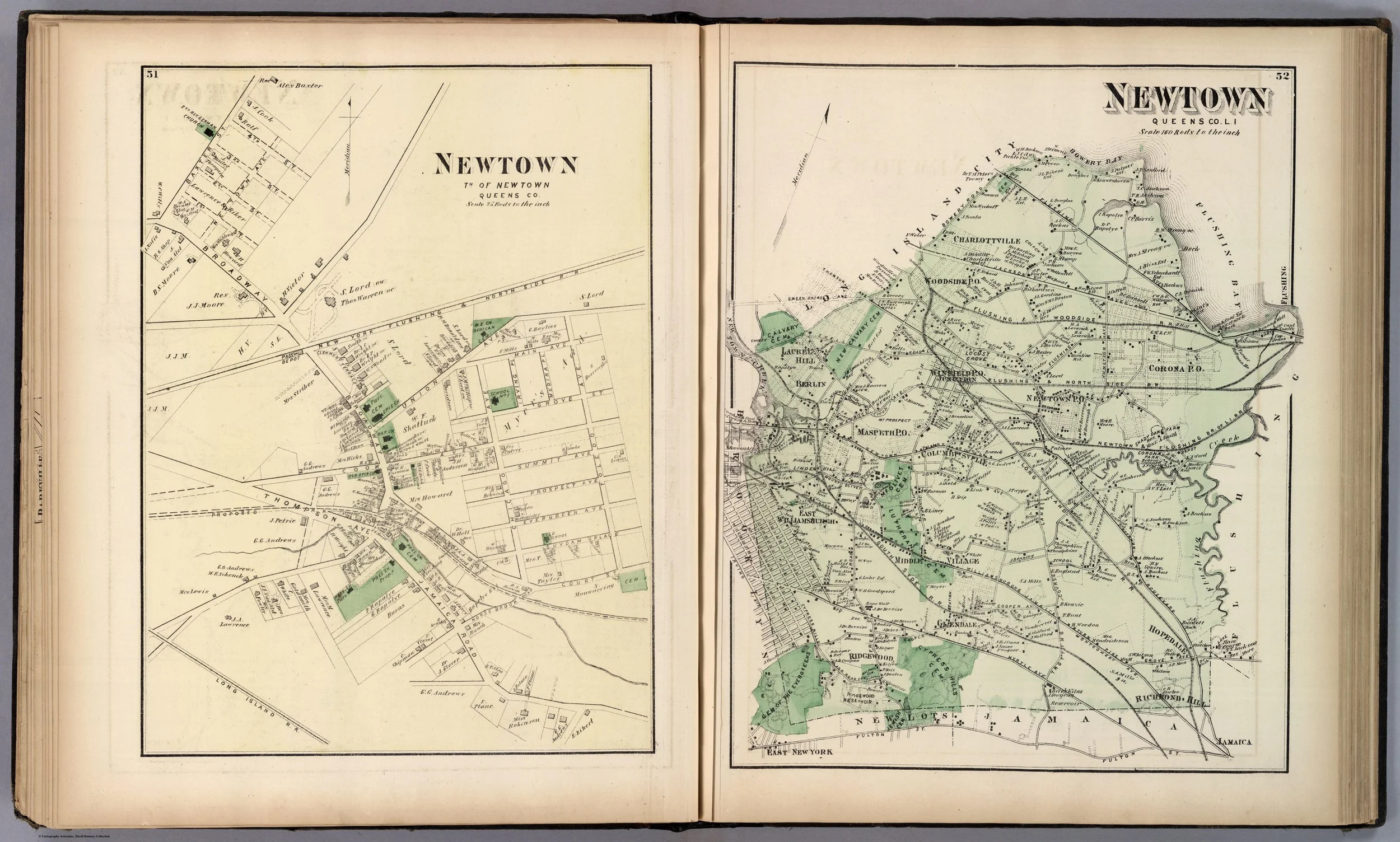
Middle Village, Newtown, & part of Astoria, by F.W. Beers, 1873. David Rumsey Map Collection.[7]
This eight-part series explores the early history of Newtown, now part of Queens, using James Riker Jr.’s 1852 Annals of Newtown as a starting point. Each article blends rigorous research with an engaging narrative, moving from Indigenous Mespat and the failed Doughty colony to the founding of Middelburg, the 1656 land purchase, waterfront farms, religious conflict, political revolt, and the question of how to use Riker in modern local-history research.1
These articles will grow as I add comparative sources and dig up interesting stories.
Series structure and internal linking map
1. Before Newtown, There Was Mespat
Focus: Indigenous Mespat, waterways, meadows, and the Dutch arrival.
Blurb: Before Newtown and modern Queens, Mespat was a Native homeland of forests, meadows, creeks, and tidal waters shaped by Dutch colonial expansion.1
Internal links:
2. Francis Doughty and the Lost Colony of Mespat
Focus: The 1642 patent, religious dissent, settlement, war, destruction, and internal dispute.
Blurb: In 1642, Rev. Francis Doughty obtained a vast patent at Mespat; war, dispute, and Dutch authority ended his colony—yet it shaped early Queens.1
Internal links:
Previous: Before Newtown, There Was Mespat
3. When Middelburg Became Newtown
Focus: The 1652 English settlement, early village life, government, fields, homes, and town formation.
Blurb: In 1652, English settlers founded Middelburg in western Long Island; by 1656, a new town was taking shape—later called Newtown, now part of Queens.1
Internal links:
4. Newtown’s First Land Deal
Focus: The 1656 purchase from sachems Rowerowestco and Pomwaukon, the “Indian rate,” and land title.
Blurb: In 1656, Middelburg’s settlers bought land rights from sachems Rowerowestco and Pomwaukon; the deed and purchaser list reveal early Queens in layers.1
Internal links:
Previous: When Middelburg Became Newtown
Next: Maspeth Creek, Dutch Kills, and the Forgotten Waterfront Farms
5. Maspeth Creek, Dutch Kills, and the Forgotten Waterfront Farms
Focus: Early plantations, Poor Bowery, Burger’s Kill, Dominie’s Hook, mills, meadows, and the waterfront economy.
Blurb: Before neighborhoods, there were waterfront farms: Mespat Kill, Dutch Kills, and Hell Gate shaped early Newtown’s economy, landscape, and power.1
Internal links:
Previous: Newtown’s First Land Deal
6. Fear, Faith, and Peter Stuyvesant
Focus: John Moore’s ministry, unauthorized worship, Dutch authority, and religious conflict in early Newtown.
Blurb: In early Newtown, English settlers, Dutch authorities, and local ministers clashed over worship, authority, and conscience; the results shaped Queens.1
Internal links:
7. The Village That Briefly Became Hastings
Focus: Political revolt, Connecticut’s claim, the name change to Hastings, and adoption of English laws.
Blurb: In the 1660s, English settlers in Newtown renounced Dutch rule, adopted English laws, and briefly became “Hastings” under Connecticut.1
Internal links:
Previous: Fear, Faith, and Peter Stuyvesant
8. From Wild Mespat to Modern Queens
Focus: Reflective capstone on Riker’s Annals, what it gets right and wrong, and how to use it in modern research.
Blurb: James Riker’s 1852 Annals of Newtown shaped how we see early Queens; this essay asks what it gets right, what it misses, and how to use it now.1
Internal links:
Previous: The Village That Briefly Became Hastings
Back to series hub: Early Newtown, Queens
About this series
This series reinterprets James Riker Jr.’s 1852 Annals of Newtown for a modern audience. Each article blends rigorous historical research with an engaging narrative, designed for local-history readers, magazine audiences, and researchers working on Queens, Maspeth, Astoria, Flushing, and western Long Island.1
Sources
[7] "Middle Village, Tn. of Newtown, Queens Co.; Part of Astoria, Long Island City, Queens Co., L.I.," by F.W. Beers, published by Beers, Comstock & Cline, 1873, in Atlas of Long Island, New York, from Recent and Actual Surveys and Records under the Superintendence of F.W. Beers (New York, 1873). From the David Rumsey Map Collection, David Rumsey Map Center, Stanford University Libraries. Accessed via: David Rumsey/ Map of Newtown
1 pasted_text_1787366318.txt https://ppl-ai-file-upload.s3.amazonaws.com/web/direct-files/attachments/65146202/d5eb84f8-36bc-4306-b41b-17a5a413c3fb/pasted_text_1787366318.txt?AWSAccessKeyId=ASIA2F3EMEYERSFOPVAB&Signature=5hk%2FgQJZ1HrtyMfhQpcOszk5v9U%3D&x-amz-security-token=IQoJb3JpZ2luX2VjEOv%2F%2F%2F%2F%2F%2F%2F%2F%2F%2FwEaCXVzLWVhc3QtMSJHMEUCIDk%2BI5TFGTNdRLOQCl2SjAcqicBUAg1DH%2BYEWYqrgo0CAiEAgJ7NwW1La8qGvspznqhFX%2FRNjU6SFyYwZiE%2F7EOmJvgq%2FAQItP%2F%2F%2F%2F%2F%2F%2F%2F%2F%2FARABGgw2OTk3NTMzMDk3MDUiDLb3UpzLwtPj02kqkirQBIHEVHmFgIMhacisrcANBAC2e9bEsxALxA1NPD1kkCWp8f3YDGUnl1It3ag1cs4I4thqf7uG5knIA02x7pBSKCjCe5xVZmjT21tjHkPj0z7kEyCS833X5ZXt5z79yc2FSXcVFZJb8%2FR4M9JhsBIZHh3NOtcWEcYowyShJaQaa68cppX9BmVdFrgzysmT9w%2Ba6jyqZovrFlUGiSHmQv3moxAHKdFstNM31rnY4oj8zKhxEgZJXINQZt7PFL%2FoOT9ZneyJkvZum%2BHVns%2B%2BhF2%2B6PayHVGUS8GlcYh80lkCw907QtEwUaVp3NRoFpI24nTLr0dMjxkQJzQMagNCdunLW%2FYKzLWgmvRyYhaFOsVzRJenoJVMO72kFTEjkSHoKHiylH7pOSYVFj%2BRaao7njuSqYlPukHfCS7JKDiLUgDA19F055qkPUM7bgWd1g37oiyJtpd5DhgdUrthWF57f3BeENYn9RnP%2B969o2Ie03cc%2BM3GLsW3M%2FiM4bw3MzDR2A6Bl82BnOUeEz%2Fe3epcYI4zCsdoYEGR8%2FdmgSIASdPxMqWdL5HsjjZM9FRTFhgVv5EvhH9fWvt%2FDOZuLv54hrp2ZsVNOWlKyDc7OqewlqRU6c8aNw9JJSZV9Fw6sjwwkNri2WuaHIv7oksBXlR1i5aHtvfmYXe2oGS9r8BNFV495tQ9%2BSbFOhsgggnLnnxBknSSIb4RYqKSe8bhby8j41PoznAISo1d1Fadpt96DRYC3yY225sbc77jTJtb0prlaM%2FEWCAehTuzoSP%2BNTNuUkP4IggwpJyk1AY6mAFp8bPasHu7PIdFKJ1BM2lMyUnaMHWV2ZVO3Gb%2FjBJXFCvzzoBJPl6izAh%2BypVfbNCbTfGbEhpXpa97e4QqzR7oq3tUQ1PQVD4cFDLEtMOozAxq%2F9iZRkKQAB5lVtSjKsZRtVXUClxZfkQoaJei6qD0YuIUXh6CDM84I1urmGElTy6QcmmP0gouqFd49L4hbbpS2tPfRqQSYA%3D%3D&Expires=1787370487