What Freemasonry Is: Ritual, Symbol, and Moral Formation
People often hear the word “Freemasonry” and picture one of three things: secrecy, old buildings, or conspiracy theories. None of those gets to the point.
Freemasonry is best understood as a fraternal tradition that uses symbols, ceremonies, and moral instruction to encourage self-discipline, reflection, charity, and fellowship. It is not simply a social club, though it is social. It is not a religion, though it speaks seriously about moral life and usually asks members to believe in God or a Supreme Being. It is not a political movement, though Masons, like everyone else, live in political societies. And it is not a hidden government behind the visible one, despite the fantasies that have attached themselves to it for centuries.
If you want the simple version, here it is: Freemasonry is a voluntary brotherhood that teaches through symbols.
That is the core idea.
Start with the obvious question
Why would grown men join something that uses aprons, old forms, formal meetings, and symbolic language about stones, tools, and building?
Because human beings do not live by information alone. We live by habits, stories, examples, and forms that help us organize our conduct. Freemasonry belongs to that older world. It assumes that character is not built by slogans. It is built by discipline, repetition, self-examination, and shared standards.
So instead of teaching morality like a rule sheet, Freemasonry teaches indirectly. It uses ritual drama, symbols, and traditional emblems to make moral lessons memorable. The point is not to turn members into archaeologists of obscure customs. The point is to give them a language in which to think about integrity, restraint, duty, truthfulness, brotherhood, and self-improvement.
That is why symbols matter so much in Masonry. They are not decoration. They are teaching tools.
Why it is called Freemasonry
The name comes from the historical connection, real and partly legendary, between modern Freemasonry and the stonemasons’ craft guilds of medieval Europe. Those working masons built in stone. They had tools, trade secrets, ranks, rules, and systems of instruction. Over time, the older world of operative masonry gave way to what is usually called speculative Masonry.
That phrase matters.
Operative masonry means actual stonework. Speculative masonry means using the language of building as a way of thinking about human character. Instead of shaping literal stone, the Mason is taught to think about shaping himself. Instead of constructing a cathedral wall, he is asked to consider the work of building a better life.
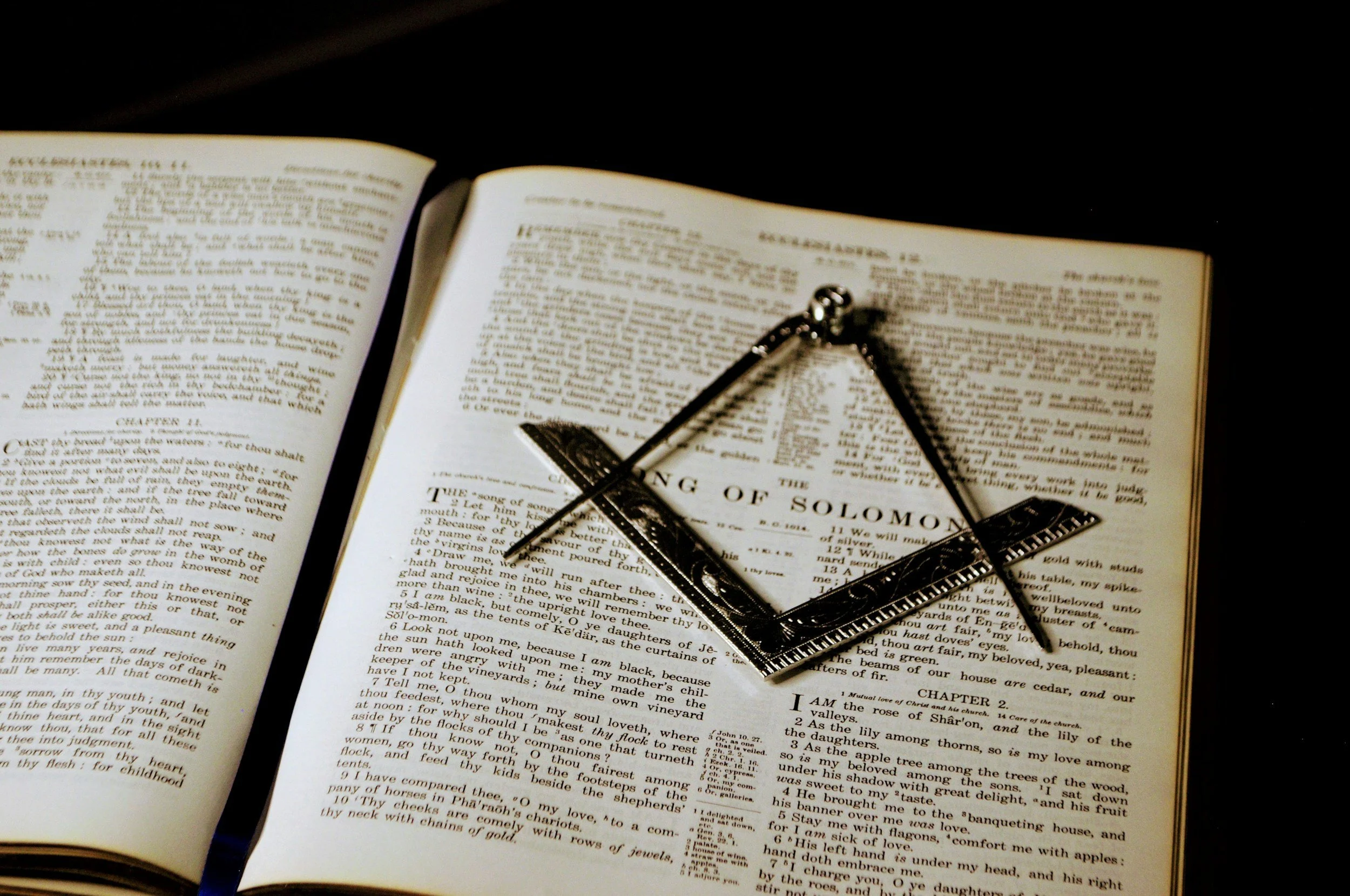
This is one of the simplest ways to understand the tradition. Freemasonry takes the tools and vocabulary of builders and turns them into a moral system of instruction.[1]
A square is no longer just a tool. It becomes a reminder of honesty and right conduct. A rough stone is no longer just a block from the quarry. It becomes an image of the unfinished self. A temple is no longer only a building. It becomes a way of thinking about order, purpose, and disciplined construction.
Once you see that, much of Masonry stops looking strange.
Is Freemasonry a religion?
No.
This is one of the most common points of confusion. Freemasonry is not a religion, does not offer salvation, does not administer sacraments, and does not claim to replace a church, synagogue, mosque, or other house of worship. Mainstream Masonic jurisdictions have said this plainly for a very long time.[2]
So why do people get confused?
Because Freemasonry does involve ceremonial forms, moral language, and references to God. It also asks candidates, in most regular jurisdictions, to affirm belief in a Supreme Being. That makes it religious-adjacent in the very loose sense that it takes moral and metaphysical questions seriously. But that is not the same as being a religion.
A simple comparison helps. A courtroom is serious, formal, and full of ritual. But it is not a church. A university graduation has robes, symbols, and ceremonial language. But it is not a sacrament. Freemasonry works in a similar way. It uses solemn forms to frame moral ideas, but it does not exist to worship in the way religions do.
In fact, one of its recurring rules is that sectarian religious disputes should not dominate lodge life. Freemasonry aims to gather men of different backgrounds on shared ethical ground, not erase their differences or create a new theology for them.[3]
Is Freemasonry secret?
Better to say that it is private and traditional than “secret” in the melodramatic sense.
Freemasonry has long been called a secret society, but this often confuses more than it explains. Its existence is public. Its buildings are public. Many of its members are public. Large parts of its history, structure, charitable work, and symbolism are easy to find in books and archives. Even many ritual details have been published for centuries, whether Masons like it or not.
So what is private?
Mainly three things:
the exact form of certain ceremonies
traditional modes of recognition
the personal experience of initiation and membership
That kind of privacy is not unusual. Families have private customs. Universities have closed meetings. Courts sometimes deliberate in private. Religious communities reserve certain experiences for members. Privacy does not automatically imply sinister intent.
The better question is not “What are they hiding?” but “Why preserve form at all?”
The answer is that ceremony works partly because it is experienced, not merely described. If every meaningful experience were reduced to spoiler notes, some of its power would vanish. Freemasonry preserves forms because it treats initiation as something to undergo, not just something to explain.[4]
That said, secrecy has also fueled fantasy. Where there is privacy, people often project power. That is one reason Masonry has been repeatedly accused of controlling politics, finance, or culture from the shadows. Such claims say more about the public imagination than about ordinary lodge life.
What happens in a lodge?
At the most basic level, a lodge is a local body of Freemasons that meets regularly. It handles ordinary organizational business, admits and instructs members, performs ceremonies, supports charitable activity, and maintains a fraternal community.
This is important because people often imagine Masonry as all symbol and no structure. In fact, it is highly structured.
There are officers, meetings, rules of order, minutes, ballots, committees, finances, and administrative responsibilities. In that sense, a lodge is an institution, not just a mood. It is held together by repeated practice.
But structure alone does not explain why anyone cares about it.
What gives a lodge its distinctive character is that it combines governance with ritual and fellowship. A man does not merely attend as he might attend a casual club. He enters a setting shaped by inherited forms. The room is arranged deliberately. Offices have meaning. words and movements matter. The whole setting teaches that conduct should rise to the level of the institution.
That may sound old-fashioned. It is old-fashioned. That is part of the point.
Freemasonry assumes that form can train attention. And attention, in turn, can train character.
What are the degrees?
In most mainstream forms of Freemasonry, the basic system is organized around three degrees:
Entered Apprentice
Fellow Craft
Master Mason
You can think of these as stages of initiation and instruction.[5]
A degree is not just a rank to collect. At least ideally, it is a structured lesson. Each degree introduces symbols, themes, obligations, and moral teachings in a staged way. The candidate is not merely told ideas. He is led through a dramatic framework designed to make those ideas stick.
This is where many outsiders misunderstand the whole enterprise. They assume the goal is advancement in status, as though Masonry were a ladder of secret promotions. But the degree system is supposed to work more like education than bureaucracy. It unfolds a moral vocabulary progressively.
Of course, human beings being human, some members inevitably become more interested in office, prestige, and titles than in instruction. That is not unique to Freemasonry. The same thing happens in religion, academia, business, and public service. But the ideal of Masonry is not accumulation. It is formation.
That difference matters.
What does Freemasonry teach?
This is where people often expect either a hidden doctrine or a grand revelation. In ordinary practice, what Freemasonry teaches is less sensational and more demanding.
It teaches that character requires work.
Its symbols return again and again to a few broad themes:
self-mastery
honesty
duty
temperance
charity
fidelity
brotherhood
reverence
mortality
improvement through discipline
None of these ideas is uniquely Masonic. That is worth saying clearly. Freemasonry did not invent morality. What it did create was a distinctive symbolic method for thinking about it.
The method matters. People often ignore truths they can recite easily. But when an idea is embedded in image, ritual, movement, memory, and repetition, it can reach deeper. Freemasonry tries to teach in that way.
Take the image of a rough stone being shaped into a finished one. You do not need a graduate seminar to understand it. The image does the work. Human beings begin incomplete. They are shaped through labor, correction, and intention. That is the lesson.
This is what I mean by saying Freemasonry teaches through symbols. It does not mainly argue. It presents.
Is Freemasonry ancient?
It depends what you mean by “ancient.”
If you mean the modern institution in its recognizable form, then no, it is not ancient in the Egyptian or biblical sense. The usual historical account places the organized beginnings of modern Freemasonry in the late seventeenth and early eighteenth centuries, especially around the formation of the first Grand Lodge in London in 1717.[6]
If you mean that it draws on older materials, older legends, older symbols, and older architectural and moral ideas, then yes, it is deeply traditional. Freemasonry is not ancient in the sense conspiracy myths want it to be. But it is old enough, layered enough, and symbolically rich enough to feel ancient to modern people.
That distinction is useful.
A thing does not have to come from Atlantis to be historically interesting. Freemasonry is interesting because it carries forward older ways of teaching: by emblem, by ceremony, by rank, by memory, and by shared form.
Why has Freemasonry attracted suspicion?
Because it combines privacy, symbolism, male fellowship, hierarchy, and historical influence. That is almost a machine for generating suspicion.
Whenever a group is selective, uses ceremonies, keeps some matters private, and includes powerful or respectable men among its members, rumors begin. Add to that anti-Catholic fear, anti-Masonic political movements, revolutionary anxieties, and modern conspiracy culture, and you get the cloud of legend that has followed Masonry for generations.[7]
Some criticism has been moral or theological. Some has been political. Some has been absurd. The absurd part is easy to recognize: claims that ordinary lodge members are secretly directing world events through coded symbols and occult influence. This badly misunderstands the scale and texture of actual Masonic life, which is usually much more local, routine, charitable, institutional, and human than its enemies or fantasists imagine.
The more serious historical criticisms deserve to be studied soberly. Freemasonry has, at times and places, reflected the blind spots and exclusions of the societies in which it existed. It has not floated above history. No human institution does.
But criticism is not the same as fantasy. To understand Masonry, you have to separate documented history from projection.
Why does Freemasonry still exist?
This is the real test. If Freemasonry were only a historical leftover, it would have vanished.
It still exists because it answers durable human needs.
People want belonging, but not only casual belonging. They want meaningful belonging. They want forms that mark seriousness. They want a place where memory matters, where moral language is still allowed to be formal, where self-improvement is treated as a discipline instead of a slogan, and where friendship is tied to obligation.
Freemasonry offers that, at least when it is healthy.
It offers a framework in which men can step briefly out of the flatness of ordinary life and enter a space shaped by tradition, ceremony, and reflection. It reminds them that not everything valuable is efficient, modern, or transparent. Some things are worth preserving because they slow us down and ask more of us.
That may not appeal to everyone. It is not supposed to.
But it explains why Freemasonry has survived long after many of the social worlds that nourished it first began to fade.
So what is Freemasonry?
Now we can answer the question again, more fully.
Freemasonry is a voluntary fraternal institution that uses inherited ceremonies, symbolic language, and structured moral instruction to cultivate fellowship, self-discipline, charity, and reflection.
Or more simply:
Freemasonry is a brotherhood that teaches men to think about how to build a life.
Not by giving them a list of opinions.
Not by replacing religion.
Not by revealing a secret theory of the universe.
But by using symbols, forms, and traditions to make moral work harder to forget.
That is what Freemasonry is.
Endnotes
Author’s note:
I write as an individual Freemason, historian, and researcher. This article reflects my personal research and interpretation and does not represent an official statement of Advance Service Mizpah Lodge No. 586, the Grand Lodge of New York, or any other Masonic organization.
[1] David Stevenson, The Origins of Freemasonry: Scotland’s Century, 1590–1710 (Cambridge: Cambridge University Press, 1988); Andrew Prescott, “The Old Charges Revisited,” in Transactions of the Leicester Lodge of Research, and standard overviews in Douglas Knoop and G. P. Jones, The Genesis of Freemasonry (Manchester: Manchester University Press, 1947).
[2] United Grand Lodge of England, “Basic Principles for Grand Lodge Recognition” and public explanatory materials on Freemasonry’s non-religious character; see also Aims and Relationships of the Craft (UGLE).
[3] James Anderson, The Constitutions of the Free-Masons (London, 1723), especially the charges concerning religion and conduct; see also UGLE, Aims and Relationships of the Craft.
[4] For the public/private distinction and longstanding publication of Masonic materials, see Jessica Harland-Jacobs, Builders of Empire: Freemasons and British Imperialism, 1717–1927 (Chapel Hill: University of North Carolina Press, 2007), and Steven C. Bullock, Revolutionary Brotherhood: Freemasonry and the Transformation of the American Social Order, 1730–1840 (Chapel Hill: University of North Carolina Press, 1996).
[5] On the three-degree Craft structure and its development, see Knoop and Jones, The Genesis of Freemasonry; Stevenson, The Origins of Freemasonry; and Robert Freke Gould, A Concise History of Freemasonry (1903).
[6] Margaret C. Jacob, The Origins of Freemasonry: Facts and Fictions (Philadelphia: University of Pennsylvania Press, 2007); Stevenson, The Origins of Freemasonry.
[7] On anti-Masonry and its political and cultural history, see Bullock, Revolutionary Brotherhood; Paul Goodman, Towards a Christian Republic: Antimasonry and the Great Transition in New England, 1826–1836 (Oxford University Press, 1988); and Jacob, The Origins of Freemasonry: Facts and Fictions.