Ulysses Was Not Lost at Sea: Thomas Taylor and the Soul’s Long Voyage
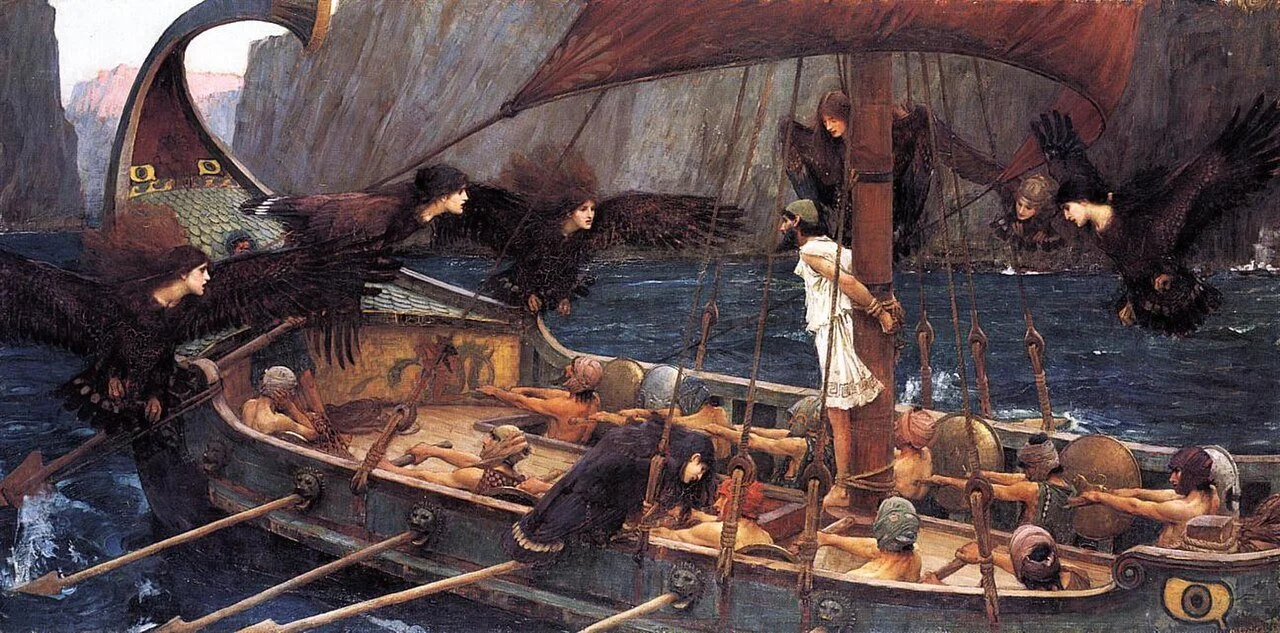
Thomas Taylor read the Odyssey as more than an adventure story. For him, Ulysses was the rational soul crossing the unstable sea of embodied life, trying—against appetite, illusion, and divine inconvenience—to get home.
The Odyssey begins with a practical problem: a man wants to go home, and nearly everything in the Mediterranean disagrees.
There are storms, giants, witches, seductive songs, divine grudges, enchanted islands, bad crew discipline, and one memorable livestock decision that ruins the schedule for everyone. Odysseus is delayed for ten years after the Trojan War, which suggests that ancient travel insurance was not yet fully developed.
But Thomas Taylor, the English Platonist and indefatigable translator of Greek philosophy, saw in these wanderings a second journey. Ulysses was not merely a king struggling to reach Ithaca. He was the human soul struggling to return from the world of change, appetite, sensation, confusion, and forgetfulness to its proper intellectual home.
Taylor’s essay, “An Explanation of the Allegory of the Wanderings of Ulysses,” appeared as an appendix to his 1823 Select Works of Porphyry. It followed his translations of Porphyry’s On Abstinence from Animal Food, On the Cave of the Nymphs, and the Auxiliaries to the Perception of Intelligibles, better known today as the Sentences.[1][2]
Taylor’s Ulysses is therefore not an arbitrary Victorian invention. He is a later Platonist reconstruction built from a genuine ancient tradition of reading Homer philosophically.
The sea of generation
Taylor’s central image comes from Porphyry’s On the Cave of the Nymphs, where Porphyry quotes Numenius. Numenius describes Ulysses as a person who passes “in a regular manner over the stormy sea of generation” and finally reaches a region where the sea and its storms are unknown.
This is the key.
The sea is not merely salt water. It is generation: the changing world of becoming, bodily existence, birth and death, pleasure and pain, accident and necessity. The sea looks beautiful from shore. It is less beautiful when it has tipped the ship sideways and removed your provisions. This, for the Platonists, is an accurate description of the sensible world.
The world is real. It is ordered. It can be magnificent. But it is unstable. Nothing in it stays put. A person who anchors his identity entirely in its changing conditions is like a sailor tying his boat to a wave.[3][4]
Ulysses becomes the soul precisely because he does not mistake the sea for home.
Ithaca is not nostalgia
It would be easy to read Ithaca as simple nostalgia: home, family, land, old furniture, the faithful dog, and the place where the coffee is made correctly. Homer certainly gives us all of that.
But Taylor’s Platonic Ithaca is more demanding. It is the soul’s return to proper order. It is not merely a place one remembers. It is the condition in which the rational self no longer wanders under the government of appetite, fear, enchantment, and external fortune.
This helps explain why the journey matters more than the destination. Odysseus cannot simply be dropped at Ithaca in Book Five and asked to behave himself. He has to become the kind of person who can recognize home, reclaim his household, and restore order.
A soul that has not learned discrimination will bring its shipwrecks with it.
The Masonic reader at the shoreline
For a Freemason, the connection here is philosophical rather than historical. There is no need to pretend Homer was waiting in the anteroom of a lodge. Yet the analogy is strong.
The Masonic journey, especially in its educational and moral dimensions, assumes that a man is not finished when he arrives. He becomes more capable through discipline, reflection, symbolic labor, fellowship, and the cultivation of mind and character.
Taylor’s Ulysses makes the same point in sea-weather rather than lodge architecture. The journey is not an escape from the world. It is the acquisition of the intelligence required to live in it without becoming lost in it.
The great danger is not that the soul will have no adventures. It is that it will begin to call the wrong island home.
Endnotes
Thomas Taylor, trans., Select Works of Porphyry (London: Thomas Rodd, 1823), including Taylor’s appendix, “An Explanation of the Allegory of the Wanderings of Ulysses.”[1][2]
Porphyry, On the Cave of the Nymphs, interprets the cave described in Odyssey 13.102–112 and preserves the crucial citation of Numenius concerning Ulysses and the “stormy sea of generation.”[3][4]
For a modern translation and introduction, see Robert Lamberton, trans., Porphyry: On the Cave of the Nymphs (Station Hill Press, 1983).[5][6]
For the major modern monograph, see K. Nilüfer Akçay, Porphyry’s On the Cave of the Nymphs in Its Intellectual Context (Brill, 2019).[7][8]