The Cave at Ithaca: Porphyry’s Map of the Cosmos
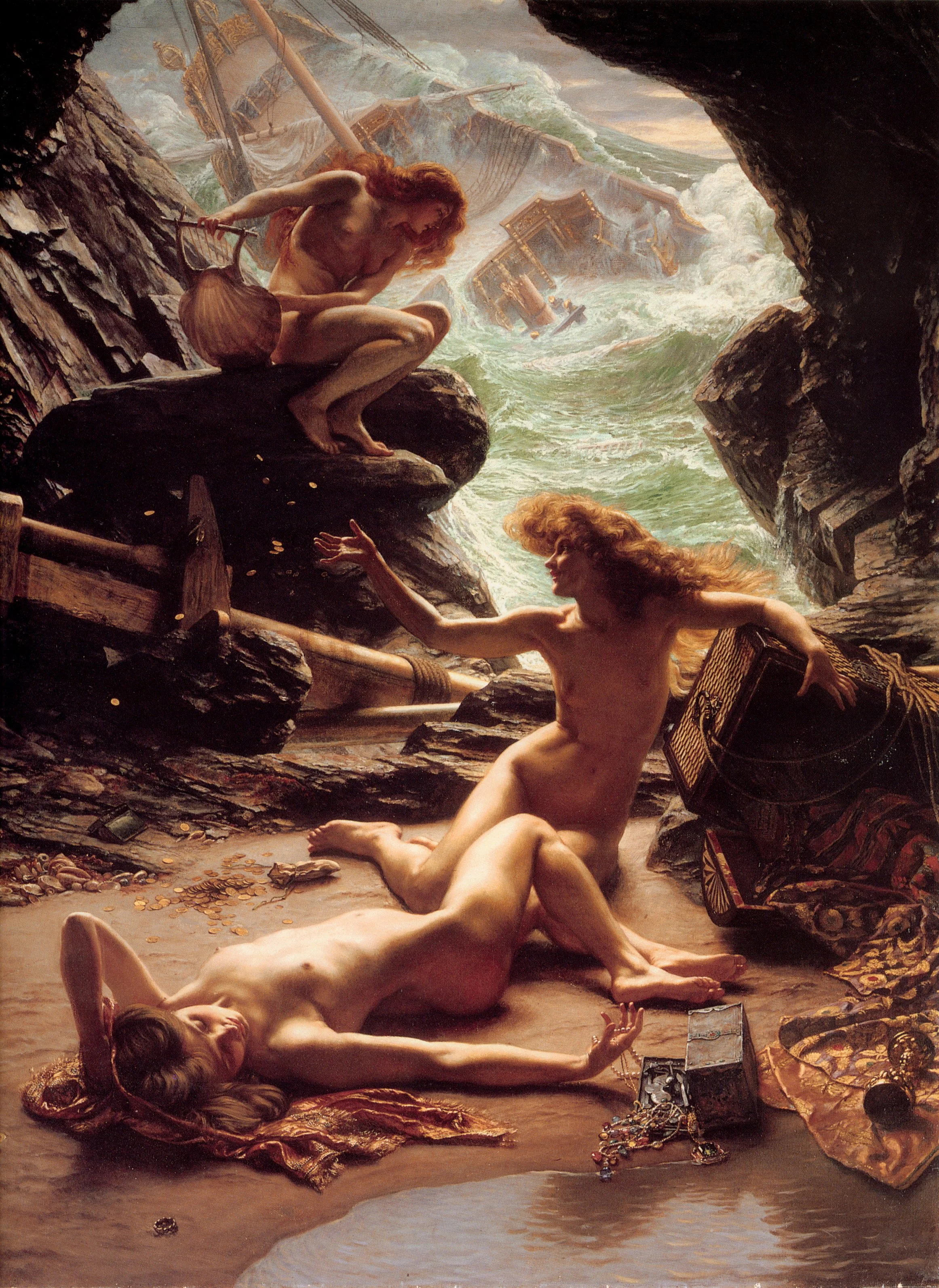
Sir Edward John Poynter, Cave of the Storm Nymphs
A cave, two gates, stone jars, bees, looms, water, and an olive tree: Porphyry thought Homer had built a philosophical diagram. The cave at Ithaca became, in his reading, the cosmos, the body, and the soul’s difficult route in and out of mortal life.
Most readers of Homer see a cave and move on.
Porphyry did not move on.
In Book 13 of the Odyssey, Homer describes a cave near Ithaca, sacred to the Nymphs. It has stone mixing bowls and jars, stone looms, bees, water, two entrances, and an olive tree standing near its mouth. These details are so oddly specific that Porphyry, writing in the third century CE, suspected Homer was doing more than furnishing the landscape.
Why should a poet pause to inventory cave equipment?
Because, Porphyry thought, the cave is a philosophical machine.
A cave that is more than a cave
Porphyry’s On the Cave of the Nymphs is one of the most important surviving works of ancient allegorical interpretation. It takes a short Homeric passage and reads it at several levels at once.
The cave is a real cave in the story. It is also an image of the cosmos: the visible world into which souls descend, where bodily life is generated, shaped, clothed, fed, distracted, and eventually released.
The cave is dark but not meaningless. It is natural but also sacred. It contains water, stone, weaving, bees, and two pathways. Porphyry treats each feature as philosophically significant, drawing on Platonic, Pythagorean, Homeric, Orphic, and religious traditions.[3][9]
This is not a game of “guess what the author meant.” Porphyry believes the cosmos itself is symbolically structured. A good myth can therefore disclose truths because the visible world is already an image of higher realities.
Bees, garments, and bodies
Porphyry’s symbolism often feels strange until one sees its underlying question: how does a soul become involved in bodily life?
The bees are associated with souls, generation, and the sweetness that draws souls toward embodied existence. Honey is pleasant, nourishing, and sticky. This is not an accidental combination. The pleasures of mortal life are often like that: delightful in small quantities and difficult to remove from the upholstery.
The nymphs’ weaving also matters. Porphyry links weaving with the formation of bodily existence. The purple garments woven in the cave evoke blood and embodiment; the cave itself becomes a place where souls acquire the coverings appropriate to mortal life.[4][9]
This is not a rejection of matter as disgusting or unreal. It is an account of entanglement. The soul enters the world, becomes clothed in bodily conditions, and risks forgetting that its garments are not its ultimate identity.
The two gates
The cave’s two entrances are among Porphyry’s most arresting symbols. One gate is associated with descent into generation; the other with ascent toward the gods. The cosmos is thus not only a prison or trap. It is a place of passage.
That is a much richer idea than the modern slogan “escape the material world.” The Platonist does not simply hate the cave. He learns what the cave is for.
Life in the world is an education in distinction. One learns the difference between appearance and reality, pleasure and good, movement and progress, desire and fulfillment, information and wisdom. The cave is difficult because the soul must live among shadows without making shadows the final truth.
Anyone who has ever spent forty minutes reading arguments online will understand the practical relevance.
A chamber of symbols
The Masonic resonance is immediate, though again it should be used with intellectual restraint. The cave at Ithaca and the Middle Chamber are not historically the same thing. But both make use of symbolic architecture.
A chamber can be a place. It can also be a condition of mind. A gate can be a physical opening. It can also signify a transition in understanding. A tool, number, stair, garment, or light may teach not because it contains a secret password, but because it forces the mind to ask what visible form is showing us about invisible order.
Porphyry’s cave is a remarkable example of this old philosophical habit: use the material world to teach how not to be imprisoned by materialism.
Endnotes
Homer, Odyssey 13.102–112, the description of the Cave of the Nymphs at Ithaca.
Porphyry, On the Cave of the Nymphs, the surviving Neoplatonic exegesis of that Homeric passage.[3][4]
Robert Lamberton’s translation includes a substantial introductory essay and notes on Porphyry’s interpretive world.[5][10]
K. Nilüfer Akçay’s 2019 study is the fullest modern English-language monograph devoted to Porphyry’s treatise.[7][8]
M. J. Edwards, “Porphyry’s ‘Cave of the Nymphs’ and the Gnostic Controversy,” Hermes 124 (1996): 88–100, is useful on Porphyry’s complex attitude toward cosmos, embodiment, and allegory.[11]