Circe’s Pigs and the Problem of Becoming What You Eat
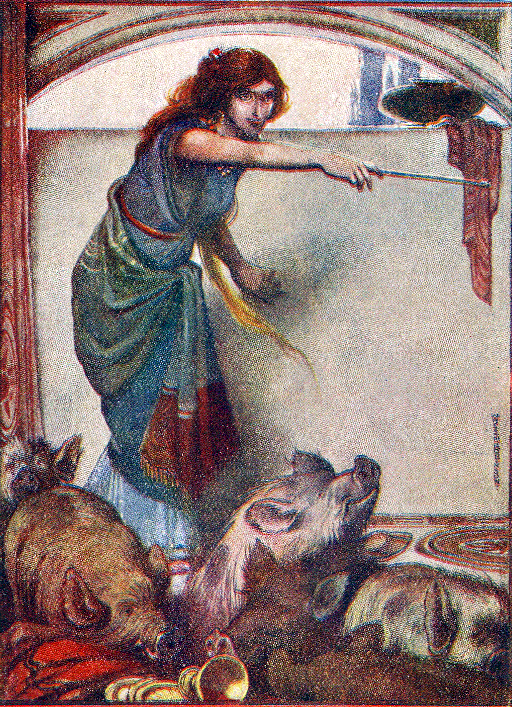
Circe turning men into pigs
Circe does not merely turn men into animals. In the Platonic tradition, she reveals what happens when appetite takes command and the rational self agrees to become a passenger.
Circe’s trick is not especially subtle.
She gives Odysseus’ companions food and drink, adds something unpleasant, taps them with a wand, and turns them into pigs. The men retain human minds, which is probably the worst part. They know what has happened, but they can no longer do much about it.
Modern readers often treat this as an episode of folklore: witch, potion, livestock, panic. The Platonic tradition saw a moral experiment.
What happens to a human being when appetite becomes the ruling power?
The answer, as usual, is impolite.
The animal inside the argument
Plato had already given later Platonists a rich vocabulary for thinking about the soul’s lower powers. In the Republic, appetite is not evil simply because it desires. It becomes dangerous when it rules. Desire without reason has no natural stopping point. It wants more food, more drink, more pleasure, more money, more praise, more victory, more of whatever it had yesterday.
Circe’s swine are therefore not merely men punished for poor hospitality habits. They dramatize a human possibility: the rational being who has allowed his life to be governed by the appetites most characteristic of an animal.
This is not an insult to pigs. Pigs are doing their best under the circumstances. It is an insult to humans who possess reason and decide it would be simpler not to use it.
Taylor’s moral sea
Thomas Taylor reads the wanderings of Ulysses as a drama of the soul’s exposure to lower forms of life. The islands, enchantresses, temptations, and storms are stations in the soul’s difficult passage through the sensible world.
In that broad Taylorian frame, Circe represents the power of bodily pleasure, enchantment, and material fascination to reshape the soul’s life. Her victims do not become animals because they lack a human body. They become animal-like because their rational power has been subordinated.
The episode has an uncomfortable modern force. A person may not wake up with hooves. He may simply discover that every decision now passes through the question, “What will make me feel better immediately?” It is a less dramatic transformation, but the symbolism is unmistakable.
Hermes and the antidote
Odysseus is saved by Hermes, who gives him the herb moly. The literal narrative is magical. The philosophical reading is not far behind: divine assistance, intellect, or higher reason provides the antidote to enchantment.
One cannot defeat appetite merely by wanting to be free of appetite. The soul needs a principle stronger than the desire it is trying to govern. In Platonic language, it needs reason trained toward the good. In religious language, it may need grace, discipline, community, prayer, or moral law. In ordinary language, it needs help.
This is a useful correction to the fantasy of heroic self-sufficiency. Odysseus does not stride into Circe’s house and overpower magic through personality. He receives instruction. He carries an antidote. He learns the terms of the danger.
The self-aware person is not the one who says, “I have no weaknesses.” He is the one who knows where he becomes susceptible to enchantment and does not enter empty-handed.
The Masonic parallel
Freemasonry has long used images of roughness, discipline, and self-government. These should not be treated as a Greek code in another costume. Yet the moral consonance is real.
The work of self-improvement assumes that man is educable. He can be shaped by habits, study, fellowship, ritual, and reflection. But it also assumes that he may become misshapen. The roughness is not only outside him. It appears in appetite, vanity, resentment, ignorance, and the easy surrender of judgment to fashion or impulse.
Circe’s island is what happens when the work stops.
The good news is that the story contains a remedy. The human being may be enchanted, but he is not necessarily lost.
Endnotes
Homer, Odyssey Book 10, the episode of Circe and the transformation of Odysseus’ companions.
Plato, Republic Book IV and Book IX, on the rational, spirited, and appetitive dimensions of the soul and the danger of appetite’s rule.
Thomas Taylor’s “Allegory of the Wanderings of Ulysses” should be treated as an English Platonist interpretation developed from ancient materials, rather than a direct commentary by Porphyry.[1][2]
On Porphyry’s Neoplatonic treatment of the soul’s descent, generation, and embodiment, see On the Cave of the Nymphs.[3][4]