The Human Mind in an Animal Life
Appetite, fear, humiliation, and the lower self
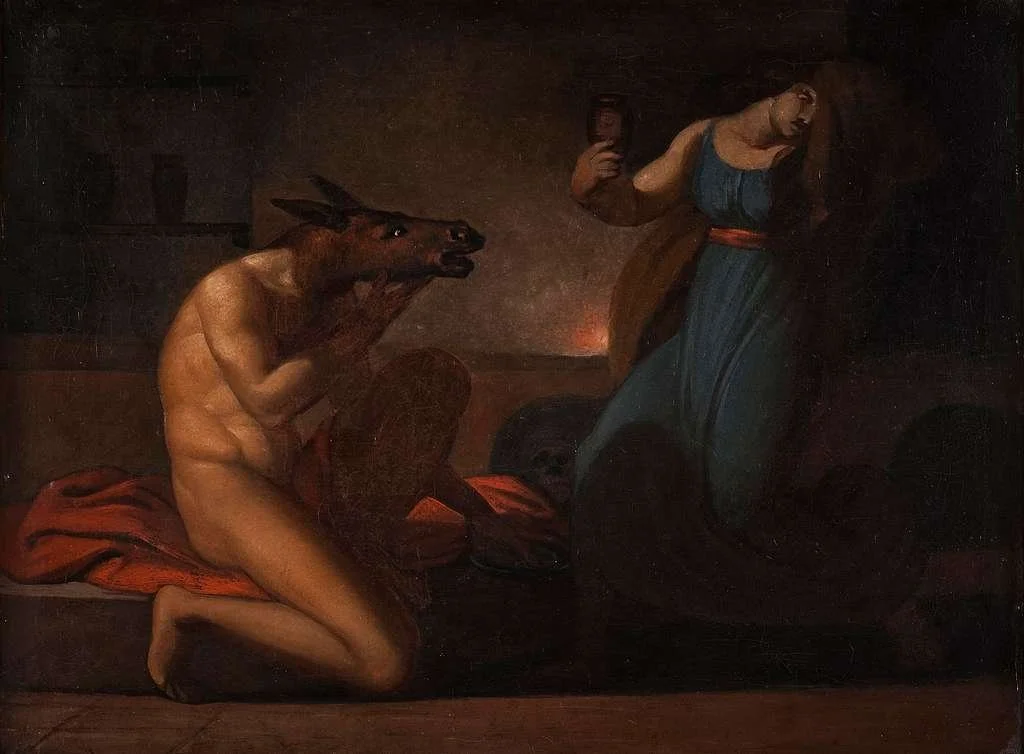
Lucius keeps his human mind after becoming an ass. That is the joke, the horror, and the philosophical point: he can recognize degradation while still being unable to escape it.
Lucius becomes an ass.
He does not become stupid.
This is important.
He retains memory. He retains judgment. He recognizes cruelty. He knows when he is being insulted, exploited, deceived, beaten, bought, sold, and treated as less than human. He often understands the absurdity of situations better than the humans around him.
He simply cannot explain himself.
He is trapped inside an animal body while carrying a human mind.
This is the joke.
It is also the horror.
The lower life
Ancient philosophy often distinguishes between higher and lower dimensions of human life.
The lower life concerns bodily need, sensation, appetite, fear, pain, pleasure, anger, vulnerability, and the demands of survival.
The higher life concerns reason, judgment, self-command, moral responsibility, friendship, truth, beauty, and the capacity to ask what one ought to do.
The point is not that bodily life is evil.
Without bodily life, there is no action, no speech, no touch, no craft, no music, no friendship, no work, no family, no service, and no human history.
The problem begins when the lower life rules alone.
Lucius’ ass-life dramatizes that condition.
He is governed by hunger, exhaustion, physical danger, sexual threat, fear of beating, and the demands placed upon his body by others. His intelligence survives, but it has little power. He knows better. He cannot easily act better.
Anyone who has ever felt ruled by an appetite, habit, fear, addiction, resentment, panic, or destructive compulsion will recognize the structure.
The mind remains awake.
The lower life has seized the reins.
Heracles and Lucius
Heracles confronts the beast within.
Lucius becomes the beast he has allowed himself to become.
This is the difference.
Heracles’ monsters are often interpreted by ancient moral allegorists as images of incontinence, irrational passion, reckless striving, and cowardice. He faces these forces outwardly and brings them under control.[7]
Lucius’ story offers a more humiliating version.
He does not stand above the animal powers and defeat them. He experiences what it means to live beneath them.
He learns the vulnerability of a creature governed by physical need and subject to the will of stronger owners.
This makes The Golden Ass less triumphal than the Heracles stories.
Lucius does not become wise because he is powerful.
He becomes capable of wisdom because he discovers what powerlessness feels like.
The animal as mirror
The ass has long carried associations of stubbornness, appetite, burden, ridicule, and low social status. Apuleius uses these associations brilliantly.
But the novel is not simply insulting animals.
The ass becomes a mirror for human beings.
The people around Lucius are often more bestial than he is. They are greedy, violent, lecherous, cruel, foolish, superstitious, selfish, and hypocritical. Lucius may have an ass’s body, but he is surrounded by humans who have allowed their souls to become governed by appetite and brutality.
This reversal matters.
The question is not, “Who is the animal?”
The question is, “What makes a human life humane?”
A person with a human body may live like an ass if he is ruled entirely by appetite, fear, vanity, or the demands of others.
A person who has been reduced, humiliated, or made powerless may still preserve a moral awareness that proves his humanity has not been extinguished.
Lucius’ human mind is the remaining spark.
It is not enough to save him immediately.
But it is enough to make recovery possible.
The lower self in ordinary life
The animal life does not always announce itself dramatically.
It appears whenever a person is reduced to reaction.
When hunger decides the conversation.
When anger writes the message.
When fear makes the moral choice.
When lust becomes the measure of another person’s worth.
When the need for approval governs speech.
When exhaustion becomes an excuse for cruelty.
When a person knows what is right but feels unable to do it because habit has become stronger than judgment.
The point is not to hate the lower self.
The point is to recognize that it cannot govern alone.
A human being requires appetite, emotion, bodily strength, rest, and desire. But these must serve a larger life.
The misery of Lucius is not that he becomes an animal.
It is that he remains human enough to know what an animal life has cost him.
Endnotes and further reading
Apuleius, Metamorphoses Books 3–10, on Lucius’ ass-life, exploitation, fear, and continued human consciousness.
Plato, Republic IV and IX, on the ordering of reason, spirit, and appetite.
Plotinus, Ennead I.1 and IV.8, on the higher and lower life of soul.[8][9]
Heraclitus the Grammarian, Homeric Problems, on Heracles’ monsters as ethical disorders.[7]
Related reading: “The Black Horse Is Not the Enemy” and “Heracles Within.”