Flushing, Queens: The Remarkable Story of One of New York’s Oldest and Most Revolutionary Neighborhoods
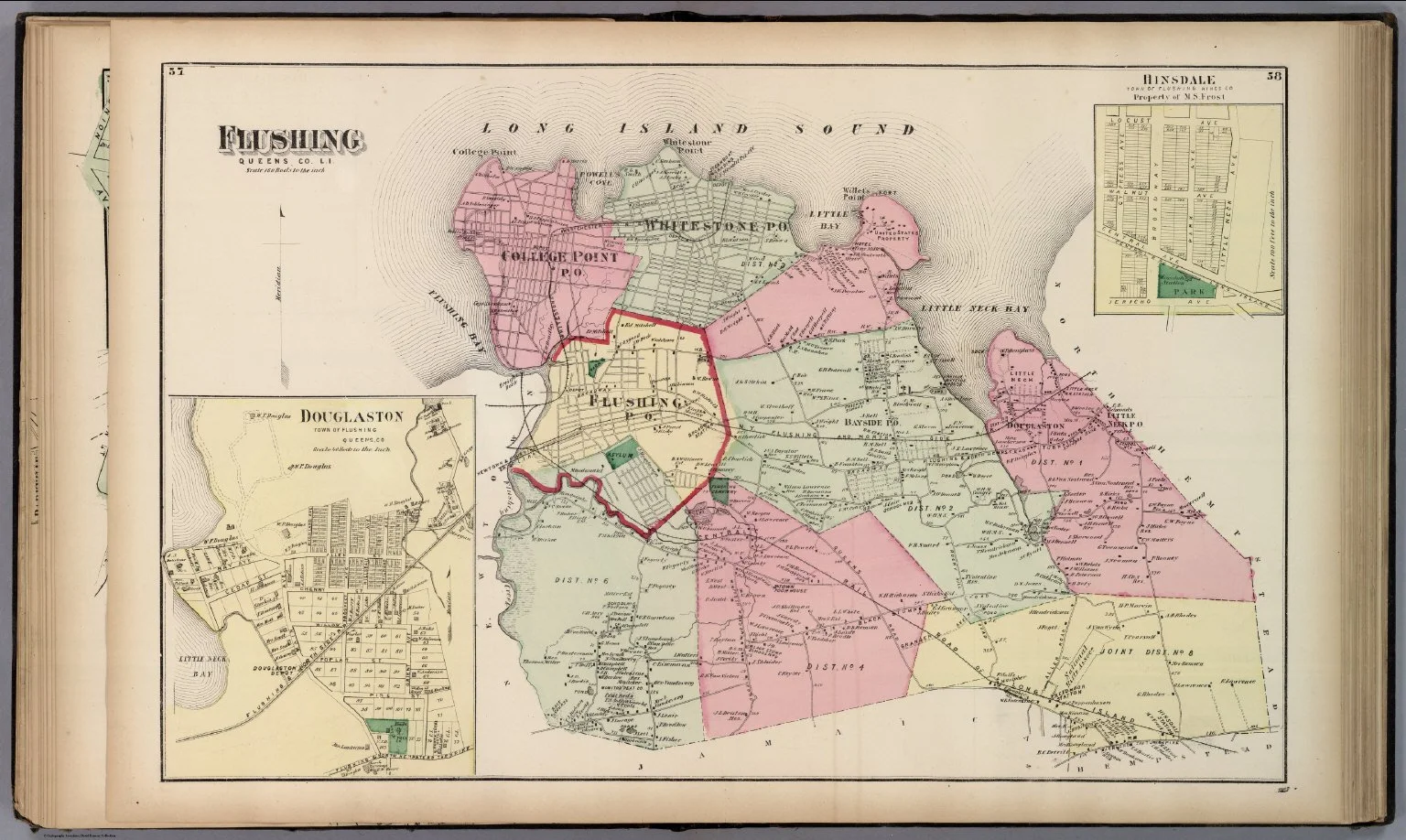
An early map of Flushing, Queens.
Few places in New York can match Flushing for sheer historical depth.
Long before it became one of the busiest and most dynamic neighborhoods in Queens, Flushing was a frontier settlement on the edge of empire. It was here, in the seventeenth century, that ordinary residents helped give lasting expression to one of the most important ideas in American history: the right to worship freely. It was here that Dutch authority, English dissent, Quaker resistance, slavery, horticultural ambition, and, later, waves of immigration all left their mark. And it is here, today, that the past still lingers—sometimes in plain sight, sometimes hidden behind traffic, storefronts, apartment towers, and redevelopment.
To walk through Flushing is to move through layer after layer of New York history.
Before Flushing was Flushing
Before Europeans established a town here, the land belonged to the world of the Matinecock and related Indigenous communities whose lives were shaped by the tidal inlets, shell banks, forests, and creeks of northern Long Island. The area offered fish, shellfish, game, and access to the waters that tied Long Island to a wider coastal geography. Later antiquarians described the remains of shell heaps and Native encampments around the area that became Flushing village—reminders that the place had a long human history before the first Dutch patent was issued.
European knowledge of the area followed the Dutch exploration and commercial penetration of the early seventeenth century. By the 1610s and 1620s Dutch traders were active in New Netherland, but Flushing itself was not among the very first sites of permanent colonial settlement. That would come later, when Dutch imperial administration and English migration unexpectedly met on the same patch of ground.
A Dutch town with an English soul
Flushing was formally established in 1645 under Dutch rule, when Director-General Willem Kieft granted a patent for the town of Vlissingen, named after the Dutch city of the same name. But from the beginning the place was unusual. Though politically part of New Netherland, many of its settlers were English-speaking colonists, some from New England, some with prior experience living under Dutch jurisdiction, and some drawn by the promise of freer conditions than those they had known elsewhere.
This gave Flushing a distinctive character. It was never simply a passive outpost of colonial rule. It was a place where people expected a measure of local autonomy, where religious differences were real, and where the population did not always accept authority quietly.
That independent streak would define Flushing’s place in history.
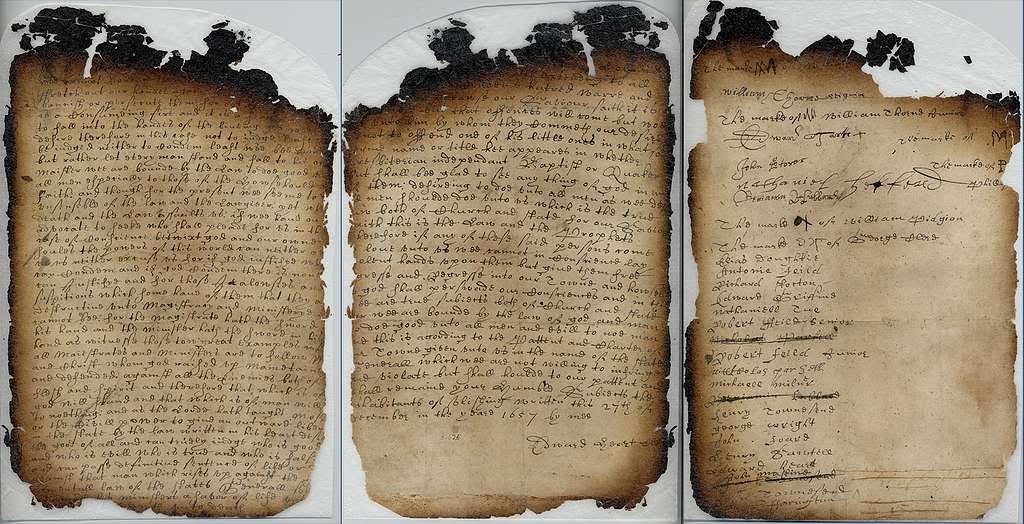
The Flushing Remonstrance document.
The Flushing Remonstrance
In 1657, Flushing became the site of one of the most extraordinary acts of conscience in colonial America: the Flushing Remonstrance.
At the time, Peter Stuyvesant, Kieft’s successor, was intensifying restrictions on religious dissenters—especially Quakers. He had already punished local residents for allowing unauthorized religious gatherings. But in Flushing, a group of townsmen objected. Their petition argued, in substance and in spirit, that persecution in matters of conscience was wrong. They appealed not only to Dutch custom but to Christian charity itself, insisting that coercion in religion violated both moral law and civil decency.
The language was startling for its time. It did not merely ask for leniency for one troublesome sect. It made a broader case that peaceable people should not be punished for worshipping differently.
The Remonstrance did not create modern religious liberty in one stroke, and it did not immediately end persecution. But it did establish something of enduring importance: a public defense of toleration expressed in moral terms, by local residents who refused to treat conscience as a crime. That is why it remains one of the clearest early statements, on American soil, of what would eventually become a defining national principle.

Peter Styvesant Portrait.
John Bowne and the cost of conviction
The story becomes even more compelling in the life of John Bowne.
Bowne, one of Flushing’s best-known early residents, allowed Quaker meetings to be held in his home. For this he was arrested, imprisoned, and eventually banished by Stuyvesant’s government. But Bowne did not disappear quietly into the historical fog. He appealed directly to the authorities in the Netherlands, challenging the legality and justice of his punishment.
He won.
That victory mattered. The ruling in his favor helped check Stuyvesant’s campaign of religious repression and strengthened the idea that New Netherland could not simply punish people for worshipping in ways the governor disliked. Bowne’s resistance, like the Remonstrance itself, made Flushing something more than an old town with colonial roots. It made the place a proving ground for one of the central promises of American life.
The Bowne House, which still stands, remains one of the most important historic landmarks in Queens and one of the most meaningful surviving sites in the long history of religious liberty in America.
English conquest, colonial stability, and uneasy growth
When the English seized New Netherland in 1664, Flushing passed into the Duke of York’s province, and Vlissingen gradually became Flushing in common use. The transfer of power did not erase tension. If anything, it shifted the terms of conflict. The English preserved some local structures while centralizing others, and disputes over taxation, authority, and representation continued.
Still, the town grew.
By the late seventeenth and early eighteenth centuries, Flushing had become a settled agricultural community with farms, mills, orchards, creeks, wharves, and a recognizable village center. It was not yet urban in any modern sense, but it was no longer precarious. It had become one of the notable settlements of Queens County.
Slavery, freedom, and moral contradiction
Like much of colonial New York, Flushing was also a slaveholding community.
That fact deserves emphasis, because the story of Flushing’s role in religious liberty can too easily become self-congratulatory if separated from the realities of bondage. Enslaved Africans were held in households and on farms throughout the region, and slavery formed part of the social and economic order of the town.
At the same time, Flushing also became a place where arguments against bondage took shape, especially within Quaker circles. The tension between a culture of conscience and a society entangled with slavery was real and unresolved. Over time, members of the Society of Friends in and around Flushing increasingly pushed toward manumission and antislavery practice. Modern scholarship has shown how deeply some Long Island Quaker families were involved in that moral transition during and after the Revolutionary era.
Flushing was, in other words, not morally pure. It was morally contested. That makes its history more difficult—but also more honest, and more worth remembering.
The Revolution and divided loyalties
During the American Revolution, Flushing and Queens County more broadly were sharply divided.
Some inhabitants sided with the patriot cause; others remained loyal to the Crown; still others hoped simply to survive whatever military power happened to control the ground beneath their feet. That divided reality was common on western Long Island, which was exposed, strategically vulnerable, and close to New York City. Principle mattered, but so did property, proximity, family ties, and fear.
The British victory in the Battle of Long Island in August 1776 left much of Queens under British control for the remainder of the war. The consequences were severe: confiscation, occupation, divided families, suspicion, pressure from both sides, and the general strain of living in a region whose future was uncertain.
Flushing’s history during the Revolution does not lend itself to simple myths. It was not a town of unanimous patriots, nor merely a place of passive loyalism. It was a place where allegiance was tested under difficult conditions, and where the larger conflict of the colonies was felt in intimate, local ways.
The village of trees, nurseries, and cultivated ground
By the late eighteenth and nineteenth centuries, Flushing became famous for something very different: horticulture.
This is one of the most distinctive and underrated chapters in the neighborhood’s history. The Prince family nursery, begun in the eighteenth century and greatly expanded over time, became one of the most important horticultural establishments in the United States. Fruit trees, ornamental shrubs, flowering plants, and imported species were cultivated in remarkable variety and distributed from Flushing to other parts of the country.
This was not merely a pleasant local specialty. It was a serious business and a cultural achievement. Horticulture in nineteenth-century America was bound up with science, gentility, commerce, and national taste. Flushing helped define the look of gardens, estates, and tree-lined landscapes across the republic. In a period before modern suburbia, Flushing had already developed an identity as a place of beauty, cultivation, and refinement.
George Washington visited the famous nursery grounds in 1789, though with his usual reserve he judged them less impressive than he had expected. His opinion mattered less than the market’s. Flushing’s horticultural reputation endured.
Education and village prestige
Flushing also built a reputation for schooling.
Private academies, seminaries, and later public institutions gave the village educational prominence beyond what might be expected of a town on the edge of New York. By the nineteenth century Flushing was not merely agricultural and picturesque; it was intellectually ambitious. This combination of refinement, learning, horticulture, and easy access to the city helped give the place an unusual social standing among Long Island communities.
That status was only strengthened as transportation improved.
Ferries, roads, railroads, and the pull of New York
During the nineteenth century Flushing was drawn more and more closely into the orbit of New York City. Stages, turnpikes, ferries, and railroads gradually transformed its economy and social composition. It remained partly a farming town and nursery center, but it also became a desirable residence for merchants, professionals, and families who worked in the city and wanted more space, cleaner air, and a cultivated domestic setting.
By the time Queens was consolidated into Greater New York in 1898, Flushing had long since ceased to be a purely rural village. It had become something more complex: partly old-town, partly commuter suburb, partly market center, and increasingly urban.
Flushing in the modern era
The twentieth century transformed Flushing yet again.
The neighborhood’s modern identity was shaped by infrastructure, public projects, and, above all, immigration. Flushing Meadows, Willets Point, roads, subways, and later waves of commercial redevelopment all altered the scale and pace of local life. But perhaps the most defining change came with the arrival of successive immigrant communities, especially from East Asia, who reshaped downtown Flushing into one of the most economically vibrant and culturally significant urban centers in New York City.
This modern Flushing is often treated as if it were wholly distinct from the colonial town that preceded it. In truth, there is a deeper continuity.
Flushing has long been a place where different peoples met, negotiated space, established institutions, and demanded room to live on their own terms. Its present diversity is not an accidental late chapter that displaced the past. It is the latest expression of a place that has repeatedly remade itself without fully erasing what came before.
Dutch outpost, English dissenting town, Quaker landmark, slaveholding community, horticultural center, commuter suburb, immigrant metropolis—Flushing has been all of these things.
What remains
There are still places where that long history can be felt.
The Bowne House remains central—not simply as an old building, but as a rare surviving witness to one of the earliest recorded battles for freedom of conscience in what became the United States. Nearby historical resources, old maps, family records, and the larger preservation work connected to Queens history all help restore to view a past too easily flattened into legend or lost in development.
The challenge with Flushing is not that it lacks history. It is that it contains too much of it to be reduced to a single identity.
That is what makes it so compelling.
It is not just old. Plenty of places are old. Flushing is historically restless. It has repeatedly reinvented itself without fully losing the memory of earlier worlds. It was a place of argument before it was a place of consensus, a place of ambition before it was a place of comfort, and a place of reinvention long before modern New York learned to celebrate reinvention as a civic virtue.
Its story is not neat.
It is better than neat.
It is crowded, conflicted, layered, unfinished, and alive.
And that, perhaps, is the most Flushing thing of all.
Sources and Notes
Images:
Peter Stuyvesant, portrait painting, 17th century. Public domain. Source: Wikimedia Commons, via PICRYL.
The Flushing Remonstrance document, 1657, scan of a public-domain original by the New York State Archives, public domain, Wikimedia Commons, file “Flushing Remonstrance.jpg.”
Literary:
Brandon J. Broderick, “History of Flushing, New York,”
https://www.brandonjbroderick.com/new-york/history-of-flushing-new-york
QNS, “A trip down memory lane: Revisiting the rich history of Flushing, Willets Point,”
https://qns.com/2023/07/flushing-willets-point-history
The Bowery Boys, “The Story of Flushing: An Epic History of Queens Old and New,”
W. W. Munsell & Co., History of Queens County, New York (New York, 1882), especially the Flushing section and the general county history.
Ellen M. Spindler, “Long Island Quaker and Bowne Family Manumissions During the Revolutionary War and Post-Revolutionary War Eras,” Quaker History 113, no. 2 (Fall 2024), as referenced by the Bowne House Historical Society.
Rosemary S. Vietor, “One House, One Family, Three Centuries of New York History,” in Beyond Architecture: The New New York, ed. Barbaralee Diamonstein-Spielvogel (New York Review Books, 2024).
Editor’s Note:
This article is intended as a readable historical overview of Flushing’s development for the Queens History section of bretemurphy.com, combining contemporary public-facing sources with nineteenth-century county history and more recent scholarship.