Middletown and the German Settlement: A Lost Rural Community in Long Island City
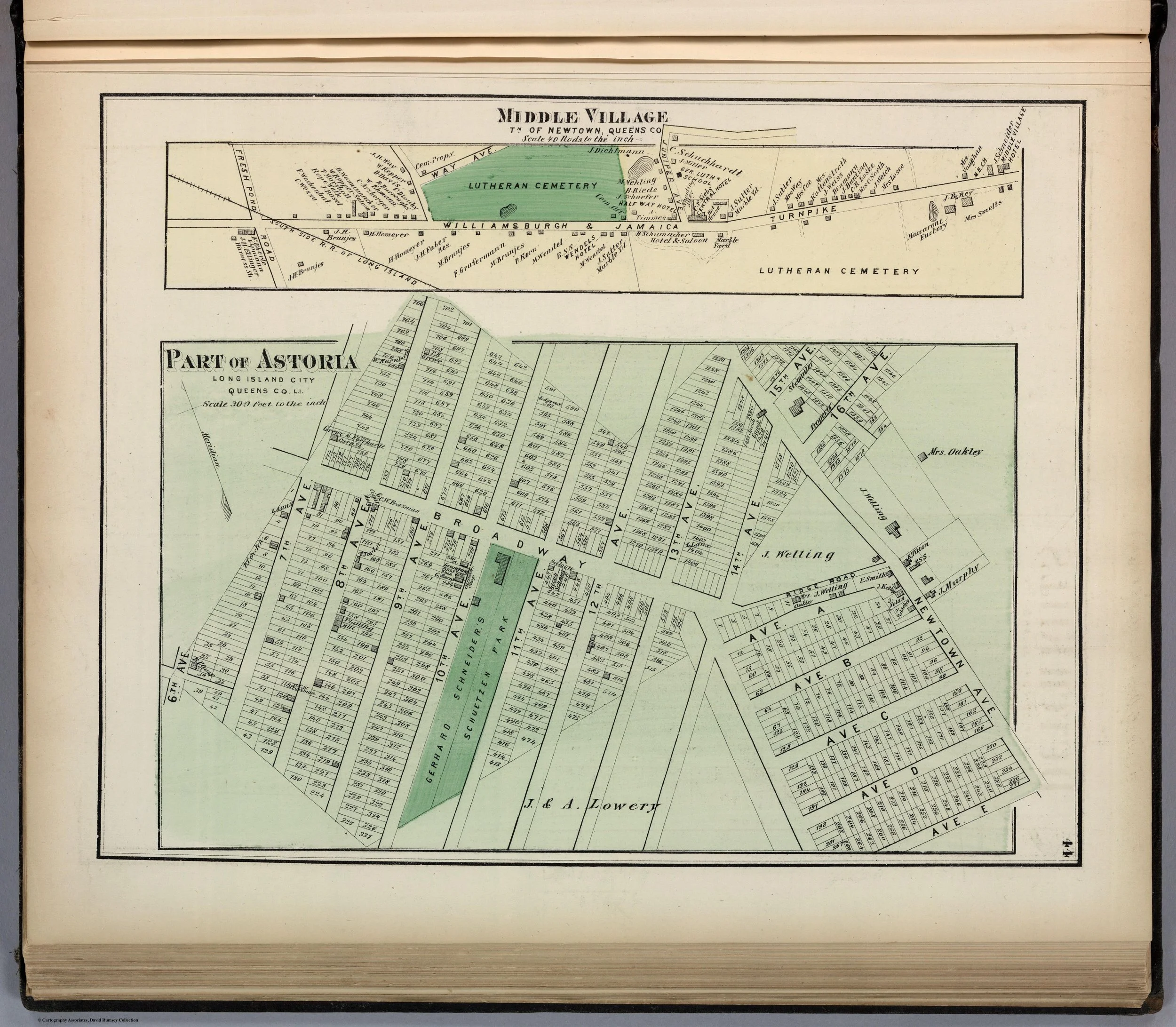
Middle Village, Newtown, & part of Astoria, by F.W. Beers, 1873. David Rumsey Map Collection.[7]
Before Long Island City existed, before Queens Boulevard became a major urban corridor, and before factories and rail yards remade western Queens, there was a small inland community known as Middletown.
Later generations also called it the German Settlement.
It was never as famous as Astoria or Hunter’s Point, and it left fewer monuments behind. Yet Middletown was one of the communities incorporated into Long Island City in 1870. Its history helps explain how a largely rural section of old Newtown became part of an industrial city.
Middletown was shaped by roads, farms, schools, churches, and the gradual arrival of immigrant families. It stood between the older settlement of Newtown and the growing waterfront districts of Astoria, Dutch Kills, and Hunter’s Point. Its name reflected geography: it was, quite literally, a settlement “in the middle.”
From Maspeth Kills to Middletown
The history of Middletown reaches back to the troubled early settlement of western Newtown.
In 1640, the Rev. Francis Doughty received a large patent that included much of the territory later associated with Maspeth and western Queens. The settlement that emerged near Maspeth Kills was short-lived. During the conflict often called Kieft’s War, the settlement was destroyed.[1]
A later English settlement developed in the region between the old Maspeth site and Flushing. According to Eugene Armbruster’s 1914 account, settlers established themselves on meadowland between waterways flowing toward Newtown Creek and Flushing Creek. Because the location lay between the older settlements, it was called Middelburgh -- the middle village.[1]
The name changed over time. Armbruster states that Middelburgh was later called Hastings and then Newtown. The historical geography is complicated because early place names often referred to overlapping settlements, roads, farm districts, and governmental divisions rather than to precise modern neighborhood boundaries. Still, Middletown remained the name attached to an inland community within the broader Newtown landscape.[1]
The eventual “German Settlement” developed within this territory as German-speaking immigrants and their families became increasingly prominent in the nineteenth century.
A community of roads and farms
Middletown did not grow around an East River landing or a navigable creek. It was an inland settlement, shaped instead by country roads.
The old Newtown Road, roads toward Flushing, the Bowery Bay Road, and routes toward Williamsburg and Brooklyn linked the community with the rest of Queens. The neighborhood’s position made it a crossing point between the agricultural interior and the increasingly urbanized waterfront districts.[1][1]
For much of its early history, the surroundings were rural. Farms, orchards, woods, and small homesteads defined the landscape. The roads were practical arteries: they carried farmers, wagons, churchgoers, schoolchildren, tradesmen, and eventually commuters.
The settlement’s rural identity should not obscure its connection to wider New York. Even before railroads and streetcars transformed the region, Middletown was linked to nearby markets and roads. It stood within reach of Newtown, Flushing, Astoria, and the ferry connections that carried people and goods across the East River.
The first school within Long Island City’s future boundaries
Middletown holds an important place in the history of education in western Queens.
According to Kelsey, the first school within the later limits of Long Island City was established there in 1721. Joseph Hallett donated a small plot of land near the Newtown Road for a schoolhouse. He was joined by Samuel Hallett, Samuel Moore, Joseph Moore, Thomas Skillman, and Isaac Bragaw.[1]
The location was described as Middletown, later the German Settlement. The school served children from the dispersed farming districts of the “Out Plantations,” at a time when public education in the modern sense did not yet exist.
The schoolhouse was modest, but its significance was considerable. It represented the determination of scattered rural families to create a local institution for instruction. Kelsey noted that historian James Riker described the undertaking as “hazardous” because of its expense.[1]
The old schoolhouse survived for many years before being sold and incorporated into an adjoining dwelling. Its disappearance was typical of many early Queens structures: local institutions often endured until the land beneath them became more valuable than the memory they carried.
Churches and the religious landscape
Middletown was also shaped by religious life.
The early Presbyterian congregation of Newtown, organized in the seventeenth century, served a broad rural district. Armbruster wrote that its first church structure stood near the later intersection of Grand Street and the old road system, serving the scattered settlement before a permanent church was erected.[1]
Dutch Reformed, Presbyterian, Episcopal, Methodist, Catholic, and later German Protestant institutions all reflected the evolving population of western Queens. The German Settlement in particular became associated with German-speaking religious and social life as immigration reshaped Long Island City during the nineteenth century.[1]
The community’s churches did more than provide worship. They offered schools, meeting rooms, charity, language instruction, social networks, and continuity for families navigating the transition from rural Newtown to urban Long Island City.
The German Settlement
By the nineteenth century, Middletown was widely known as the German Settlement.
The name reflected demographic change. German immigrants and German-American families settled in the area, joining earlier Dutch, English, and other Long Island families. The community became one of the places where old agricultural Queens and immigrant New York met.[1]
The term “German Settlement” was not merely descriptive. It reflected a neighborhood identity grounded in language, church affiliation, work, kinship, and shared institutions.
Kelsey located the 1708 Hallett family tragedy in the vicinity later known as the German Settlement. The episode—an enslaved woman and an Indigenous man were accused of killing William Hallett Jr., his wife, and five children—was followed by brutal punishment at Jamaica. The story is important not as sensational local folklore, but as evidence that slavery, racial violence, and colonial law were part of the history of western Queens.[1]
The nineteenth-century histories describe this event through the assumptions and language of their own time. A modern account must recognize that the surviving narrative came from a colonial system that enslaved African people, dispossessed Indigenous communities, and imposed extreme violence through the courts.
Schools in the nineteenth century
The old district school system continued to shape Middletown and the German Settlement into the nineteenth century.
Kelsey described School No. 4, located on Skillman Avenue near School Street, as serving a broad area that included Hunter’s Point, Ravenswood, Woodside, and other parts of western Newtown. The original building, a simple frame structure, stood until it burned in 1863.[1]
The school district was extensive because population remained scattered. Children from farms and hamlets traveled to common schools that served large rural territories. As Long Island City developed, these arrangements became increasingly inadequate.
The destruction of the old schoolhouse and the later construction of newer schools marked the transition from rural district education to a more urban, municipal system. When Long Island City was incorporated in 1870, education became one of the responsibilities of the new Board of Education.[1]
The old Middletown schoolhouse was part of a larger story: the gradual replacement of localized, often uneven educational arrangements by city-wide institutions.
From countryside to Long Island City
Middletown was incorporated into Long Island City in 1870, together with Astoria, Hunter’s Point, Ravenswood, Dutch Kills, Blissville, Steinway, and Bowery Bay.
The merger was driven by urban growth. Hunter’s Point needed streets, sewers, water, and better municipal services. Astoria had already developed a stronger village government. Dutch Kills, Blissville, Middletown, and the other settlements stood between old Newtown and the expanding industrial waterfront.[1]
For Middletown, incorporation meant that an inland rural community was now administratively connected to a city whose center of gravity lay along the East River and Newtown Creek.
This did not instantly change the physical character of the district. Farms and older roads remained. But the forces of change accelerated. New streets, railroads, streetcars, cemeteries, industrial works, and housing development reshaped the land.
The German Settlement became less isolated. It was absorbed into the transportation and population growth of Long Island City, then into the Borough of Queens after Greater New York was created in 1898.
A neighborhood that vanished into the city
Middletown has largely vanished from modern maps. The German Settlement survives mainly in historical references, institutional memory, and fragments of local geography.
That disappearance is itself historically meaningful.
Some Queens neighborhoods remain visible because their names became subway stops, postal districts, or commercial centers. Others were absorbed into larger identities: Astoria, Sunnyside, Woodside, Maspeth, Long Island City, or simply Queens.
Middletown was one of those places.
Yet it mattered. It supplied an inland community to the future city. It contained one of the earliest schools in the later limits of Long Island City. It formed a bridge between colonial Newtown and nineteenth-century immigrant Queens. And it reminds us that Long Island City was not built only from waterfront villages and industrial sites. It was also assembled from small rural communities whose names gradually disappeared beneath the larger city.
End Notes:
[7] "Middle Village, Tn. of Newtown, Queens Co.; Part of Astoria, Long Island City, Queens Co., L.I.," by F.W. Beers, published by Beers, Comstock & Cline, 1873, in Atlas of Long Island, New York, from Recent and Actual Surveys and Records under the Superintendence of F.W. Beers (New York, 1873). From the David Rumsey Map Collection, David Rumsey Map Center, Stanford University Libraries. Accessed via: David Rumsey/ Map of Middle Village