Isis and the Return to Form
Divine mercy, gratitude, and the question of what restoration requires
Lucius is restored not through his own cleverness but through divine mercy, ritual obedience, gratitude, and a new manner of life. The question becomes not merely whether he has regained his body, but what kind of human being he will now inhabit.
By the final book of The Golden Ass, Lucius has suffered enough to become less amusing.
He has been an ass for a long time. He has endured bodily exhaustion, public humiliation, danger, exploitation, and an endless procession of human beings who treat weakness as an invitation to use another creature for their own ends.
Then, beside the sea at Cenchreae, he prays.
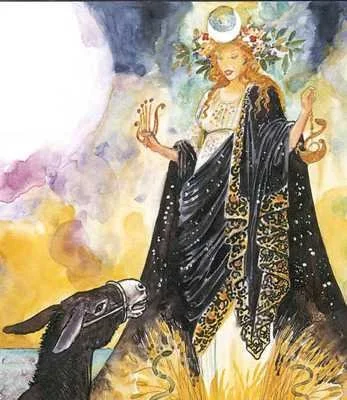
The goddess Isis appears.
The scene changes the novel’s register. The comic, bawdy, violent, folkloric world of the earlier books opens into a solemn religious vision. Isis identifies herself through many names and forms, presenting herself as a universal divine power associated with nature, the gods, the sea, the underworld, fertility, salvation, and human devotion.
She gives Lucius instructions.
He must participate in a coming procession. He must eat roses carried by a priest. He obeys. His ass-form falls away. He becomes human again.
It is one of the most extraordinary restorations in ancient literature.
It is also not simply a reward for having suffered.
Restoration as gift
Lucius does not save himself through cleverness.
This is important because cleverness helped cause the disaster.
He had wanted mastery over magical power. He had wanted to become exceptional. He had wanted the experience of transformation on his own terms.
The restoration arrives differently.
It arrives as gift.
Lucius must pray. He must listen. He must obey. He must wait. He must accept a ritual order he did not invent. He must receive help from a power greater than his private ambition.
This does not erase his agency. He must still act. He must follow the instructions. He must step forward in the procession. He must eat the roses.
But the basic relation has changed.
He no longer treats transformation as something he can seize.
He receives it.
This is the beginning of gratitude.
Isis and historical respect
It is important not to turn Isis into a generic symbol of “the divine feminine,” self-esteem, or vague spiritual awakening.
Apuleius’ account belongs to the religious world of the Roman Empire. Isis was a major goddess whose cult spread widely across the Mediterranean. The final book of the Metamorphoses includes ritual, initiation, priesthood, sacred clothing, dreams, processions, offerings, and a devotional life that has its own historical integrity.
The scene can be philosophically meaningful without being stripped of its religious particularity.
Lucius’ restoration is not merely an inner mood.
It is a conversion of life.
He enters a new discipline. He serves Isis and later Osiris. He undergoes initiations. He adopts practices, relationships, obligations, and a new identity shaped by gratitude and devotion.
The point is not simply that he feels better.
He lives differently.
Returning to form
The phrase “return to form” is useful here.
Lucius regains human form physically. But the deeper question is whether he can return to a genuinely human manner of life.
He has learned what it means to be ruled by appetite, fear, external force, and social contempt.
He has learned that human dignity can be lost outwardly while moral awareness remains inwardly alive.
He has learned that cleverness is not wisdom.
He has learned that power sought without discipline can reduce rather than elevate.
Now he must decide what to do with that knowledge.
This is the moral significance of restoration.
A person may be rescued from a bad condition. That does not automatically make him good.
He may recover health, reputation, status, employment, sobriety, relationship, freedom, or confidence. Each recovery is a gift. But the gift creates a question:
What kind of life will now be built from it?
Lucius receives his body back as a gift.
The rest of his life becomes the question of whether he knows what a gift requires.
The Masonic comparison
The Masonic connection should remain ethical rather than theological.
A Mason receives much that he has not created alone: fellowship, instruction, ritual, symbols, historical inheritance, correction, opportunities for service, and the example of those who came before him.
These are gifts.
The response should be gratitude expressed through conduct.
A person who has received Light should become more responsible for the darkness he can reduce.
A person who has received instruction should become more patient with those still learning.
A person who has received fellowship should become more capable of fellowship.
A person who has been restored after error should become less eager to condemn others.
The rose that restores Lucius is not a private possession.
It is a sign that he has been given another chance to live rightly.
Endnotes and further reading
Apuleius, Metamorphoses Book 11, on Lucius’ prayer to Isis, the goddess’s epiphany, the rose procession, restoration to human form, and initiation.
On the religious and philosophical dimensions of Book 11, see scholarship on Apuleius, Isis, and Platonism.[2][3]
Related reading: “The Work Is Not Over When the Lodge Closes” and “The Two Gates of the Soul.”