The Soul Receives Wings
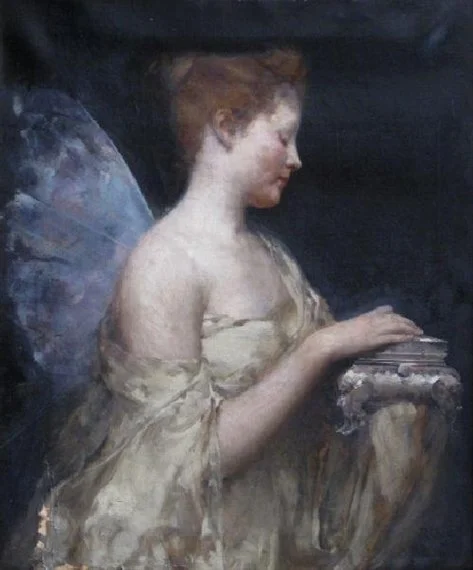
John Reinhard Weguelin – Psyche (1890)
Immortality, transformation, and the end of the story that is not the end of the work
Psyche is made immortal at the end of the tale. But the point is not that she stops being human. It is that the soul has learned, through labor and love, not to live by possession alone.
Every fairy tale must decide what to do with the ending.
The simplest ending says: they lived happily ever after.
Apuleius gives us something stranger.
Cupid brings Psyche before Jupiter. The gods approve the marriage. Psyche drinks ambrosia and becomes immortal. Venus is reconciled. A daughter is born, named Pleasure.
It is an ending full of divine order, marriage, reunion, reconciliation, and reward.
It is also an ending that should not be read too quickly.
Psyche becomes immortal.
But she has not become immortal because she was naturally flawless. She has been curious, fearful, trusting, suspicious, brave, vain, wounded, laboring, exhausted, and dependent upon help.
She has failed more than once.
Her transformation is not the reward for never being human.
It is the result of learning how to become more fully human.
The soul’s apotheosis
Apotheosis—the elevation of a mortal into divine life—is a recurring image in ancient myth. Heracles receives it after his life of labors and suffering. Psyche receives it after desire, error, loss, work, and reconciliation.
In both cases, a philosophical reader must be careful.
The myth does not offer a technical diagram of the afterlife. It does not prove that the soul earns divinity through a list of tasks. It does not allow us to reduce Psyche’s story to a single formula.
But it can suggest something profound.
A life becomes “divine” in the ancient Platonic sense not by becoming less moral, less relational, or less responsible. It becomes divine through greater participation in goodness, beauty, truth, order, love, and the life of intellect.
Psyche’s immortality therefore makes sense as the completion of an education.
She has become more capable of love without possession.
More capable of beauty without vanity.
More capable of suffering without surrender.
More capable of receiving help without shame.
More capable of carrying what she cannot own.
The soul receives wings because it has learned how not to live by appetite alone.
Pleasure, the child of Love and Soul
Cupid and Psyche’s daughter is called Pleasure.
This is one of the tale’s final jokes and deepest insights.
Pleasure is not condemned. It is not the villain. It is the child of Love and Soul.
But this is not the pleasure Psyche sought when she opened the box. That was stolen beauty, private advantage, and the attempt to secure love by improving the image of the self.
The final Pleasure belongs to a different order.
It is the pleasure that follows reconciliation, maturity, right relation, and love no longer dominated by fear.
The difference resembles the ancient distinction between pleasure as a passing sensation and joy as the flourishing of a life.
The first may be intense and empty.
The second may be quiet and durable.
A person who has learned to love truth, beauty, friendship, service, and genuine human good has not become hostile to pleasure. He has become less easily fooled by its imitations.
The limits of allegory
The temptation to explain every detail of Cupid and Psyche is powerful.
Psyche equals the soul. Cupid equals desire. Venus equals matter, nature, jealousy, divine order, or the difficult mother-in-law. The sisters equal envy. The ants equal minor virtues. The rams equal passions. The eagle equals intellect. The box equals vanity. The sleep equals ignorance. The wedding equals union with the divine.
Some of these interpretations are illuminating.
None should be treated as the single final meaning of the story.
Apuleius is too playful for that. The tale lives because it can be read at several levels: comic, erotic, folkloric, philosophical, religious, psychological, and literary.
The disciplined reader does not need to flatten it into a code.
He can let the story ask him questions.
What does curiosity become when it loses trust?
What does beauty become when it serves vanity?
What does love become when it seeks possession?
What does suffering become when it is accepted as labor rather than treated only as insult?
What does the soul become when it learns to receive help, endure correction, and desire the good of another?
These are enough.
The work continues
The story ends in Olympus.
Our lives do not.
That is why the philosophical value of Psyche lies not in the fantasy of escaping human difficulty. It lies in the reminder that human difficulty can become formative.
The tasks remain.
The seeds still need sorting.
The dangerous power still requires timing.
The dark water still exceeds private strength.
The box still tempts us to take what we should carry.
The lamp still offers a kind of knowledge that may wound what we love.
The sisters still speak in voices of concern.
The work of the soul continues in ordinary life.
Psyche receives wings not because she has stopped being human.
She receives wings because she has learned that the soul cannot live by possession alone.
Endnotes and further reading
Apuleius, Metamorphoses 6.23–6.24, on Cupid’s appeal to Jupiter, Psyche’s immortality, the divine marriage, and the birth of Pleasure.
On the Platonic, satiric, and literary complexity of Cupid and Psyche, see scholarship on Apuleius’ philosophical use of the tale.[2][4]
For comparison with Platonic and Neoplatonic ascent, see Plotinus, Ennead I.6, “On Beauty,” and III.5, “On Love.”[9][10]
Related reading: “Why the Soul Has Wings” and “The Black Horse Is Not the Enemy.”