Cupid Does Not Mean Romance
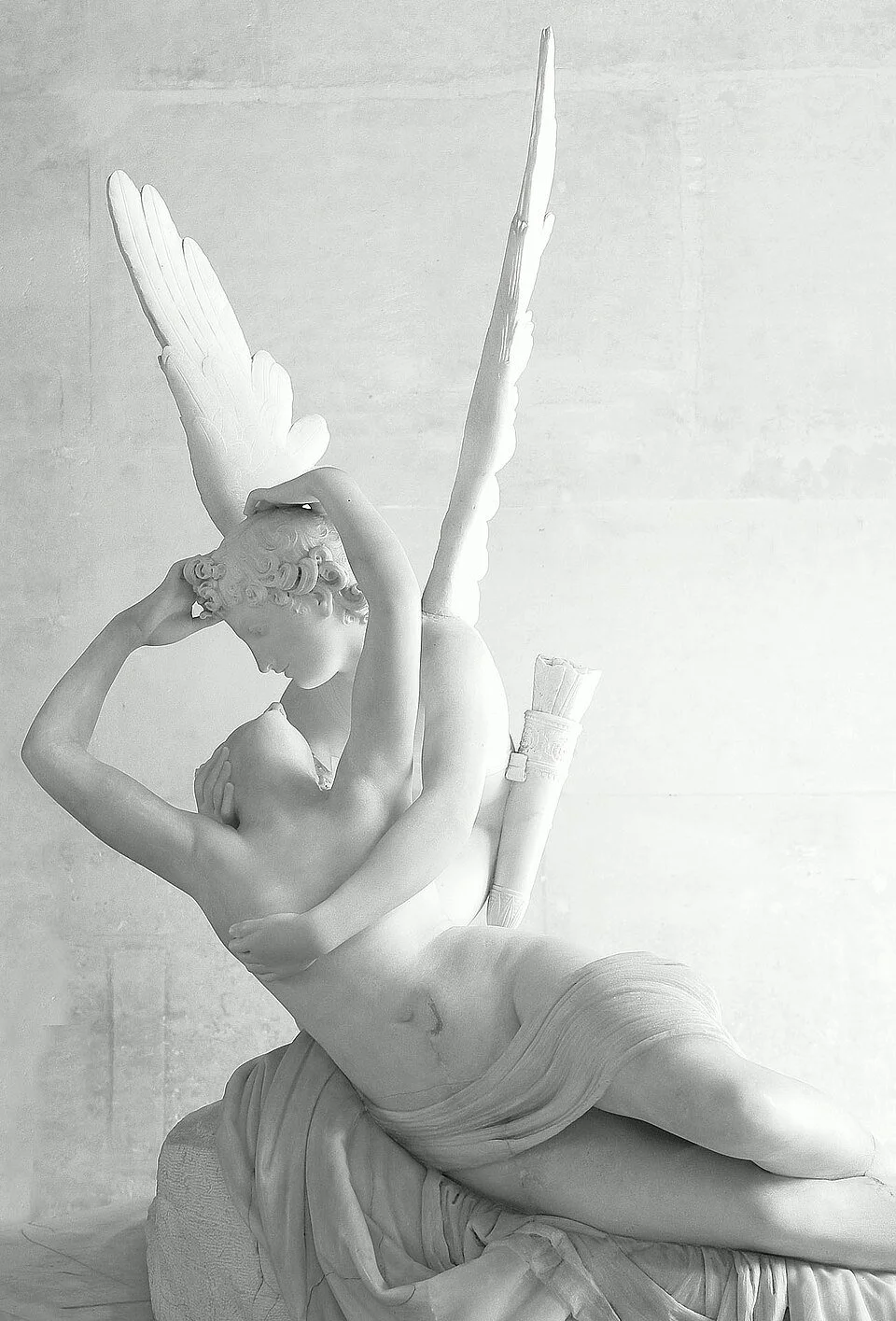
Antonio Canova - Psyché ranimée par le baiser de l'Amour, 1793
Platonic eros, love, and the education of desire
Cupid is not merely a winged mascot for romance. In Platonic thought, eros is the longing that begins in attraction but can rise toward beauty, truth, goodness, and a love less concerned with possession than with the flourishing of another soul.
Cupid is often reduced to romance.
A small winged figure. A bow. A heart. A greeting card. A familiar excuse for poor judgment in February.
But the Greek Eros from which the Roman Cupid descends is larger and more dangerous.
Eros is longing.
It is the restless movement of the soul toward what it lacks, admires, desires, fears losing, or believes may complete it. It can become appetite, obsession, jealousy, possession, creativity, courage, philosophy, friendship, beauty, and the desire to bring something enduring into the world.
Plato does not ask us to get rid of eros.
He asks what eros is becoming.
Love begins in lack
In Plato’s Symposium, Diotima tells Socrates that love desires what it does not possess.
This makes love uncomfortable.
We long because we lack.
We are drawn toward beauty because we are not beautiful in every way. We are drawn toward wisdom because we are not wise. We are drawn toward goodness because we know, however dimly, that our present condition is incomplete.
Cupid does not mean that another person completes us like a missing puzzle piece.
He means that another person, a beautiful thing, an act of courage, a work of art, a truth, or an experience of goodness can awaken awareness that we are not complete.
That awareness can become selfish.
Or it can become educative.
The selfish lover says: “You must belong to me so that I may feel whole.”
The educated lover says: “Your beauty has reminded me that I must become more capable of truth, generosity, and care.”
The difference is enormous.
The ladder of love
Diotima’s Ladder of Love begins with attraction to one beautiful body. It then expands.
The lover learns to recognize beauty in many bodies. He comes to value beautiful souls, then beautiful practices and laws, then knowledge, and finally Beauty itself—the enduring source through which beautiful things are beautiful.[7][8]
This is sometimes presented as though Plato wants to discard persons in favor of abstract concepts.
That is too cold.
The point is not to become indifferent to human beings. The point is to become less possessive.
A person who loves only one body may be trapped by fear of loss.
A person who learns to admire beautiful souls becomes more attentive to character.
A person who loves beautiful practices and laws becomes concerned with justice.
A person who loves knowledge becomes less satisfied with appearance.
A person who seeks Beauty itself becomes capable of recognizing beauty without immediately trying to consume it.
The ladder does not destroy desire.
It gives desire a horizon.
Psyche and Cupid
Cupid and Psyche can be read within this Platonic world without forcing the tale into a rigid allegory.
Psyche begins with beauty. She is admired, feared, envied, and treated as an object of public fascination. But beauty alone does not make her happy. It leaves her isolated.
Cupid begins as hidden desire. He gives love, but under conditions Psyche cannot yet understand. Their relationship fails when Psyche tries to convert hidden love into possessed knowledge.
The later tasks transform her.
She learns to distinguish. She learns patience. She learns to approach dangerous power with measure. She learns to receive help. She learns that beauty cannot be stolen. She learns that desire must survive suffering if it is to become more than appetite.
By the end, the story has moved far beyond romance.
Love becomes an education.
Brotherly love and the good of another
The Masonic connection is not sentimental.
Brotherly love is not merely liking one another. It is not uniform agreement, social familiarity, or the ritualized exchange of pleasant words.
It is the discipline of willing another person’s good.
That requires the education of desire.
A brother must learn not to treat others merely as sources of praise, influence, opportunity, comfort, validation, or support for his private ambitions.
He must learn to ask: What does this person need in order to flourish? What truth can I offer? What correction can I give charitably? What burden can I help carry? How can I admire his gifts without envy?
This is Platonic eros in a moral key.
It is desire turned outward toward the good of another.
The longing that enlarges
Cupid is not merely the feeling that another person completes us.
He is the longing that teaches us we are not complete.
That longing can make us grasping, jealous, and afraid.
Or it can make us more attentive, more generous, more courageous, and more capable of beauty.
The question is not whether we desire.
The question is whether desire is making the soul smaller or larger.
Endnotes and further reading
Plato, Symposium 201d–212c, especially Diotima’s account of eros and the Ladder of Love.[7][8]
Plato, Phaedrus 249d–256e, on beauty, eros, recollection, and the soul’s ascent.
Plotinus, Ennead III.5, “On Love,” for a later Platonic account of eros and intelligible desire.[9]
Related reading: “Love as a Ladder, Not a Trap” and “Why the Soul Has Wings.”