Venus Gives the Soul Impossible Work
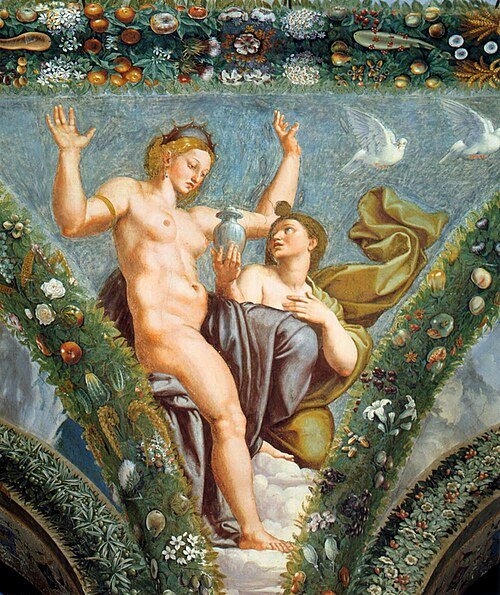
Raffaello Sanzio - Venus and Psyche
Psyche’s labors, moral formation, and the long education of desire
Venus does not give Psyche one dramatic ordeal. She gives her a sequence of tasks requiring discrimination, patience, courage, restraint, and help. The soul is not transformed by one revelation. It is formed through work.
Venus is angry.
This is understandable, though not entirely admirable.
Psyche has become so beautiful that mortals have begun giving her the attention once reserved for Venus. The goddess of love, beauty, and desire now finds herself in the uncomfortable position of competing with a human girl for public admiration.
The situation deteriorates.
Psyche marries Cupid. She loses him. She comes to Venus seeking mercy and reunion.
Venus does not offer a comforting conversation.
She offers tasks.
Not one task. Several.
Psyche must sort an enormous heap of mixed seeds. She must gather golden wool from violent rams. She must fetch water from a deadly river guarded by dragons. Finally, she must descend toward the underworld and bring back a box from Proserpina.
It is tempting to turn each labor into a rigid code.
The seeds “mean” this. The wool “means” that. The water “means” something else. The box “means” the subconscious, trauma, or a particularly difficult morning.
The ancient evidence does not justify such certainty.
But the tasks do form a compelling philosophical pattern. Each requires a capacity the unformed soul lacks: discrimination, patience, timing, humility, courage, restraint, and the willingness to accept help.
Sorting the seeds
The first labor is absurdly simple and therefore impossible.
Psyche is shown a vast heap of mixed seeds—wheat, barley, millet, poppy, peas, lentils, and others—and ordered to separate them by evening.
The task resembles the condition of an untrained mind.
Everything is mixed together.
Fear with prudence.
Desire with love.
Pride with self-respect.
Anger with justice.
Flattery with friendship.
Information with wisdom.
A person who cannot distinguish these things is easily ruled by them.
Psyche is saved by ants.
This is one of the story’s quiet jokes and deepest lessons. The soul that cannot complete a task through grand heroic strength may be helped by small, patient, collective intelligence.
The ants do not give a speech. They do not announce a theory of moral development. They sort.
One seed at a time.
This is how discernment often works.
A person becomes wiser not by one dramatic revelation, but by repeatedly learning to separate what has been confused.
What is actually true?
What do I merely fear?
What is owed?
What is desired?
What is beautiful?
What is useful?
What is a passing mood?
The ants teach moral grammar.
The golden wool
Next, Psyche is commanded to gather wool from violent golden rams. Their fleece is magnificent. Their temper is less so.
If she approaches them directly during the heat of the day, they will kill her.
A reed gives her advice: wait until evening, when the rams have calmed and their golden wool has caught on the branches and brambles.
This is not cowardice.
It is timing.
The task teaches that dangerous power cannot always be seized by force. Sometimes the soul must wait, observe, and receive what becomes available when passion has cooled.
The golden rams are a fitting image for the forces that attract us precisely because they are dangerous: ambition, sexuality, anger, charisma, power, the desire to dominate, the hunger to be admired.
The untrained person rushes toward them at noon.
The wiser person learns the season, the measure, and the proper distance.
Not every strength should be confronted head-on.
Some must be approached after they have ceased charging.
The black water
Psyche must then bring water from the Styx, or from a terrifying source associated with inaccessible heights, dragons, and danger. The task exceeds her strength. She cannot climb where she must climb. She cannot survive what guards the water.
Jupiter’s eagle helps her.
Again, Psyche does not triumph through private self-sufficiency.
She receives assistance from above.
This is important.
Modern self-improvement often imagines the individual as a lonely engineer of his own transformation. He identifies the problem, researches the solution, purchases the appropriate notebook, and emerges morally renewed by Thursday.
Ancient stories are less optimistic about that.
Psyche needs ants. She needs a reed. She needs an eagle. She needs guidance. She needs the help of powers and creatures beyond herself.
The philosophical lesson is not passivity. Psyche must still show up, endure, carry, wait, and act. But she must also learn that help is not humiliation.
A soul incapable of receiving help is not strong.
It is isolated.
The work of becoming capable
The tasks form a moral rhythm.
The first teaches discernment.
The second teaches restraint and timing.
The third teaches humility before what exceeds one’s strength.
The fourth will teach the danger of taking for oneself what one has only been asked to carry.
This is not a fixed ancient interpretive chart. It is a philosophical way of reading the narrative’s sequence.
Psyche is being formed.
She has beauty from the beginning. She has suffering. She has desire. She has curiosity. She has courage. But she does not yet have steadiness.
The labors teach her steadiness.
This is what self-work actually feels like.
Not glorious all the time.
Not always dramatic.
Often repetitive, humble, frustrating, and dependent upon small acts of attention.
The soul does not become mature because someone tells it that it is special.
It becomes mature because it learns to sort, wait, carry, listen, and endure.
The Masonic labor
This is where Psyche’s work speaks naturally to the Masonic imagination.
A Mason is not made perfect by being admitted into a symbolic system. He is given tools, duties, images, and a language for labor.
The work is gradual.
One does not square the whole life in a night.
One does not establish uprightness through a single declaration.
One does not learn proportion without repeatedly discovering where one has been excessive.
One does not become charitable merely by admiring charity.
Psyche’s labors are not punishment for being human.
They are the work required to become capable of carrying the soul she already possesses.
Endnotes and further reading
Apuleius, Metamorphoses 6.10–6.20, on Psyche’s tasks: sorting seeds, gathering golden wool, fetching water, and retrieving Proserpina’s box.
On philosophical interpretations of Psyche’s development, curiosity, and moral growth, see recent scholarship on Apuleius’ tale.[2][4]
Related reading: “The Black Horse Is Not the Enemy” and “The Work Is Not Over When the Lodge Closes.”