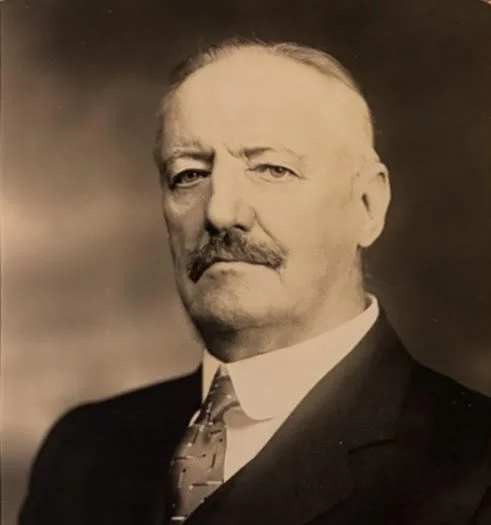
Portrait of John Anderson Leach
One Lodge, Six Charters / Advance Lodge No. 635
Raised in 1905, the Astoria nurseryman’s son became a magistrate, a civic leader and the Police Department’s longest-serving trial commissioner, and was remembered as a past master of his lodge.
The Advance Lodge record of October 17, 1905 is brief: John Anderson Leach, thirty-nine years old, born in Astoria, living in Astoria, lawyer. He was raised a Master Mason that night as the lodge’s 326th member. Thirty years later, when the newspapers sketched the career of the veteran police official everyone at Headquarters seemed to rely on, they listed among his distinctions that he was a past master of Advance Lodge. Between those two notices lay a life spent weighing evidence and other men’s conduct, and an unusual reputation for doing both fairly.
A Boyhood Among the Nursery Rows
Leach was born on November 10, 1865, in a house that stood on the ground where the Queens towers of the Hell Gate Bridge later rose. His father, Bailey Leach, was a Yorkshire nurseryman who brought English methods of cultivation to the fields of Astoria. Another nurseryman’s son grew up nearby: Joseph Cassidy, the future Democratic boss and Borough President of Queens, whom young John knew well as a boy.
Bailey Leach died while his children were young, leaving his widow, Susan, with five of them. John was the eldest. His mother put the nursery in his hands, and at eighteen he was running it, knowing the business thoroughly and making it pay. At night he studied law, and one of his classmates in those evening courses was a young man named John F. Hylan. Leach was admitted to the New York bar in June 1897, at thirty-one.
Nine Hundred Objections
He remained, for a while, unknown outside his own neighborhood. A Democrat from the day he could vote, he never joined a local political club. What brought him into public view was a lawsuit. The Astoria Taxpayers’ Association retained him to fight a permit, approved by his boyhood acquaintance Cassidy, that allowed a gas company to lay great five-foot mains through Astoria streets. Leach argued that the plan would force property owners to pay for two sewers on every affected block. He filed nine hundred objections, and he won a court order requiring the company to build the one sewer at its own expense.
A larger fight followed over a general improvement program for Long Island City. By later accounts it saved taxpayers about a million dollars and brought a twenty-year plan for paying assessments in the districts affected. He also served on the city’s Charter Revision Commission of 1901, and in 1903 he called to order the Queens convention of the reform-minded Citizens’ Union, served as its secretary, and was named to its conference committee on a fusion ticket.
By 1906 he was first vice president of the Queens County Bar Association. When the bar voted on whether to keep the county courthouse in Long Island City after the fire that had damaged it, Leach was in the eleven-to-nine majority that kept it there. Among those voting with him was Edward J. Knauer, past master of Advance Lodge.
President of the Business Men
In December 1908 the members of the Long Island City Business Men’s Association elected Leach their president, and in February 1910 they chose him again to lead the reorganized body under a new constitution. The changes were his kind of work. Meetings went from quarterly to monthly. The association was divided into working committees on engineering, law, legislation and public improvements, each with headquarters in the association’s rooms and a paid staff. A retail merchants’ committee set about building what amounted to a local credit agency for First Ward businesses.
The committee chairmen he named that March included Frederick T. Hallett, another Advance Lodge brother, who took charge of auditing. The association’s business that spring read like a list of everything modern Long Island City needed: streetcars across the new Queensboro Bridge, public band concerts on the bridge plaza, a police precinct of its own for the bridge so that people injured on the plaza would not be carried across the river to a Manhattan hospital, and the legal opening of Pierce Avenue. When the members re-elected every officer that November, they cited the large amount of good work done during the year and sent Leach before the Board of Estimate to press for the opening of the Steinway tunnel.
Bridges and Fireworks
The year 1909 brought Queens two great celebrations, and Leach had a hand in both. For the June opening of the Queensboro Bridge, he served on the plan and scope committee that shaped the whole festival and chaired the committee in charge of the official banquet. That August, when Queens organized its share of the Hudson-Fulton celebration, he was named to the borough executive committee, chaired its ways and means committee, and helped persuade the citywide committee to give Queens four thousand dollars. He offered the Business Men’s Association rooms as the committee’s headquarters, and then took personal charge of the First Ward’s fireworks night, with a hired band and a grandstand.
Magistrate Leach
His civic work caught the eye of Mayor William J. Gaynor, who in 1911 appointed him a city magistrate to fill an unexpired term. The bench did not make him solemn. In June 1912 the attachés of the Queens police courts held an outing at Whitestone Landing, and the Long Island City court staff, “the Defendants,” took on Magistrate Harry Miller’s Jamaica contingent, “the Complainants,” at something like baseball. Leach took a turn as umpire, the Defendants won by a score nobody could verify, and a reporter enjoyed every minute.
At home in Astoria, Mrs. John Anderson Leach sang soprano with the St. Cecelia Club, whose first concert in 1911 counted Leach, Hallett and other Astoria men among its subscribing members. Leach left the bench in 1916 and went back to his practice, the firm of Leach & Williams on the Queensboro Bridge Plaza, which handled many large estates. He was also president of the First Mortgage Company of Long Island City and an active member of Trinity Methodist Episcopal Church in Astoria.
Fifty Thousand Trials
His old classmate Hylan became mayor in 1918, and on January 23 of that year, in the middle of an abrupt shake-up at Police Headquarters, Leach was appointed a deputy police commissioner. He took charge of the department’s legal bureau. The work was exacting and almost entirely unglamorous: trying policemen charged with breaking department rules, drafting bills for the Legislature, and digesting every law and ordinance that touched police work.
He stayed at it for nearly eighteen years, rising to First Deputy Commissioner and serving under eight police commissioners. By 1935 he had presided at the department trials of more than fifty thousand policemen, never fewer than three thousand a year. Of all his decisions, only six were reversed on appeal. He represented the New York police at international conferences abroad.
The record also shows a hands-on official. One June morning in 1920, driving to Headquarters from Astoria, he saw a patrolman at Jackson Avenue struggling with a man too drunk to move. Leach stopped his car, helped carry the prisoner into it, and delivered him to the station himself. In 1921, when an Astoria church advertised police protection for the cars of people coming to hear Theodore Roosevelt Jr. speak, he wrote to the papers to correct it: the police would keep order, but anyone who parked on the street took the same risk as at any public gathering, “and the risk is great.” In 1923 he met the receiver of a bankrupt trolley line at the freezing Woodside transfer point to arrange a heated car where riders could wait.
Uncle John
The men he judged gave him a nickname. Officers at Headquarters said that as trial commissioner he often reduced a fine after setting it, on the theory that a policeman’s family should not suffer for his errors. They also said that a good officer with an old minor offense on his record sometimes found himself promoted years later, and that the man keeping track of his good conduct all along was Uncle John Leach. His friends spoke of large charities he kept secret.
Trust followed him in private life as well. In 1931 the banker William Boardman, a lifelong friend and Hollis neighbor, named him an executor of an estate believed to exceed a million dollars. When Leach approached the retirement age of seventy in 1935, word came from high in the administration that the department meant to keep him on indefinitely. He was then a widely traveled lecturer who illustrated his talks with stereopticon pictures from his journeys, an expert on Queens real estate and deeds, a charter member of the Queens Borough Chamber of Commerce, and a member of the First Presbyterian Church of Jamaica. His mother, Susan, lived with him in Hollis until her death in September 1936, past ninety, and he served as executor of her will.
The Measure in the Ledger
Advance Lodge took in John Anderson Leach as a working lawyer with an Astoria address and a nursery behind him. It came to know him as one of its past masters, a brother who spent his professional life deciding how men had conducted themselves and who was trusted, by policemen and bankers alike, to decide it fairly. The lodge’s brief entry of 1905 recorded his age, his birthplace and his trade. Everything else had to be earned, and over the following thirty years he earned it.
Endnotes and Sources
Lodge Records
Advance Lodge No. 635, F. & A.M., Astoria, membership record of John Anderson Leach: raised October 17, 1905, age 39, 326th member, born and living in Astoria, occupation lawyer, as examined by Brete Murphy.
Newspapers
Brooklyn Daily Times: September 15, 1903 (“Citizens Union Hold Their Opening Meeting”); July 28, 1906 (“History of Queens County Bar Association”); December 4, 1908 (Long Island City Business Men’s Association election); February 18, 1910 (“Leach in the Lead”); November 11, 1910 (“Getting Facts as to Queens Water Supply”); January 23, 1918 (“Bugher Ousted as Police Head”); January 11, 1931 (“Boardman Leaves $1,000,000 Estate”).
Brooklyn Daily Eagle: February 14, 1909 (“Queens’ Celebration Committees Merge”); August 12 and August 21, 1909 (Hudson-Fulton committees); February 18, 1910 (“John Anderson Leach Is Chosen President”); March 4, 1910 (“President Leach Names Committee Chairmen”); January 14, 1911 (St. Cecelia Club concert); June 16, 1912 (“Court Attaches on Merry Frolic”); May 25, 1913 (“Rockaway Opens Its New Firehouse”); April 23, 1919 (Long Island City Memorial Association); January 20, 1923 (“Andrews on Job, Tackles Problems”); January 11, 1931 (“Y.M.C.A. to Get $450,000 by Boardman Will”); September 12, 1936 (“Mrs. Susan Leach Left an Estate of Over $10,000”).
Times Union (Brooklyn): February 14, 1909 (“Queensboro Bridge Committee Chairmen Named by Williams”); June 7, 1920 (“Leach Effects Arrest of a Bona Fide Drunk”).
The Chat (Brooklyn): September 4, 1909 (“Queens Will Celebrate”).
The New York Times: February 13, 1921 (“Police Won’t Guard Autos at Meeting”).
Daily News (New York): September 22, 1935 (“Leach Due to Quit But May Keep Job”).
Public Records
Will of Susan R. Leach, Queens County Surrogate’s Court, 1936, and will of William Boardman, Queens County Surrogate’s Court, 1931, as reported in the Brooklyn Daily Eagle and Brooklyn Daily Times.
A Note on the Sources
- Birth date: The 1935 Daily News profile says Leach would reach seventy on November 10, 1935, which fits his recorded age of thirty-nine at his raising in October 1905.
- Law school: The 1918 account says Leach and Hylan studied law together at night at New York University; the 1935 profile names New York Law School.
- Magistracy: The 1918 account credits Mayor Mitchel with the appointment, but Leach appears as Magistrate in 1912 and 1913, before Mitchel took office, which supports the 1935 account that Mayor Gaynor appointed him in 1911. The 1935 profile says he declined reappointment in 1916; the 1918 account says he was not reappointed.
- Leach was elected president of the Long Island City Business Men’s Association in December 1908 and re-elected under the new constitution in February 1910 and again that November.
Image
- Portrait of John A. Leach, from author's collection.
Continue the Story
Leach’s work connected Advance Lodge to the legal, commercial and civic institutions of a changing Queens.
- Brother Frederick T. Hallett: The Measure of an Astorian — Meet the merchant and fellow lodge brother whom Leach appointed to oversee the Business Men’s Association’s auditing.
- Edward J. Knauer of Advance Lodge No. 635 — Follow another past master whose public life intersected with Leach’s in the Queens County Bar Association.
- Astoria Before the Skyline — Explore the neighborhood where Leach grew up among the nursery fields.
