What the Liberal Arts Are For
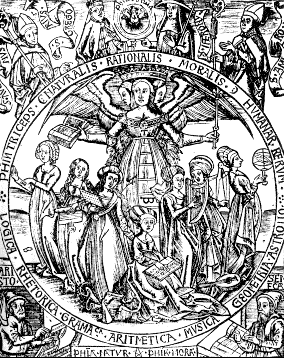
The liberal arts were never meant to be academic decoration. They were designed to form a free person: one capable of judgment, self-command, and truthfulness in the presence of the crowd.
The phrase liberal arts is often misunderstood before the conversation even begins.
To some, it sounds vaguely cultural: books, ideas, old languages, and respectable tastes. To others, it sounds political, as though “liberal” referred to a modern ideological identity. Neither meaning reaches the heart of the matter. The word liberal here comes from liber, the free person. Liberal education was the education thought fitting for someone who ought not live merely as a tool of appetite, fashion, or command.[1]
Its purpose was freedom.
Not freedom in the thin modern sense of unrestricted preference, but freedom in the older and more demanding sense: the power to govern oneself by reason, to judge carefully, to speak responsibly, and to resist becoming a passive instrument of other people’s designs.
That older ideal deserves recovery, especially now.
A free man, in the classical and medieval tradition, was not simply a man who had choices. He was a man whose mind was not wholly ruled from outside. He could weigh language, test argument, endure complexity, and distinguish appearance from reality. He was not immune to error, but he was not helpless before persuasion. He had some interior ballast.
This is one reason the liberal arts belong so naturally beside Freemasonry.
At its best, Masonry is not a theater of borrowed dignity. It is a discipline of self-construction. It assumes that a man can be shaped, refined, and strengthened, and that this work requires more than sentiment. Symbols matter, ritual matters, fellowship matters — but only if they contribute to inward formation. Otherwise they harden into costume.
The liberal arts answer a similar question from the side of the mind: what must a person learn if he is to become difficult to deceive, difficult to flatter, and difficult to govern by noise?
The traditional answer was the seven liberal arts.
The first three — grammar, logic, and rhetoric — formed the trivium. They trained the mind to read, reason, and speak.[2] Grammar taught a person to understand language precisely. Logic taught him to judge whether claims actually followed from one another. Rhetoric taught him to persuade honestly and to detect persuasion when others used it carelessly or manipulatively.
The next four — arithmetic, geometry, music, and astronomy — formed the quadrivium. They trained the mind in number, proportion, relation, harmony, and order.[3] These disciplines were not prized merely for utility. They taught the soul to recognize structure beyond preference and to encounter realities that do not bend to mood.
Taken together, the liberal arts did not simply fill the mind.
They ordered it.
That distinction matters. Modern education often assumes that knowledge is mainly additive: more facts, more information, more exposure, more content. The older model was formative. It asked what kind of person the student was becoming. Did his studies make him more exact, more patient, more truthful, more capable of independent judgment? Or merely more credentialed?
The difference is not trivial.
A society may produce highly trained specialists who are still intellectually dependent, morally suggestible, and rhetorically helpless. Such people can function at a very high technical level while remaining vulnerable to slogans, prestige, and social pressure. They may know a great deal and understand very little about how minds are captured.
The liberal arts were meant to resist that condition.
So is Masonry, if its symbols are taken seriously. The rough ashlar does not become fit by announcement. The work is actual or it is nothing. A man who cannot discipline his language, inspect his assumptions, or order his thoughts remains unworked material no matter how polished his affiliations appear.
This is why liberal education should never be reduced to cultural polish. It is not a finishing school for taste. It is training in liberty: liberty from confusion, from impulsive speech, from intellectual dependence, and from the crowd’s constant demand for quick conformity.
Such freedom is not automatic.
It must be cultivated.
And it must be renewed.
Every age produces new forms of pressure. Some are crude and coercive. Others are soft, ambient, and socially rewarding. But all of them benefit when men lose the arts of careful reading, sound inference, measured speech, and ordered thought.
That is why the liberal arts remain necessary.
And why their older purpose still matters.
They help form a person who can hear language without being hypnotized by it, encounter opinion without surrendering to it, and stand in fellowship with others without dissolving into them. That is a civic good, a moral good, and not least a Masonic good.
The point of the liberal arts is not simply that they make a man educated.
It is that they make him harder to own.
Endnotes
[1] On the classical understanding of liberal education as the education of the free person, see Josef Pieper, Leisure: the Basis of Culture, and standard historical treatments of the seven liberal arts.
[2] For the trivium as the foundation of verbal and rational formation, see classical and medieval accounts of liberal learning, including Hugh of St. Victor, Didascalicon.
[3] On the quadrivium as the study of number and proportion, see Hugh of St. Victor and standard histories of medieval education.
Brief Bibliography
Hugh of St. Victor, Didascalicon
Josef Pieper, Leisure: the Basis of Culture
Dorothy L. Sayers, “The Lost Tools of Learning”
Bruce A. Kimball, Orators and Philosophers