The Twenty-Four-Inch Gauge, Benjamin Franklin, and the Problem of Time

An old measuring tool, Franklin’s daily schedule, and the habit of keeping a journal all point to the same idea: if time is the raw material of a life, it should be measured and used on purpose.
The Twenty-Four-Inch Gauge, Benjamin Franklin, and the Problem of Time
An old measuring tool, Franklin’s daily schedule, and the habit of keeping a journal all point to the same idea: if time is the raw material of a life, it should be measured and used on purpose.
A day disappears easily.
You begin with intentions. Then the interruptions arrive, followed by delays, errands, small emergencies, and the odd conviction that answering one more trivial message is somehow responsible behavior. By evening the day is gone, and it is not always clear where it went.
This is not a new problem. It is an old one wearing better machinery.
Long before modern productivity advice, people who built things already understood a basic truth: what is not measured is usually wasted. Benjamin Franklin understood the same thing about time. So does the old symbol of the twenty-four-inch gauge, a tool that came to represent the division of the day into proper parts.[1] Put these together and a simple lesson emerges. If you want a life with shape, you have to give shape to your days.
The Twenty-Four-Inch Gauge and Measured Time
The twenty-four-inch gauge began as a working tool. Its original use was practical. It measured material so work could proceed in order rather than guesswork.
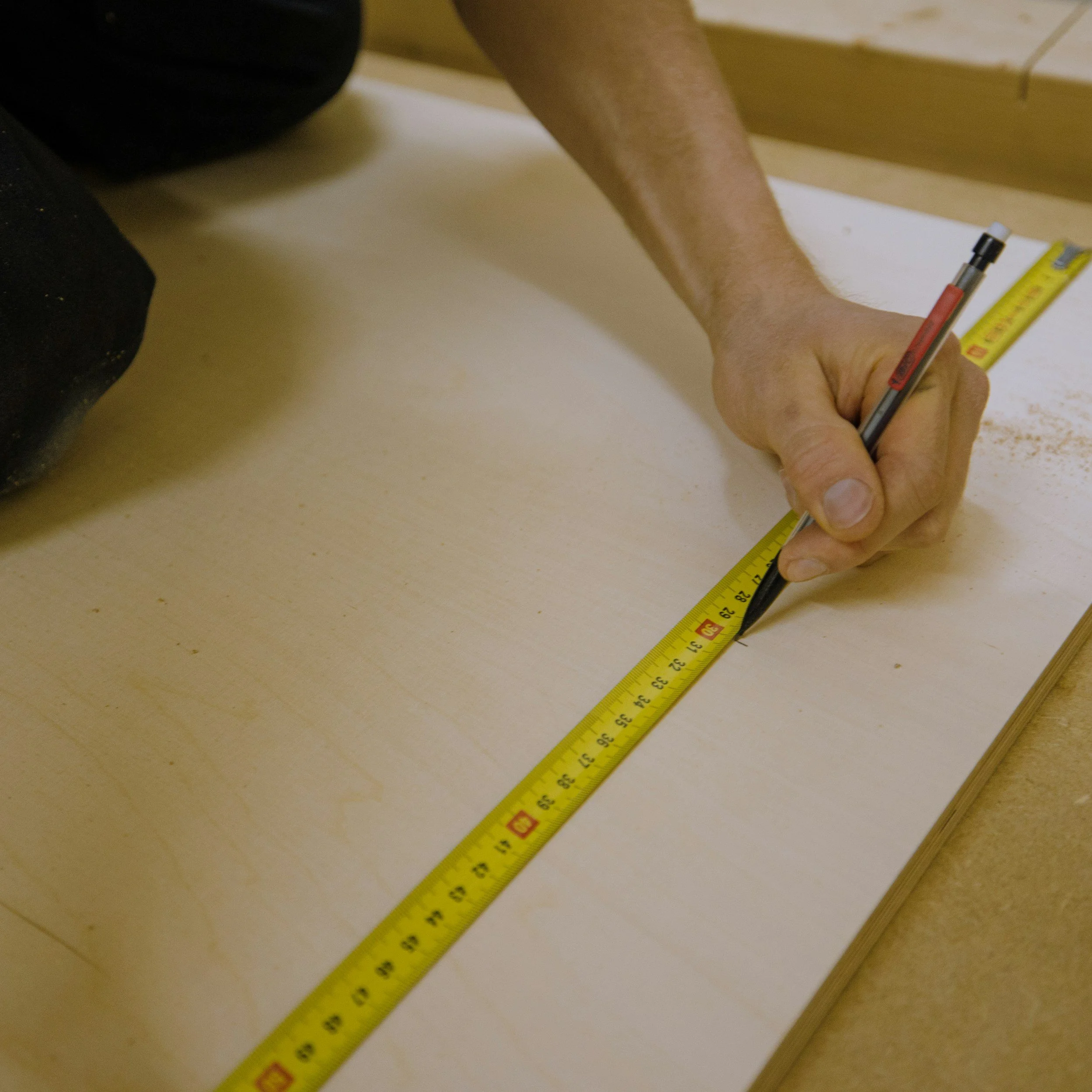
Measuring material before a cut. The Gauge symbolism begins with that practical fact.
That practical origin matters. Good building depends on proportion, sequence, and accuracy. A beam that is not measured properly does not improve through optimism. Material must be inspected, marked, and used with intention.
As a symbol, the twenty-four-inch gauge came to stand for the division of the day.[1] The image is clear enough to survive any elaborate explanation. A day, like a length of timber, is finite. You can use it well or badly, but you cannot pretend it is endless.
This makes the gauge a strong metaphor for time management. Time is the material. Character is what gets built from it.
Benjamin Franklin’s Schedule Was a Form of Measurement
Benjamin Franklin is often quoted as if he were chiefly a manufacturer of wise sayings. He was something more useful than that. He was procedural.
He tried to improve himself by method.
In his Autobiography, Franklin describes a daily schedule that organized his hours and framed them with two questions: “What good shall I do this day?” and “What good have I done to-day?”[2] Those are good questions because they perform different tasks. The first gives direction. The second tests reality. One plans the day. The other inspects it.
Franklin also defined Order as one of his thirteen virtues: “Let all your things have their places; let each part of your business have its time.”[3] That sentence joins physical order and temporal order in a single rule. Space should be arranged. Time should be arranged. Disorder in either one tends to spread into the other.
Why Journaling Makes Time Visible
The value of a journal is not that it makes life profound. Its value is that it makes life legible.
Without a written record, people are poor witnesses to their own days. They remember what flatters them, or what irritates them, or what happened most recently. They do not remember in proportion.
A journal corrects that.
Used seriously, a journal can show:
- what was planned
- what was actually done
- what caused delay
- what keeps repeating
- what needs to change
Franklin understood this. His notebooks were not exercises in self-expression. They were tools for self-examination.[2] He wrote things down so he could compare intention with conduct.
That is one of the few reliable ways to improve.
The Builder’s View of a Day
Builders know something abstract thinkers sometimes forget: sequence matters.
A competent foreman does not simply hope the work will unfold in a sensible order. He studies the plan, stages the labor, anticipates dependencies, and checks progress against reality. He knows one missed step can create trouble several stages later.
A day works the same way.
If the important work is postponed, the rest of the schedule usually degrades around it. If materials are not ready, time is lost. If attention is fragmented early, the whole day often turns reactive. This is not a moral melodrama. It is simple job sequencing applied to life.
That is why the twenty-four-inch gauge and Franklin’s routines belong together. Both assume that structure is not oppressive. It is useful.
A Journal Is a Foreman’s Notebook for the Self
There is a close analogy between Franklin’s notebook and a foreman’s daily log.
A foreman writes down:

A written record turns a day from a vague impression into something that can be reviewed.
weather labor deliveries delays progress changes next steps
Franklin wrote down:
virtues faults intentions results corrections[2]
Different material, same principle. Write it down while it is fresh. Review it later when it can teach you something.
This kind of journaling is especially valuable because it reduces vagueness. Instead of asking whether the day felt productive, you can ask better questions:
What did I actually do? Where did the time go? What interfered? What should be changed tomorrow?
Those questions are plain. That is why they work.
Why Franklin’s Method Still Holds Up
Franklin’s system lasts because it does not depend on mood. It depends on repetition.
It also makes room for failure. Franklin admitted that Order was one of the virtues he found hardest to master.[2] That is encouraging. The point of a schedule or a journal is not to prove that you are naturally excellent. It is to make correction possible.
Modern advice often confuses intensity with discipline. Franklin’s method is quieter than that. It asks for regularity, not drama.
You divide the day.
You do the work.
You record the result.
You adjust.
There is nothing glamorous about this, which is one reason it remains trustworthy.
Build the Day Before It Vanishes
The deeper lesson of the twenty-four-inch gauge is not that time must be crammed full. It is that time should not be left shapeless.
Measure the day.
Give the hours their use.
Keep some record.
Review the work.
Correct the line.
A builder would recognize the process immediately. Franklin would too.
And both would understand the larger point: a good life is rarely assembled by accident. It is built from days that have been measured honestly and used with care.
Notes
Author’s note:
I write as an individual Freemason, historian, and researcher. This article reflects my personal research and interpretation and does not represent an official statement of Advance Service Mizpah Lodge No. 586, the Grand Lodge of New York, or any other Masonic organization.
- [1] On the symbolic use of the twenty-four-inch gauge as a way of dividing the day into proper parts, see M. D. Bauer, The Grand Secret: Freemasonry, Benjamin Franklin, and the Republic of Letters, Harvard DASH.
- [2] Benjamin Franklin, Autobiography, Part II, for Franklin’s daily schedule, his morning and evening questions, his virtue-tracking method, and his remarks on the difficulty of maintaining Order.
- [3] Franklin’s definition of Order appears in Part II of the Autobiography: “Let all your things have their places; let each part of your business have its time.”