The Sirens, the Cyclops, and Other Things That Want Your Attention
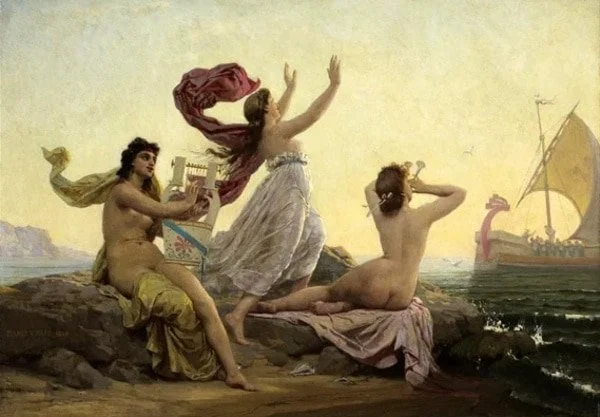
Marie-François Firmin-Girard – Ulysses and the Sirens Public domain, via Wikimedia Commons
The Odyssey is full of monsters. The Platonic reader notices that nearly all of them are also failures of attention: fascination without judgment, appetite without limit, and isolation without wisdom.
The Sirens know everything.
That is their sales pitch. They sing of the Trojan War, the deeds of heroes, and all that happens on the fertile earth. They offer knowledge, beauty, and the irresistible feeling that you are about to hear the one thing you absolutely must hear.
This is why they are dangerous.
The Sirens do not tempt Odysseus with ignorance. They tempt him with knowledge without discipline, curiosity without judgment, and attention captured so completely that the listener forgets the shore, the ship, the crew, and the fact that no one has ever left their island to write a favorable review.
The Cyclops, meanwhile, has one huge eye and no civilization. He sees plenty. He understands almost nothing.
Together they make an excellent pair of warnings for the modern mind.
The Sirens and undisciplined curiosity
A Platonic reader is not hostile to knowledge. Quite the opposite. The entire ascent of the soul depends upon learning to love truth. But there is a difference between loving truth and being unable to stop consuming information.
The Sirens’ song is knowledge as intoxication. It flatters the hearer with the promise that he can possess everything merely by listening. It requires no moral preparation, no patience, no method, no obligation, no transformation of character.
Odysseus survives not by pretending he has no desire to hear them. He admits the desire, has himself bound to the mast, and instructs his crew not to release him no matter how persuasive he becomes.
This is one of the oldest and best descriptions of a precommitment strategy. If you know that a particular temptation will make you foolish, arrange your life before the temptation arrives.
The crew use wax. We have passwords, blocked sites, deadlines, librarians, colleagues, modesty, and the useful practice of not trusting oneself at two in the morning.
The Cyclops and the single eye
Polyphemus is a creature of appetite and solitary force. He lives outside civic order, ignores hospitality, eats guests, and has one enormous eye.
One eye is not no vision. It is insufficient vision.
The Cyclops sees only from the center of his own appetite. He has no perspective, no reciprocity, no sense of proportion, and no recognition that another person might have an inner life worth respecting. He is powerful and perceptually narrow.
A Platonic interpretation need not force a one-to-one equation—“Cyclops equals ego”—to make use of this. The episode dramatizes what occurs when power is not educated by justice. The Cyclops has sight without insight.
Odysseus’ victory is not simply physical. He survives by intelligence, language, timing, cooperation, and knowledge of consequences. “Nobody” is not just a clever joke. It is a reminder that brute force is often defeated by a mind that can see relations rather than merely objects.
Attention as a moral faculty
The ancient philosophical point is that attention is not neutral. What we attend to shapes what we become capable of desiring.
The Sirens capture attention through excess. The Cyclops destroys attention through narrowness. One offers too much without measure; the other sees too little to become human.
The disciplined soul must avoid both errors. It must learn to focus without becoming blind, to seek knowledge without becoming intoxicated by novelty, and to recognize that truth requires character as well as cleverness.
This is where the liberal arts remain profoundly relevant. Grammar, rhetoric, logic, mathematics, music, astronomy—each teaches attention in a different key. They are not merely subjects. They are exercises in seeing clearly enough not to be eaten by the next monster.
The lodge as a school of attention
The Masonic lodge, at its best, is also a school of attention. Its symbols, movements, words, offices, furniture, and degrees assume that meaning is not exhausted by a first glance. One learns to observe, compare, remember, question, and return.
That is the opposite of the Sirens’ offer. The Sirens promise instant total knowledge. The disciplined student accepts gradual understanding.
There is no glamour in that sentence. There is, however, a lifetime of work in it.
Endnotes
Homer, Odyssey Book 12, on the Sirens; Book 9, on Polyphemus the Cyclops.
For ancient allegorical traditions in Homeric interpretation, see Heraclitus the Grammarian, Homeric Problems, trans. Donald A. Russell and David Konstan (Society of Biblical Literature, 2005).[12][13]
Robert Lamberton, Homer the Theologian: Neoplatonist Allegorical Reading and the Growth of the Epic Tradition (University of California Press), remains essential for the broader Neoplatonic treatment of Homer.[14][15]
For the difference between civic moral education and higher Platonic contemplation, see Plotinus, Ennead I.2, “On Virtues.”[16][17]