From Good Citizen to Contemplative: Plotinus’ Ladder of Virtue
For Plotinus, ordinary decency matters enormously—but it is not the end of the journey. Civic virtue orders the self; purificatory virtue frees it; contemplation turns it toward what is highest.
It is possible to become a decent person and still remain distracted.
One can pay bills, honor promises, keep temper within legal limits, show up when expected, and avoid becoming the subject of neighborhood group chats. These are not small accomplishments. Civilization depends on them.
But Plotinus thought they were not the whole of virtue.
In Ennead I.2, “On Virtues,” he distinguishes the virtues of civic and practical life from the soul’s higher purification and contemplation. Later Neoplatonists, especially Porphyry, developed this into a formal ladder: civic virtues, purificatory virtues, contemplative virtues, and paradigmatic virtues.[1][22]
The result is a map of human development that is more demanding than ordinary morality and considerably more interesting.
The virtues of ordinary life
At the civic level, the familiar cardinal virtues operate within the conditions of embodied and social life.
Prudence guides practical judgment. Courage governs fear. Temperance establishes agreement between appetite and reason. Justice ensures that each part of the soul does its proper work: reason ruling, the passions serving rather than staging a coup.[2][23]
This is the level of the well-ordered person. He does not expect appetite to disappear; he expects it to behave. He does not deny fear; he refuses to let fear make policy. He does not imagine that justice will arrive by good intentions alone; he trains himself to act fairly when it costs him something.
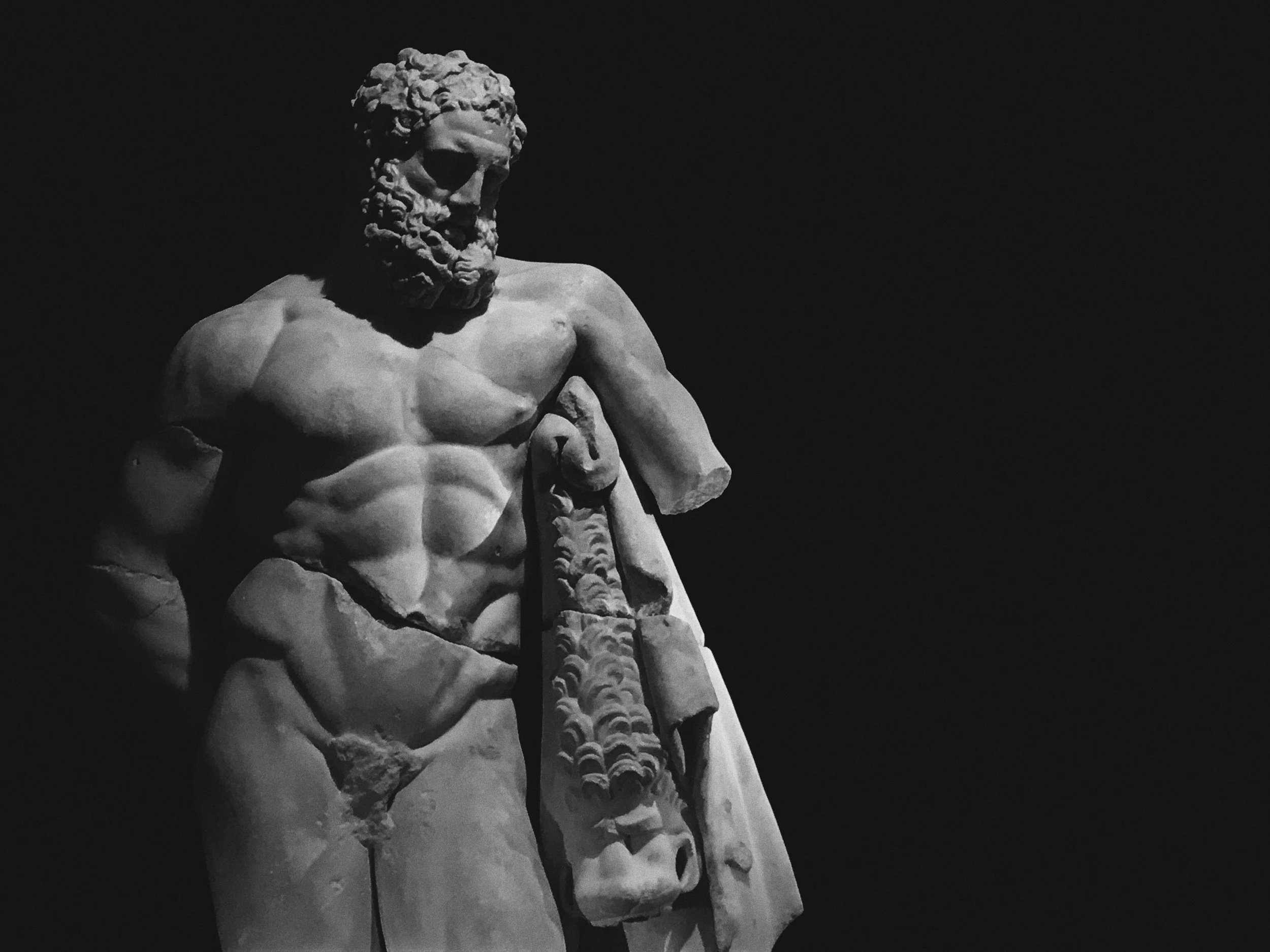
Heracles belongs primarily here. His Labors display courage, endurance, discipline, service, and a power turned outward toward the relief of others.
Purification: more than moderation
But Plotinus presses further. The civic virtues moderate the passions. Purificatory virtues alter the soul’s relation to them.
The person moving toward purification no longer bases judgment on bodily pleasure, bodily pain, social approval, or material success. He begins to withdraw from the assumption that these things tell him what is ultimately good or real.
Porphyry, Plotinus’ student and systematizer, explains the distinction with great clarity. Political virtues moderate the passions in accordance with reason and support fellowship with others. Purificatory virtues belong to the soul that is moving toward contemplation: they involve departure from excessive concern with bodily matters and freedom from emotional entanglement with what happens to the body.[2][24]
This is not a demand to despise the world or neglect one’s duties. It is a demand to relocate one’s center of gravity.
A person may still experience praise without living on it. He may still feel pain without calling pain the definition of evil. He may still act in the world without allowing the world’s applause or contempt to determine his character.
The higher work of attention
Contemplative virtue begins when the soul turns more fully toward Intellect—the intelligible realm of truth and the Forms. At this level, wisdom is no longer merely practical cleverness. It becomes contemplation of what is stable and real.
Porphyry’s Sentences 32 describes this progression with almost architectural precision. Civic virtue concerns measured passions and right action. Purificatory virtue detaches the soul from passions. Contemplative virtue is the soul’s intellectual activity: wisdom contemplates what Intellect contains; justice acts in conformity with Intellect; temperance is an inward turning toward Intellect; courage is freedom from disturbance through likeness to the impassive divine.[2][25]
This may sound forbidding until one recognizes the ordinary experience behind it. Contemplation begins whenever we stop asking only, “What do I want right now?” and start asking, “What is true? What is worthy? What would it mean to bring my life into alignment with it?”
The difference is not decorative. It is the difference between owning a compass and following it.
A Masonic reading of ascent
The Masonic reader may find in this ladder a helpful philosophical frame for the liberal arts and sciences. Properly understood, those studies do more than fill the mind with respectable furniture. They train attention.
Grammar teaches precision. Rhetoric teaches the responsible use of speech. Logic teaches discrimination. Arithmetic and geometry habituate the mind to proportion and relation. Astronomy raises the eye beyond the immediate and provincial. Music reveals order in number and harmony.
None of this makes a person virtuous automatically. A dishonest man can learn geometry. But the disciplines provide material for the moral and intellectual ascent described by the Platonists. They help the mind become less captive to confusion, prejudice, and noise.
The Middle Chamber, read in this philosophical key, is not merely a room one reaches. It is a condition of mind one learns to inhabit.
Endnotes
Plotinus, Ennead I.2, “On Virtues,” is the foundational text for his distinction between civic virtues and purifications.[22][23]
Porphyry, Sentences 32, develops the fourfold hierarchy of civic, purificatory, contemplative, and paradigmatic virtues.[1][2]
On the relation between Plotinus and Porphyry’s more formal scale, see the scholarly overview in The New Cambridge Companion to Plotinus.[26]
For the Platonic source behind the ideal of likeness to god, see Plato, Theaetetus 176a–b; Plotinus makes this ideal central to Ennead I.2.