The Pyre on Oeta: What Heracles Leaves Behind
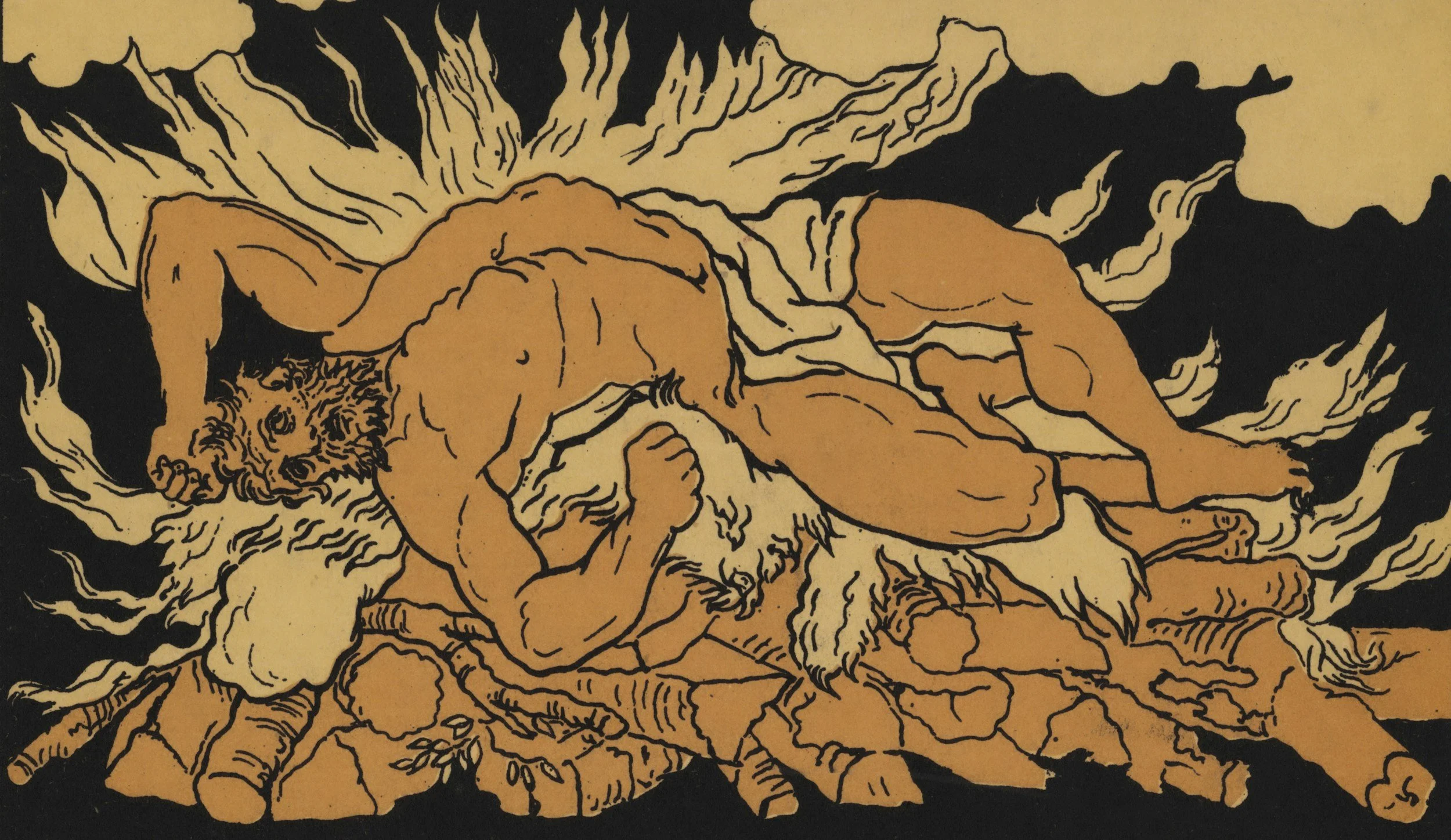
Heracles’ final fire is not merely an ending. Through Plotinus’ divided-soul image and the later Neoplatonic ladder of virtue, the death on Mount Oeta becomes a meditation on what must be shed—and what may endure.
Every long story of self-improvement eventually faces an awkward question: what, precisely, is being improved?
Heracles reaches Mount Oeta in agony. The poisoned robe of Nessus consumes his flesh; he orders a pyre; the mortal ordeal ends in fire; and the hero is received among the gods. It is one of the most dramatic exits in Greek myth, which is saying something in a tradition where people often leave life through thunderstorms, prophecies, family curses, or accidental contact with livestock.
The literal story is ancient and powerful enough. But in a Neoplatonic frame, it also invites a philosophical question. What burns on Oeta? Is it Heracles himself—or the claim that his bodily suffering, fear, fame, anger, and mortality are the whole of who he is?
What Plotinus actually gives us
We should begin with restraint. No surviving text shows Plotinus, Porphyry, Proclus, Olympiodorus, or Damascius offering a detailed allegorical decoding of the Mount Oeta episode. It would be irresponsible to write, “The pyre equals X, the robe equals Y, the thunderbolt equals Z,” and place the whole thing under a Neoplatonic name-tag.
What Plotinus does provide is the key image of the two Heracles figures: the shade in Hades and Heracles himself among the gods. That image separates the lower, mortal, body-related aspect of human life from the higher soul’s divine orientation.[15][16]
With that distinction in view, Oeta can be read philosophically—not as a surviving technical exegesis, but as a disciplined interpretation. The fire becomes a figure for purification: a stripping away of what is perishable, passion-bound, and mistaken for the self’s deepest identity.
The higher Heracles
In the Neoplatonic tradition, the self is not simply the sum of sensations, memories, anxieties, appetite, reputation, and physical condition. Those things are real, and anyone who has stubbed a toe knows they can make an excellent argument for their importance. But they are not ultimate.
The higher soul is capable of orientation toward Intellect and the divine. Plotinus’ Heracles, raised among the gods while his shade remains below, makes that truth visible in mythic form.[17][27]
This does not mean that one earns immortality by pretending not to have a body. It means that the body does not own the final definition of the soul.
That is why the Oeta story can be read as a drama of release. The hero does not become divine because he has accumulated enough heroic publicity. He becomes divine because the story reveals that heroic action, purification, and the higher soul’s affinity with the divine are more fundamental than the mortal conditions that torment him.
Active virtue and the life beyond action
Still, Plotinus adds a subtle complication. Heracles is the hero of action—of useful, public, difficult work. He becomes godlike through “noble serviceableness,” but he is not presented as the supreme contemplative philosopher. Something of him remains symbolically below because his excellence belongs to the active life.[17]
This is a marvelous thought for anyone tempted to divide the world into “practical people” and “spiritual people,” as if one group fixed roofs while the other stared impressively into the middle distance.
For Plotinus, active virtue is real virtue. It matters. It is not discarded. But it points beyond itself. One begins by doing the good; one advances by becoming less ruled by the things that make good action difficult; one seeks, finally, to know the source of goodness more directly.
Heracles’ apotheosis is therefore not a reward sticker placed on the hero’s last assignment. It is the mythic completion of a movement already present in the Labors: from chaotic force toward ordered service; from suffering endured to suffering understood; from the wilderness of the self toward a higher likeness.
The work that survives the fire
The Masonic resonance is quiet but unmistakable. In the work of the lodge, the aim is not self-annihilation but refinement. The roughness is not the man’s essence. The task is to remove what obscures form, proportion, and usefulness.
The same can be said of Heracles on Oeta. The pyre does not make him less himself. It burns away the mortal confusion that had covered the higher self.
The question the myth leaves with us is not, “How may I become an Olympian god?” This is fortunate, since the zoning regulations are unclear. It is: what in my life do I mistake for the whole of me?
Is it fear? Injury? Appetite? The need to be admired? The memory of failure? The role one has played for so long that it has mistaken itself for a soul?
Heracles’ final lesson is not that the world should be abandoned. It is that one must work within it without becoming spiritually trapped by it.
Endnotes
For the traditional death and apotheosis of Heracles on Mount Oeta, see Sophocles, Women of Trachis; Ovid, Metamorphoses 9; and the later Roman tragedy known as Hercules on Oeta. The latter is now commonly treated as post-Senecan or pseudo-Senecan rather than securely by Seneca.[28][29]
Plotinus, Ennead I.1, on the shade of Heracles in Hades and Heracles among the gods.[15]
On Plotinus’ account of higher and lower dimensions of soul, see Ennead IV.8 and modern scholarship on the soul’s descent and its continuing orientation toward the intelligible realm.[20][21]
For Porphyry’s hierarchy of virtue and the movement from civic order through purification to contemplation, see Sentences 32.[1][2]
On the Greek artistic and literary tradition of Heracles’ apotheosis, see scholarship on the Classical representation of his weariness, death, and elevation.[30][31]