Before the Airport: The Many Lives of Jamaica Bay
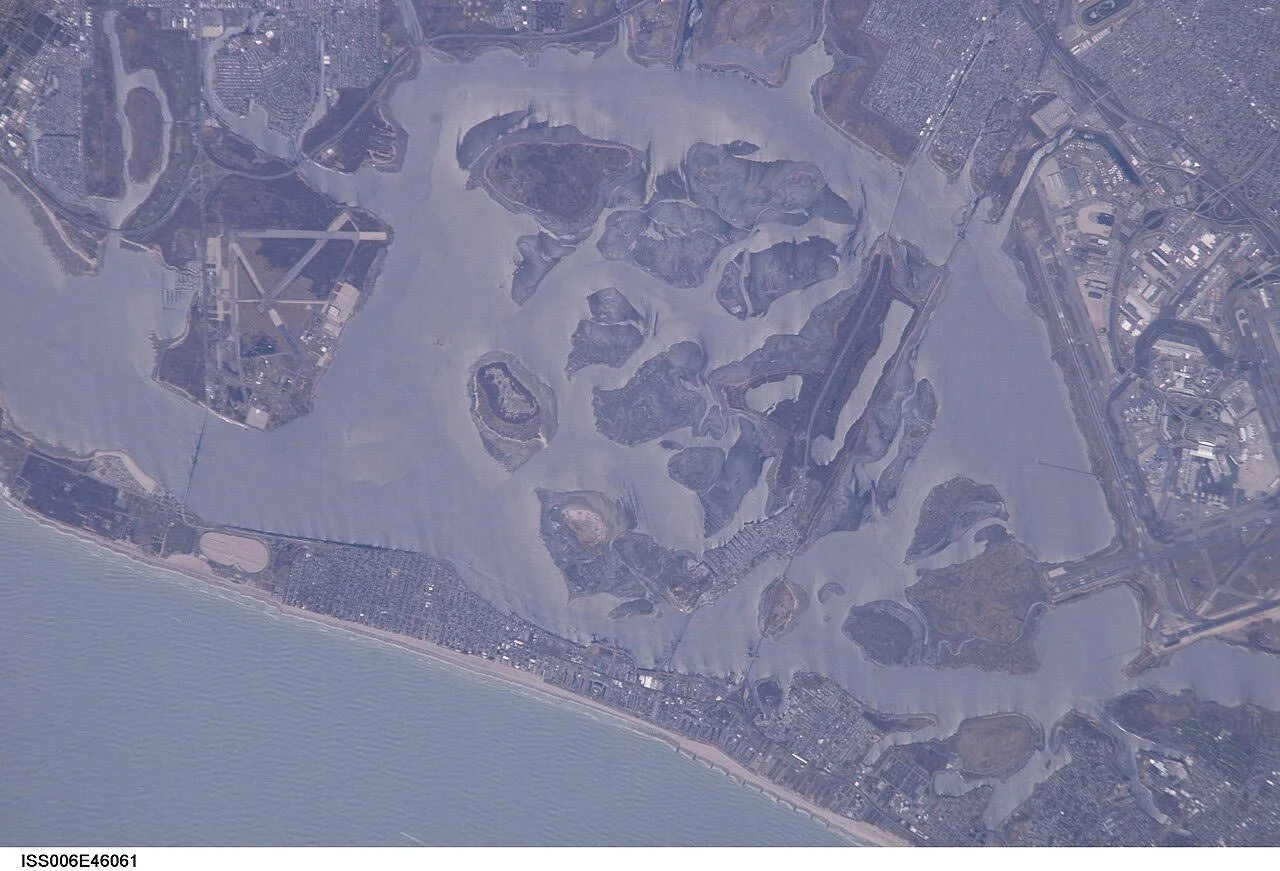
Jamaica Bay from the ISS, 2003.
Long before airports, parkways, and restoration plans, Jamaica Bay was a productive estuary shaped by Indigenous use, colonial settlement, fishing, shellfishing, recreation, and maritime life.
Before Jamaica Bay became a place most people saw from the window of a descending plane or the edge of a parkway, it had already lived many lives.
Today the bay is often framed as an environmental zone: wetland, wildlife refuge, restoration site, climate-risk landscape, or infrastructural edge. It is all of those things. But that modern framing can flatten the bay’s longer history. Long before it became associated with airport expansion, marsh loss, and ecological management, Jamaica Bay was one of the most productive and heavily used estuarine environments in the New York region.[1]
Its waters fed people. Its marshes supported labor and extraction. Its channels connected communities. Its shores hosted settlement, industry, leisure, and seasonal escape. To understand Jamaica Bay historically is to recover a landscape that was never simply “natural” and never merely marginal. It was a working, inhabited, and contested edge of the city long before the city fully claimed it.[2]
A productive estuary before modern infrastructure
Jamaica Bay’s early significance began with its ecology.
As an estuary, the bay mixed saltwater and freshwater across a shifting environment of creeks, coves, marsh islands, mudflats, and tidal channels. Such landscapes are biologically rich, and Jamaica Bay was especially so. Fish, shellfish, birds, and marine life thrived in its shallow waters and wetlands, making it an important source of food and material support for human communities over centuries.[3]
Before European colonization, Indigenous peoples in the region, including the Canarsee, used the bay and surrounding shorelands for fishing, shellfishing, hunting, travel, and seasonal subsistence.[4] This was not an untouched wilderness in the romantic sense. It was a known and used coastal environment whose value lay in the close relationship between marsh, water, and human livelihood.
When Dutch and later English settlers established themselves nearby in the seventeenth century, they entered an already productive environment and built upon that logic of use.[5] The bay’s waters offered fish and shellfish; its marshes yielded practical resources; its channels provided movement and exchange. For generations, Jamaica Bay helped sustain local communities not as scenery, but as working landscape.
When the bay fed the region
For much of its history, Jamaica Bay fed people directly.
Its oyster beds became the most famous part of that story, but they were not the whole of it. The bay also supported clams, fish, and other marine resources that sustained local economies and contributed to the wider food supply of metropolitan New York.[6] Before refrigeration and modern food distribution, access to productive nearby waters mattered enormously. Communities on and around the bay lived with a degree of material dependence on what its estuarine environment could yield.
That productivity required knowledge as much as abundance. People learned the rhythms of the tides, the locations of shellfish grounds, the behavior of fish runs, and the seasonal changes that shaped access to the water.[7] Jamaica Bay was rich, but its riches were meaningful because generations of people knew how to work them.
Modern accounts of the bay often begin with environmental decline, but that can obscure the scale of what existed before decline. The tragedy of pollution and destruction becomes sharper when we remember that the city did not merely damage an abstract wetland. It transformed a productive estuary that had once supported food systems, labor, and local livelihood.[8]
Settlement, water, and work
It is easy now to imagine Jamaica Bay as peripheral. Historically, it was anything but.
Before the rise of the modern airport landscape, before major landfill projects, and before the infrastructure of twentieth-century metropolitan growth, the bay formed part of a working coastal world. Its shorelines and islands supported settlement and movement. Boats linked communities across the water. Marshes were not vacant land but useful terrain. The bay was a place of labor, transport, extraction, and exchange.[9]
This kind of economy did not leave behind the monumental physical traces associated with later industrialization. It was smaller scale, more seasonal, and more ecologically dependent. But it was still economically meaningful. Jamaica Bay mattered because it supported practical life at the city’s edge, and for a long time that edge was not yet subordinate to airports, highways, or waste systems.[10]
Understanding that earlier world helps correct a common historical distortion. Places like Jamaica Bay often come to seem marginal only after urban development reorganizes around them. Once larger systems of capital and infrastructure take priority, earlier landscapes of fisheries, shellfishing, marsh use, and coastal labor can begin to look minor in retrospect. But they were not minor to the people who depended on them.[11]
A playground at the edge of the city
By the nineteenth century, Jamaica Bay was not only a source of food and livelihood. It was also becoming a destination.
As Brooklyn and New York expanded, the bay attracted anglers, hunters, boaters, hotel guests, and summer visitors looking for recreation at the urban edge.[12] The same waters and marshes that had long supported subsistence and commercial use also offered leisure, scenery, and escape. Broad Channel, the Rockaways, and other parts of the bay became associated with hotels, bungalows, boating culture, and weekend excursions.[13]
This recreational life was not separate from the bay’s working identity. It grew from the same environmental conditions that made the estuary productive in the first place. The bay’s shallows, fisheries, open water, and marshes made it attractive both to people seeking food and to people seeking pastime.
By the late nineteenth century, improved transportation made access easier, and Jamaica Bay became more visibly integrated into metropolitan leisure culture.[14] Visitors came for fishing, boating, hunting, and temporary retreat. In this period the bay began to acquire another of its many historical identities: not only estuary and fishery, but playground.
The burden of growth
Yet the very qualities that made Jamaica Bay useful also made it vulnerable.
As the city grew, the bay’s waters and marshes were increasingly treated not only as resources but as opportunities for reengineering. Dredging altered channels. Filling eliminated wetlands. Islands were combined, reduced, or erased. Industry and waste disposal intensified along the margins. What had once been valued as productive complexity began to be seen, in many planning contexts, as inconvenient space available for transformation.[15]
This shift was part of a larger metropolitan pattern. New York repeatedly pushed unpleasant or extractive uses to landscapes it considered peripheral. Jamaica Bay absorbed many of those burdens. Over time it became associated not simply with food and recreation, but with dumping, pollution, speculative development schemes, infrastructural ambition, and environmental decline.[16]
The most dramatic single transformation came in the twentieth century, when the construction of what became John F. Kennedy International Airport consumed vast areas of marshland in the eastern bay.[17] By then, however, the longer process was already underway. The airport did not begin the bay’s transformation from working estuary to engineered edge, but it became one of its defining symbols.
Why the earlier bay matters
To recover the many lives of Jamaica Bay is not to indulge nostalgia. It is to restore historical proportion.
Modern discussions of the bay often focus on habitat, resilience, and restoration. Those are essential concerns. But they can unintentionally obscure the fact that Jamaica Bay was once a human landscape as well: inhabited, worked, visited, argued over, and heavily used.[18] It was never only nature. It was one of the places where New Yorkers worked out their relationship to food, water, recreation, transport, waste, and urban expansion.
That is why the bay’s history matters beyond environmentalism. Jamaica Bay reveals something fundamental about how cities treat edge landscapes. First they depend on them. Then they exploit them. Then they forget what those places once made possible.[19]
The story of Jamaica Bay is not simply the story of ecological decline. It is also the story of memory loss.
Conclusion
Before the airport, Jamaica Bay had already lived many lives.
It was Indigenous land and estuary. It was fishery and shellfish ground. It was working shoreline, transport corridor, marsh economy, and recreational frontier. Later it became a target of dredging, filling, and infrastructural transformation. Today it survives as both damaged ecosystem and restoration landscape.
To see only one of those versions is to misunderstand the bay.
Jamaica Bay matters historically because it was never just scenery at the edge of New York. It was one of the places where the city fed itself, entertained itself, expanded itself, and displaced the costs of that expansion. Long before airplanes crossed its skies, the bay was already central to the life of the region.
Endnotes
Image
Source: NASA, “View of New York,” ISS Expedition 6, April 14, 2003, via Wikimedia Commons. Public domain.
Literary
[1] National Park Service, “Introducing Jamaica Bay,” https://www.nps.gov/im/ncbn/jamaica-bay.htm.
[2] National Park Service, Jamaica Bay: Historical Resource Study, https://npshistory.com/publications/gate/jamaica-bay-hrs.pdf.
[3] National Park Service, “Introducing Jamaica Bay.”
[4] Ibid.; see also National Park Service, Jamaica Bay: Historical Resource Study.
[5] National Park Service, Jamaica Bay: Historical Resource Study.
[6] Ibid.
[7] Ibid.
[8] Ibid.; see also Kristin M. Olsen, “Jamaica Bay As New York City’s Conflicted Backyard,” https://msuweb.montclair.edu/~olsenk/Abstract%20presentation.html.
[9] National Park Service, Jamaica Bay: Historical Resource Study.
[10] Ibid.
[11] Ibid.
[12] National Park Service, “Introducing Jamaica Bay”; Science and Resilience Institute at Jamaica Bay, “The Environmental History of Jamaica Bay,” https://srijb.org/the-environmental-history-of-jamaica-bay.
[13] National Park Service, “Introducing Jamaica Bay.”
[14] Science and Resilience Institute at Jamaica Bay, “The Environmental History of Jamaica Bay.”
[15] National Park Service, “Introducing Jamaica Bay”; National Park Service, Jamaica Bay: Historical Resource Study.
[16] National Park Service, Jamaica Bay: Historical Resource Study; Olsen, “Jamaica Bay As New York City’s Conflicted Backyard.”
[17] National Park Service, “Introducing Jamaica Bay.”
[18] National Park Service, Jamaica Bay: Historical Resource Study.
[19] This interpretation is synthesized from National Park Service, “Introducing Jamaica Bay”; National Park Service, Jamaica Bay: Historical Resource Study; and Science and Resilience Institute at Jamaica Bay, “The Environmental History of Jamaica Bay.”