The Rise and Ruin of Jamaica Bay Oysters
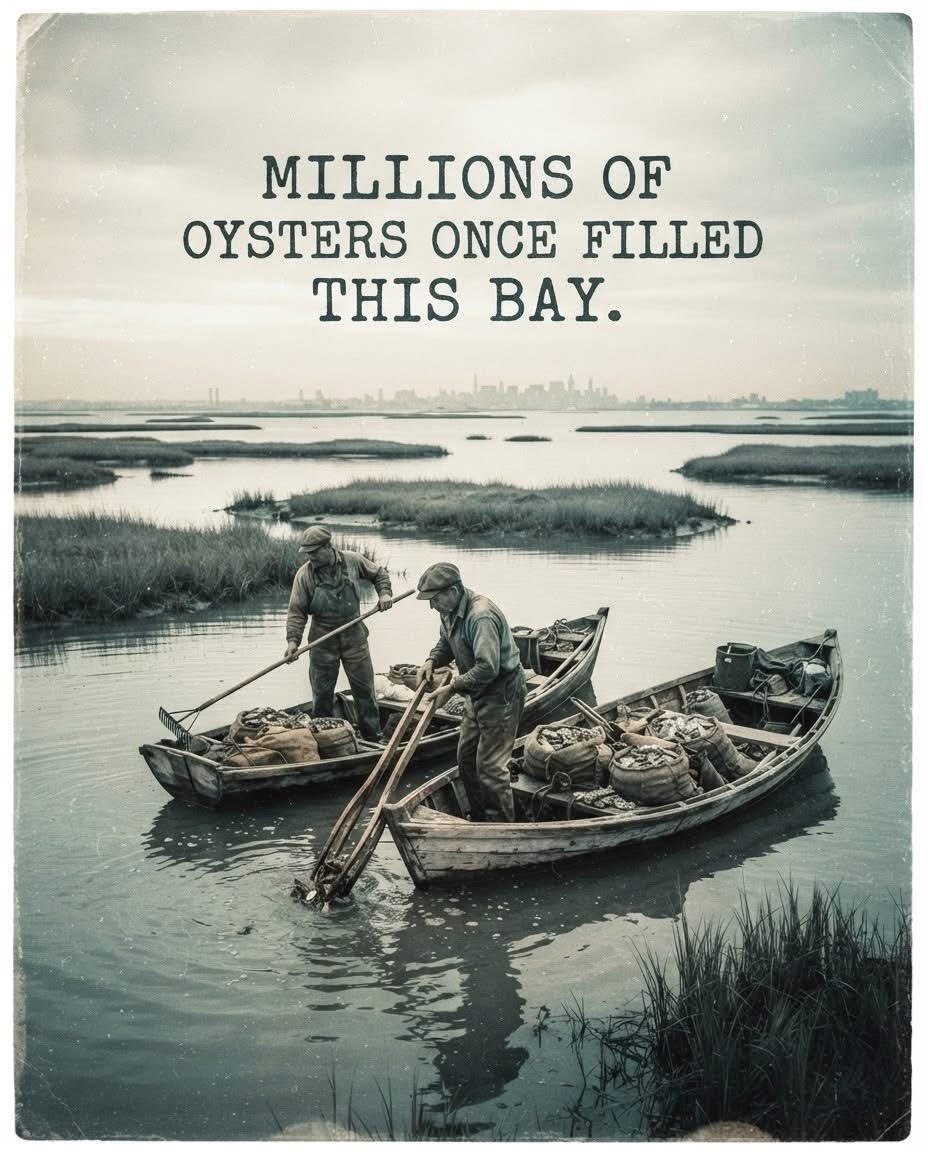
AI-generated Jamaica Bay oystermen in New York oyster history.
The oyster beds of Jamaica Bay helped define its economy, but disease, pollution, and urban growth turned one of the bay’s great natural assets into a public-health hazard.
An oyster bed can look like nature and still function like infrastructure.
For generations, Jamaica Bay’s oyster grounds were exactly that: a productive underwater landscape that fed people, supported local livelihoods, and tied the bay to the wider economy of New York. Long before the bay was discussed in terms of restoration, resilience, or airport geography, it was valued for what could be taken from its waters. Oysters were among the most important of those resources, and their history offers one of the clearest ways to understand both the bay’s abundance and its decline.
It is also one of the starkest stories in the environmental history of New York.
Jamaica Bay’s oyster world did not simply fade because tastes changed or markets moved elsewhere. It was undermined by the very growth of the metropolis it helped sustain. Pollution worsened. Waste entered the water. Public health fears mounted. By the late nineteenth century, oysters that had once represented nourishment and commercial promise could also signify contamination and disease.
The arc is almost too neat: abundance, exploitation, danger, collapse.
But that is often how cities ruin the landscapes that feed them.
A bay made for shellfish
Jamaica Bay’s physical character helps explain why oysters mattered so much there.
Historically, the bay was not a single open basin but a complex estuarine system of marshes, tidal creeks, coves, mudflats, and islands.[1] Such environments can be extraordinarily productive. Where salt water and fresh water mix, nutrients circulate, sediment settles, and shallow-bottom ecologies support fish and shellfish in abundance. For nearby communities, this meant food close at hand. For markets, it meant commodity value. For those willing to manage or exploit submerged lands, it meant profit.
The National Park Service notes that Dutch and English communities around Jamaica Bay prospered for nearly 300 years from its natural resources, including oysters and clams.[2] That long duration matters. Oystering was not a brief fad or a marginal sideline. It formed part of the basic economic logic of the bay. The estuary fed people directly, but it also generated labor, trade, transport, and legal conflicts over who had the right to use what lay beneath the water.
A productive oyster ground is a common resource only until someone finds a way to privatize advantage within it.
That dynamic shaped Jamaica Bay too.
Oysters as economy
It is easy to romanticize oyster history because the oyster itself now feels quaintly local, artisanal, almost literary. In the nineteenth century, however, oysters were not merely fashionable. They were practical food and serious business.
Across the New York region, oyster consumption was immense, and Jamaica Bay participated in that wider market.[3] The bay’s shellfish economy linked local ecological conditions to urban demand. Harvesters gathered oysters from natural beds and, as in other estuarine systems, control over shellfish grounds became a matter of money as well as subsistence. Rights to underwater terrain could be contested, leased, or monopolized, depending on local legal regimes and political influence.[4]
This is one of the useful things oyster history reveals. It reminds us that environmental abundance does not sit outside ordinary urban conflicts. Once a city begins to value a natural resource, that resource enters systems of law, speculation, and competition. The bay floor becomes a kind of property frontier, even if it lies underwater.
Jamaica Bay’s oyster beds were therefore not just ecological assets. They were pieces of an economic geography in which wealth could be extracted from estuarine conditions and moved outward into the expanding life of the city.
What makes this history particularly striking is that the success of the oyster economy depended on the bay remaining biologically alive. Unlike some extractive industries, shellfishing cannot continue indefinitely once the surrounding waters become foul enough. An oyster is not merely harvested from an environment. It filters that environment. Which means it also records the damage done to it.
That became a problem.
The city grows, and the water changes
The history of Jamaica Bay oysters is, in large part, the history of what happened when metropolitan growth overwhelmed estuarine capacity.
As New York and Brooklyn expanded through the nineteenth century, the waters flowing into and around Jamaica Bay became increasingly contaminated.[5] Industrial activity intensified in parts of the bay. Waste accumulated. Tributaries carried urban runoff and sewage. On Barren Island, fish rendering, fertilizer production, and refuse-related operations added especially noxious burdens to the surrounding environment.[6]
None of this happened all at once, and that gradualism matters. Environmental decline is often hard to recognize in real time because a resource can remain economically active even as its conditions worsen. Oysters may still be harvested. Markets may still function. Buyers may still assume that traditional sources remain trustworthy. The ecological warning signs appear before the social consensus catches up.
Jamaica Bay appears to have passed through exactly this kind of delayed crisis. The same waters that had long sustained shellfish production were becoming compromised by the byproducts of urban expansion. A metropolis that prized the bay for its food also increasingly used it as a sink.
This contradiction was not unique to Jamaica Bay, but the bay offers a particularly legible version of it. The estuary’s productivity made it valuable; the city’s growth made that same productivity difficult to maintain safely.
At some point, abundance becomes exposure.
Typhoid in the oyster beds
The turning point in the public meaning of oysters came when contamination became not just an ecological concern but a health crisis.
The National Park Service notes that by the 1890s, Jamaa Bay oysters were implicated in typhoid outbreaks, helping discredit the safety of shellfish taken from polluted waters.[7] This was devastating not only because of the disease itself, but because it altered the symbolic status of the oyster. Food that had once suggested freshness, locality, and prosperity could now carry the fear of invisible urban filth.
That shift is crucial. People will tolerate environmental damage longer than they will tolerate the idea of poisoning themselves.
Public health scares often succeed where conservation warnings do not, because they translate diffuse ecological decline into immediate bodily risk. Once consumers begin to associate a food source with disease, confidence can collapse quickly. And with confidence goes price, demand, and the viability of the entire local industry.
Typhoid did not single-handedly destroy Jamaica Bay’s oyster economy, but it crystallized a process already underway. It made visible the connection between polluted water and contaminated food. It exposed the inability of the old shellfish economy to coexist indefinitely with the disposal habits of the modern metropolis. And it showed, in the most intimate possible way, that the city’s abuse of the bay could come back into the city through the act of eating.
There are many ways for an environment to protest. One of the most effective is to enter the bloodstream.
The problem of invisible filth
One reason oyster contamination mattered so much historically is that shellfish sit at an uncomfortable boundary between natural abundance and urban anxiety.
An oyster looks pristine. Its danger, if present, cannot be reliably seen. It is therefore an ideal vessel for public fear in periods when cities are becoming newly conscious of microbes, sewage, contamination, and the hidden pathways of disease. By the late nineteenth century, these concerns were no longer abstract. Modern urban life had made invisible pollutants thinkable in new ways, and shellfish from compromised waters became especially vulnerable to suspicion.[8]
Jamaica Bay oysters thus became part of a broader historical transition in how cities understood environmental risk. Earlier generations could value estuarine food without dwelling excessively on bacteriological danger. Later generations, living amid denser development and more evident pollution, found such confidence harder to sustain.
The oyster had not changed. The city around it had.
And once the city changed enough, the old relationship between eater and estuary could not survive intact.
From productive bottom to damaged landscape
The decline of the oyster industry did not mean the bay instantly ceased to matter. But it did mean that one of its most historically coherent uses had been profoundly weakened.
This had consequences beyond shellfish alone. Oystering had tied communities to water in practical, ongoing ways. It sustained knowledge of channels, bottom conditions, seasons, and local ecologies. It reinforced the idea of the bay as a productive landscape rather than a mere margin. When that economy eroded, something larger eroded with it: a human relationship to Jamaica Bay grounded in harvest and trust.
The bay’s identity then became more vulnerable to replacement by other metropolitan functions — recreation for a time, industrial burden more heavily, and eventually a mixture of infrastructure, environmental management, and residual local use.[9] Once a food-producing estuary stops being trusted as food-producing, it becomes easier for the city to imagine other destinies for it.
That is one of the deeper lessons of this history. Ecological decline does not merely destroy species or industries. It changes the menu of futures a place appears to offer.
If Jamaica Bay could no longer reliably produce safe oysters, it was no longer quite the same bay in the metropolitan imagination.
What the oyster story tells us now
The rise and ruin of Jamaica Bay oysters is not just an antiquarian tale about vanished shellfish beds. It is a compact history of urban metabolism.
The city drew nourishment from the bay. It valued the bay because it was biologically rich. It then subjected the bay to forms of growth and disposal that degraded that richness. When the resulting contamination became impossible to ignore, the old economy collapsed, and the bay moved further toward other, less intimate relationships with the metropolis.
In that sense, oyster history is not peripheral to New York. It is central.
It shows how cities depend on nearby ecologies while steadily impairing them. It shows how pollution can remain tolerable until it interrupts commerce or health. It shows how public confidence in nature is harder to restore than public access to nature. And it shows how quickly a living productive landscape can be reclassified once its original use becomes suspect.
Today, efforts to restore Jamaica Bay often emphasize habitat, resilience, and ecological function.[10] Those aims are important. But the history of the oyster beds reminds us that restoration is also about memory. It asks whether New Yorkers can still imagine the bay as something more than scenery, buffer, or problem. Can it again be understood as a life-supporting estuary in a meaningful civic sense? Or has the older food-producing bay become irretrievable except as historical lesson?
That is the haunting force of this story.
The oyster beds helped make Jamaica Bay valuable. Their contamination helped reveal how thoroughly that value had been betrayed.
Endnotes
Image
AI-generated illustration of Jamaica Bay oystermen, created to evoke New York oyster history. Shared via Forgotten New York History on Facebook and used here as a conceptual image only, not as an authentic historical photograph. Source: Forgotten New York History, “Millions of Oysters Once Filled This Bay,” Facebook, Aug. 23, 2026, Facebook
Literary
[1] National Park Service, JAMAICA BAY historical resource study, accessed previously via user-provided source. The study describes the historical geography of the bay as a complex estuarine system of islands, marshes, channels, and tidal zones. https://npshistory.com/publications/gate/jamaica-bay-hrs.pdf
[2] National Park Service, “Introducing Jamaica Bay,” previously cited. The page notes that Dutch and English communities prospered for nearly 300 years from the bay’s resources, including oysters and clams. https://www.nps.gov/im/ncbn/jamaica-bay.htm
[3] Forgotten New York, “Jamaica Bay,” previously cited; see also the National Park Service overview for the bay’s importance as a shellfishing landscape. https://forgotten-ny.com/2007/07/jamaica-bay
[4] National Park Service, JAMAICA BAY historical resource study. The study discusses the economic and legal significance of Jamaica Bay’s marine resources and submerged lands in the broader history of the bay.
[5] National Park Service, “Introducing Jamaica Bay.” The page notes contamination beginning in the mid-nineteenth century and worsening with development.
[6] Ibid.; National Park Service, JAMAICA BAY historical resource study, on Barren Island’s fish-oil, fertilizer, and refuse industries.
[7] National Park Service, “Introducing Jamaica Bay.” The page states that by the 1890s Jamaica Bay oysters were linked to typhoid outbreaks.
[8] For the period context of contamination fears as discussed in relation to Jamaica Bay shellfish, see National Park Service, “Introducing Jamaica Bay,” and the historical resource study.
[9] National Park Service, JAMAICA BAY historical resource study; Forgotten New York, “Jamaica Bay”; and “Jamaica Bay,” Wikipedia, for the broad transformation of the bay through industrialization, dredging, filling, and later infrastructural change. https://en.wikipedia.org/wiki/Jamaica_Bay
[10] Science and Resilience Institute at Jamaica Bay, “About Us,” previously cited for the contemporary resilience and restoration framing of the bay. https://www.srijb.org/about/
Small note: in the draft above, “Jamaa Bay” in the typhoid paragraph should read “Jamaica Bay.”