The Ferry and the Forgotten Places
College Point, Astoria, Far Rockaway, and the transit paths Queens almost lost
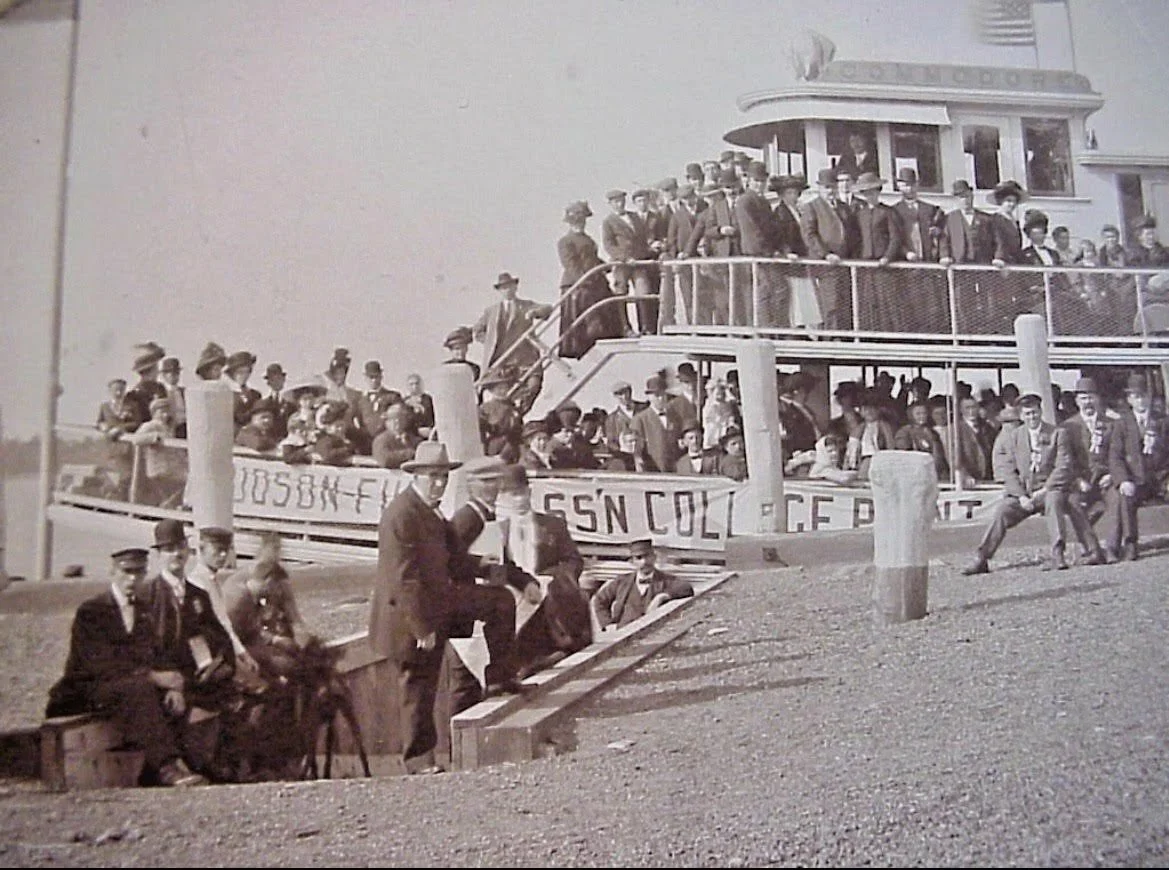
College Point, NY—Hudson Fulton Ass’n ferry at the dock, 1906
Some transportation histories leave monuments. Others leave only traces: an old landing, a vanished route, a shoreline that used to matter more than it seems to now. Queens is full of such places, and the ferry helps bring them back into view.
Cities forget in layers.
They forget roads by paving over them.
They forget shorelines by industrializing them.
They forget ferry routes by replacing them with bridges and then pretending the old crossings were little more than quaint preliminaries.
Queens is particularly rich in this sort of amnesia.
People remember the great things because they are large and continue to inconvenience us: bridges, expressways, subway bottlenecks, airports, megaprojects. But the smaller transit histories—the discontinued ferry, the old landing, the half-remembered connection between neighborhoods that now seem unrelated—these often vanish from common memory altogether.
Which is a pity, because forgotten routes tell you what a city once needed.
College Point and the Lost Habit of Crossing
Take College Point.
Today it is not the first place many people think of when they imagine Queens transit history. Yet the New York City municipal archives remind us that from 1921 to 1939, the city operated a ferry between Clason Point in the Bronx and College Point in Queens.[1]
Now, that is a marvelous fact precisely because it sounds so improbable to modern ears. Not impossible, just improbable. It reminds us that one generation’s routine trip becomes another generation’s historical curiosity.
Why was such a route useful? Because local movement does not always obey the grand radial logic of Manhattan-bound transit. Sometimes neighborhoods need lateral connections, borough-to-borough water crossings, or practical short links that larger systems overlook. The ferry to College Point belonged to that world.
Its disappearance tells us two things:
first, that fixed crossings elsewhere made it less necessary in official terms;
second, that the city increasingly preferred larger integrated systems over smaller water-based local links.
Astoria Before the Bridge Became the Story
Astoria has suffered from another kind of forgetting.
People still know it as waterfront Astoria. They know Hell Gate, the East River, the views, the bridge nearby. But the ferry history tends to disappear beneath the larger drama of the Triborough Bridge and the automobile century.
Yet the Astoria Ferry, running from East 92nd Street to Astoria between 1920 and 1936, was part of the municipal system and mattered enough to be maintained until the bridge made it redundant.[2]
This matters because it restores proportion. The bridge did not emerge into emptiness. It replaced a transportation ecology already in operation. Astoria was not waiting passively for modernity to arrive in steel. It already had routes, habits, rhythms, and shoreline connections. The bridge transformed these. It did not invent movement where none had existed.
Far Rockaway and the Meaning of Distance
Far Rockaway presents another kind of forgotten transit history. It is not that people forget it had transportation. It is that they underestimate how much transportation has shaped its very identity.
Far Rockaway has long existed in tension between remoteness and accessibility. It was once a resort landscape, then a commuter edge, then a more complex residential and commercial district bound to the city by rail yet still marked by geographic separation. Modern discussions often begin with what it lacks. But historically, the place has repeatedly been redefined by whichever route best promised reconnection.
That is why the modern ferry matters there even if ridership numbers remain modest in citywide terms. It taps into a long Queens pattern: when conventional routes leave a place feeling peripheral, water can suddenly seem like a revelation all over again.
Not because the water is new.
Because the city has run out of easy certainty elsewhere.
The Transit Paths Not Taken
There is another way to think about all this.
Transportation history is not only a record of what was built. It is also a record of what ceased, what failed, and what was never fully developed. Queens contains many such unrealized or interrupted trajectories.
What if local ferry systems had been modernized rather than abandoned?
What if lateral borough connections had received more sustained support?
What if shoreline transit had not been treated merely as a stopgap until bridges and roads could dominate?
What if the twentieth century had not become so enthralled by the private automobile and the structures built to indulge it?
These are not idle questions. They help explain why some neighborhoods are well-served and others remain awkwardly connected despite sitting on navigable water.
Why Forgotten Routes Matter Now
Forgotten routes matter because they widen the imagination.
Once you know that Astoria had a municipal ferry.
Once you know College Point was linked across the water.
Once you see the Rockaways as part of a longer history of selective access rather than mere periphery.
Then present-day transit debates look less inevitable.
The city we have was built by choices, not destiny.
The Department of Records essay says the municipal ferry system has experienced “rise, fall and rise again.”[3] The phrase is apt, but incomplete. There was also forgetting in between. And forgetting is powerful. Once a route disappears long enough, people stop arguing for it because they stop imagining it.
That is one reason historians are useful, when they are useful at all. They restore lost possibilities to memory.
Queens as a Borough of Edges
Queens has always been a borough of edges:
edge of city and suburb,
edge of water and land,
edge of Manhattan’s influence,
edge of industrial and residential transformation.
Ferries make such edges legible.
They reveal that places now thought marginal were once central to a different map of movement. They show that transportation systems do not merely connect strong places; they can also preserve the significance of awkward or out-of-the-way ones. And when those systems disappear, the places themselves often fade in civic visibility.
College Point is one such place.
So is old ferry-linked Astoria.
So, in a different register, is Far Rockaway.
Conclusion
The forgotten ferry routes of Queens are not footnotes. They are clues.
They tell us how people once moved before bridges monopolized the imagination.
They show that waterfront neighborhoods had practical importance, not just scenic appeal.
And they remind us that urban geography is always contingent. A neighborhood feels central or distant because infrastructure teaches people to experience it that way.
Queens still carries the remains of those older lessons.
You only have to know where to look.
Endnotes
Image
“College Point, NY—Hudson Fulton Ass’n Ferry at Dock (1906),” eBay listing https://ebay.io/m/OdpD62 (accessed September 10, 2026).
Liturature
[1] New York City Department of Records & Information Services, “The Rise, Fall, and Rise Again of the New York City Municipal Ferry System,” July 29, 2019, https://www.archives.nyc/blog/2019/7/29/ferries
[2] Ibid.
[3] Ibid.
[4] Brete Murphy, “Far Rockaway: A Queens History Hub,” “Astoria Before the Skyline,” and related Queens neighborhood history essays, bretemurphy.com
[5] Justin Tyndall, “Estimating Commuter Benefits of a New Transit System: Evidence from New York City’s Ferry Service,” June 10, 2025.